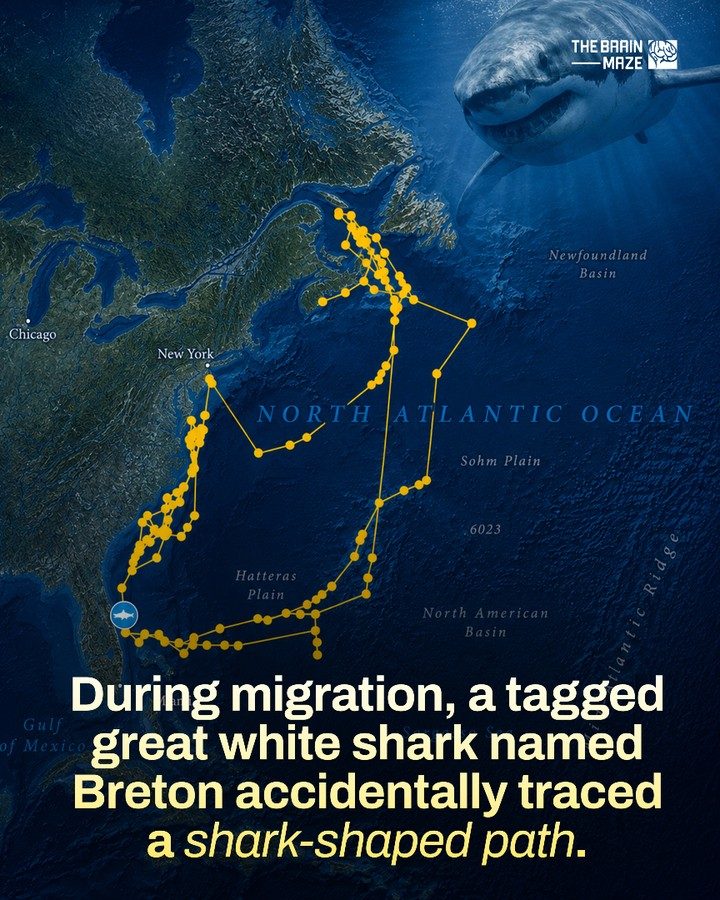
Shark Migration Path
The great white shark Breton has been monitored by researchers using a satellite tracking device, and his migration path has resulted in a fascinating, shark-shaped path across the North Atlantic Ocean. The outline, resembling a self-portrait, came about accidentally as a result of the great white shark's movements.
Context / Why this matters
Great white sharks are amongst the most well-tracked animals in the world. Researchers attach satellite tracking devices to their dorsal fins to follow their migrations, and this data is invaluable for understanding these elusive predators' behavior, habitats, and conservation needs.
Breton's unique path is a result of what these researchers do to follow great white shark migrations. The tracking devices record their movements as they go about their natural life. By looking at the data, researchers can see the routes that the sharks take, and in this case, Breton's path across the Atlantic looks like a giant shark.
Main discussion
The Atlantic Migration
Great white sharks undertake incredible journeys each year. Breton's path, which crosses the North Atlantic Ocean, is a typical route for these sharks. They often travel between feeding grounds and warmer waters, where they mate and give birth.
Breton's migration path took him through several significant areas in the North Atlantic, including the Newfoundland Basin, the North American Basin, the Hatteras Plain, and the Sohm Plain. These locations are essential for great white sharks, as they provide abundant food and suitable habitats.
The Shark-Shaped Path
Great white sharks are known for their lengthy migrations, but Breton's path is remarkable for its shape. The locations recorded by the satellite tag formed an outline that resembles a shark, giving the appearance of a self-portrait. But there’s more—this outline isn’t a unique feature of Breton’s path; it is actually a common shape in great white shark migrations. The shark-shaped path is a result of the way the tracking device records the shark's movements.
The path took Breton through major oceanic features, including the Atlantic Ridge, which runs down the middle of the Atlantic Ocean. The ridge is a vast underwater mountain range that forms a natural barrier and influences the movements of many marine species, including great white sharks.
Monitoring Great White Sharks
Great white sharks are difficult to study because of their size, strength, and elusive nature. Researchers use satellite tracking to monitor their movements and gather data on their behavior. Tracking devices attached to the shark's dorsal fin record locations as the shark moves, allowing scientists to map out their journeys.
The satellite tracking devices are essential tools for understanding great white shark behavior. They record the shark's movements and transmit that data to researchers, who can then analyze it to learn more about these animals. The devices are designed to fall off after a certain period, ensuring they do not interfere with the shark's natural behavior.
Practical Tips
For Conservation Efforts
Understanding great white shark migrations is crucial for their conservation. By tracking their movements, researchers can identify key habitats and feeding grounds, which can then be protected. This information is vital for developing effective conservation strategies.
For conservationists, this data also helps to monitor the health of great white shark populations. By tracking individual sharks, researchers can learn about their lifespan, reproductive success, and survival rates. This information can be used to assess the overall health of the population and identify any potential threats.
For Researchers
For researchers, understanding great white shark migrations can provide valuable insights into their behavior and ecology. By tracking their movements, scientists can learn about their preferred habitats, feeding patterns, and mating behaviors.
Researchers can also use this data to study the impact of environmental changes on great white sharks. By monitoring their movements over time, scientists can observe how these animals respond to changes in their environment, such as changes in water temperature or ocean currents.
For the Public
For the public, learning about great white shark migrations can be both fascinating and informative. These animals are often misunderstood and feared, but tracking their movements can help to dispel myths and misconceptions. By understanding their behavior and habitat needs, we can gain a greater appreciation for these incredible predators.
Additionally, great white sharks are a keystone species, meaning they play a critical role in maintaining the health of their ecosystems. By protecting these sharks, we can also help to preserve the ecosystems they inhabit, which benefits numerous other species as well.
Important Takeaways
Understanding great white shark migrations is crucial for their conservation and for gaining a deeper appreciation of these magnificent creatures. By tracking their movements, researchers can learn about their behavior, habitat needs, and the impact of environmental changes. This information is vital for developing effective conservation strategies and for educating the public about the importance of these predators.
Conclusion
The path traced by Breton is a fascinating example of the incredible journeys undertaken by great white sharks. From the Newfoundland Basin to the Hatteras Plain, their migrations cover vast distances and take them through diverse habitats. By understanding these migrations, we can gain valuable insights into the behavior and ecology of these remarkable animals, and work towards their conservation and the protection of their habitats.
Watch the Reel
Questions readers ask
How do researchers track great white shark migrations?
Researchers attach satellite tracking devices to the dorsal fins of great white sharks. These devices record the sharks' movements, providing valuable data on their migration paths, feeding grounds, and mating areas.
What makes Breton's migration path unique?
Breton's migration path is unique because it accidentally formed a shark-shaped outline across the North Atlantic Ocean. This distinctive path offers insights into the behavior and habits of great white sharks.
Why is tracking great white shark migrations important?
Tracking great white shark migrations helps researchers understand the sharks' behavior, identify crucial habitats, and inform conservation efforts. This data is essential for protecting these iconic predators and their ecosystems.
What can we learn from great white shark migration maps?
Migration maps reveal typical routes, feeding grounds, and mating areas. By studying these maps, researchers can gain insights into the sharks' movement patterns and the importance of specific locations in the North Atlantic.
How do satellite tracking devices help in shark research?
Satellite tracking devices allow researchers to monitor great white sharks remotely, providing real-time data on their movements. This technology enables scientists to study these elusive predators without direct intervention, ensuring their safety and well-being.
What are some typical great white shark feeding grounds in the North Atlantic?
Typical feeding grounds include areas with high concentrations of prey, such as seals and fish. These locations often coincide with known migration routes and are essential for the sharks' survival and reproduction.
What insights can be gained from studying great white shark mating behaviors?
Studying mating behaviors helps researchers understand the great white shark population dynamics, including reproductive success and genetic diversity. This knowledge is crucial for developing effective conservation strategies.
Related deep dives
Similar reads based on topic and creator.



Recent articles
Fresh deep dives from the latest Reels we unpacked.




Comments
Be the first to comment.