Space Exploration Fashion: Gravity's Impact on Vertical Jump
Space exploration has always captivated our imagination, but have you ever wondered how your physical abilities would change on different planets? Specifically, how would your vertical jump height vary in different gravitational environments? Let's dive into the science behind vertical jumps and gravity, and explore the fascinating world of space exploration fashion.
Context / Why this matters
Understanding how gravity affects our bodies is crucial for both astronauts and space enthusiasts. Whether you're planning a mission to Mars or simply dreaming of space exploration, knowing how your vertical jump would change can provide insights into how your body would adapt to different gravitational environments. Moreover, the fashion aspect adds an exciting layer, blending the practicalities of space travel with the creative design of futuristic clothing.
Main discussion
The Science of Vertical Jumps
Vertical jump height is primarily determined by the force exerted by your muscles against gravity. On Earth, this force is counteracted by the planet's gravitational pull, which is approximately 9.8 meters per second squared (m/s²). This gravitational pull affects how high you can jump.
The formula to calculate vertical jump height is:
Vertical Jump Height = (Initial Velocity²) / (2 * Gravity)
Where Initial Velocity is the speed at which you leave the ground, and Gravity is the gravitational acceleration.
Gravity on Different Planets
Different planets have varying gravitational forces, which significantly impact your vertical jump.
Mercury
Mercury has the lowest gravity among the planets in our solar system, at about 3.7 m/s². This means you would experience roughly 38% of Earth's gravity. Consequently, your vertical jump would be approximately 2.7 times higher than on Earth.
Venus
Venus has a gravity of about 8.87 m/s², or 90% of Earth's gravity. This slight difference would result in a jump height about 1.1 times higher than on Earth.
Mars
Mars has a gravity of approximately 3.71 m/s², or about 38% of Earth's gravity. Similar to Mercury, your vertical jump on Mars would be around 2.7 times higher than on Earth.
Jupiter
Jupiter, the largest planet, has a gravity of about 24.79 m/s², or 2.53 times Earth's gravity. This means your vertical jump would be significantly shorter, roughly 0.4 times your Earth jump height.
Saturn
Saturn's gravity is about 10.44 m/s², or about 1.06 times Earth's gravity. Your jump height would be slightly lower, around 0.94 times your Earth jump height.
Uranus
Uranus has a gravity of about 8.87 m/s², similar to Venus, at 90% of Earth's gravity. Your jump height would be about 1.1 times higher than on Earth.
Neptune
Neptune's gravity is approximately 11.15 m/s², or 1.14 times Earth's gravity. Your vertical jump would be slightly lower, around 0.88 times your Earth jump height.
Space Exploration Fashion
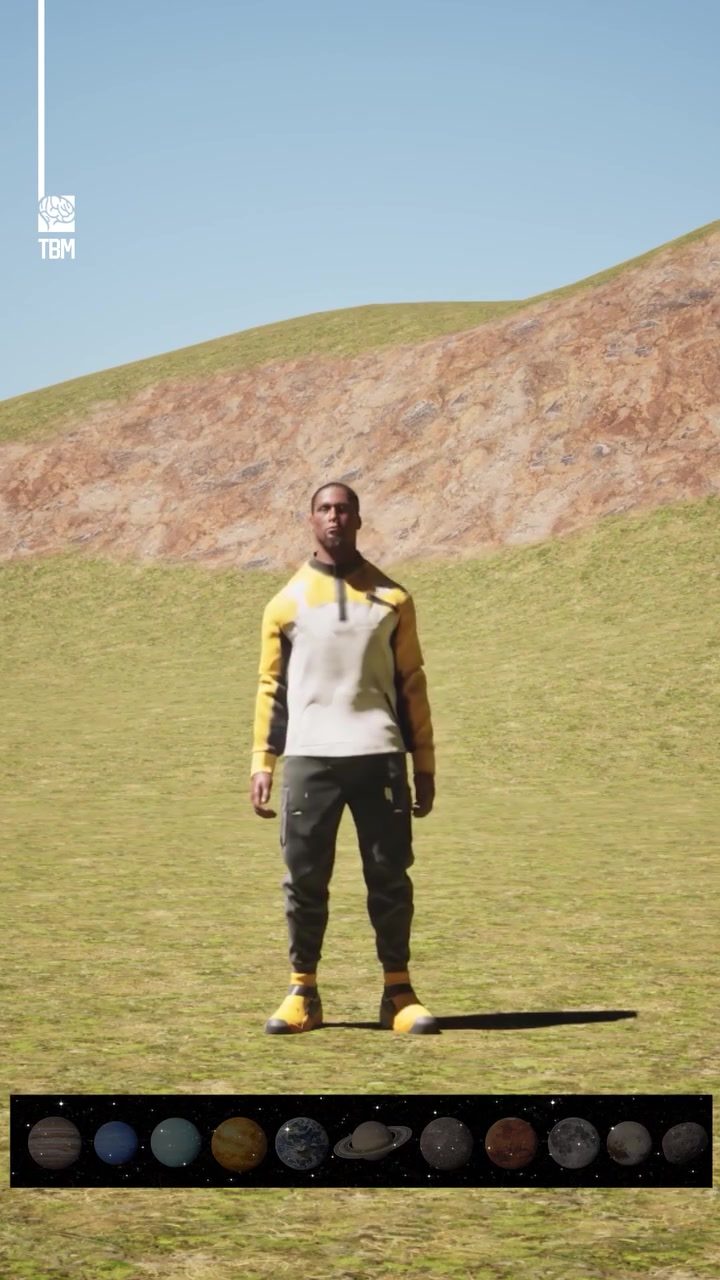
Space exploration fashion is not just about function; it's also about style. Brands like TBM are at the forefront, blending futuristic designs with practical space travel needs. Whether you're on a lunar surface or a planet-like setting, TBM clothing ensures you look as good as you feel.
Fashion in space exploration goes beyond aesthetics. It incorporates advanced materials and designs to protect astronauts from harsh environments. For example, spacesuits like those featured in the visuals are designed to withstand extreme temperatures, radiation, and micrometeoroids. They also provide mobility, which is crucial for tasks like vertical jumps.
The Intersection of Science and Fashion
The intersection of science and fashion in space exploration is a fascinating blend of practicality and creativity. As we continue to explore the cosmos, the clothing and gear we wear will evolve. This evolution will be driven by advancements in technology and materials, as well as the need for increased comfort and style.
Practical tips
When dreaming of space exploration or designing futuristic clothing, consider the following practical tips:
- Understand Gravitational Forces: Know the gravitational pull of different planets to anticipate how your body will react.
- Design for Mobility: Ensure your clothing or gear allows for maximum mobility, which is crucial for tasks like jumping.
- Consider Environmental Factors: Think about the environmental conditions on different planets and design clothing that protects from extreme temperatures, radiation, and other hazards.
- Blend Style and Function: Balancing aesthetics with practicality is key in space exploration fashion. Your clothing should look as good as it performs.
Important takeaways
- Your vertical jump height varies significantly on different planets due to differences in gravitational pull.
- On lower-gravity planets, your jump height increases, while on higher-gravity planets, it decreases.
- Space exploration fashion, as seen with brands like TBM, combines style with the practical needs of space travel.
- The design of spacesuits and other gear must prioritize mobility and environmental protection.
Conclusion
Exploring how your vertical jump height changes on different planets opens up a world of fascinating scientific and practical insights. Whether you're a space enthusiast or a fashion designer, understanding these gravitational effects can inspire innovative designs and a deeper appreciation for the challenges and wonders of space exploration. As we continue to push the boundaries of human exploration, the blend of science and fashion will play a crucial role in our journey among the stars.
Watch the Reel
Questions readers ask
How does gravity influence the height of a vertical jump?
Gravity pulls your body back down to the ground after you jump, so the strength of gravity directly affects your vertical jump height. On planets with lower gravity, you can jump higher because there's less force pulling you down. Conversely, on planets with stronger gravity, you'll experience a lower jump height due to the increased downward pull.
What is the expected jump height on Mars compared to Earth?
Mars has about 38% of Earth's gravitational pull. This means you can expect to jump approximately 2.6 times higher on Mars than you would on Earth. For example, if you can jump 2 feet (0.61 meters) on Earth, you could potentially jump around 5.2 feet (1.58 meters) on Mars.
Which planet would allow for the highest vertical jump among the rocky planets?
Among the rocky planets, Mercury offers the highest vertical jump due to its weak gravity, which is only about 38% of Earth's. This means you could jump approximately 2.6 times higher than on Earth. For instance, a 2-foot (0.61-meter) jump on Earth could become around 5.2 feet (1.58 meters) on Mercury.
How would your vertical jump change on Venus compared to Earth?
Venus has a gravitational pull of about 90% of Earth's, so your vertical jump would be slightly lower. You can expect to jump around 1.1 times higher on Venus compared to Earth, so you would see a considerable reduction in jump height.
Why is understanding gravity's impact on vertical jumps important for space exploration?
Knowing how gravity affects vertical jumps is vital for space exploration because it helps astronauts and mission planners understand the physical demands of different environments. This information can aid in designing equipment, training programs, and safety protocols tailored to the specific gravitational conditions of other planets and celestial bodies.
How does the gravity on the Moon affect vertical jump compared to Earth?
The Moon's gravity is only about 16.5% of Earth's, so you can jump much higher. On average, you could jump about 6 times higher than on Earth. This significant difference can greatly impact how astronauts move and perform tasks on the lunar surface.
Related deep dives
Similar reads based on topic and creator.




Recent articles
Fresh deep dives from the latest Reels we unpacked.




Comments
Be the first to comment.