AI Model Training Costs: A Breakdown of Cloud Supercomputer Expenses
Training AI models has become increasingly costly, with leading tech companies investing hundreds of millions of dollars to develop advanced AI. The cost of training these models is largely driven by the need for powerful cloud-based supercomputers capable of handling vast amounts of data and processing complex prompts continuously.
Why This Matters
The rising cost of AI model training is a critical issue for several reasons. Firstly, it highlights the escalating demand for cloud-based supercomputers, which are essential for processing the enormous data sets required to train AI models. Secondly, these costs reflect the competitive landscape in AI development, where companies are investing heavily to stay ahead in the race for innovation. Understanding these costs provides valuable insights into the economic and technological challenges faced by AI developers, as well as the potential future directions of AI research.
The Costs of Training Leading AI Models
Google's Investment in Gemini 1.0 Ultra
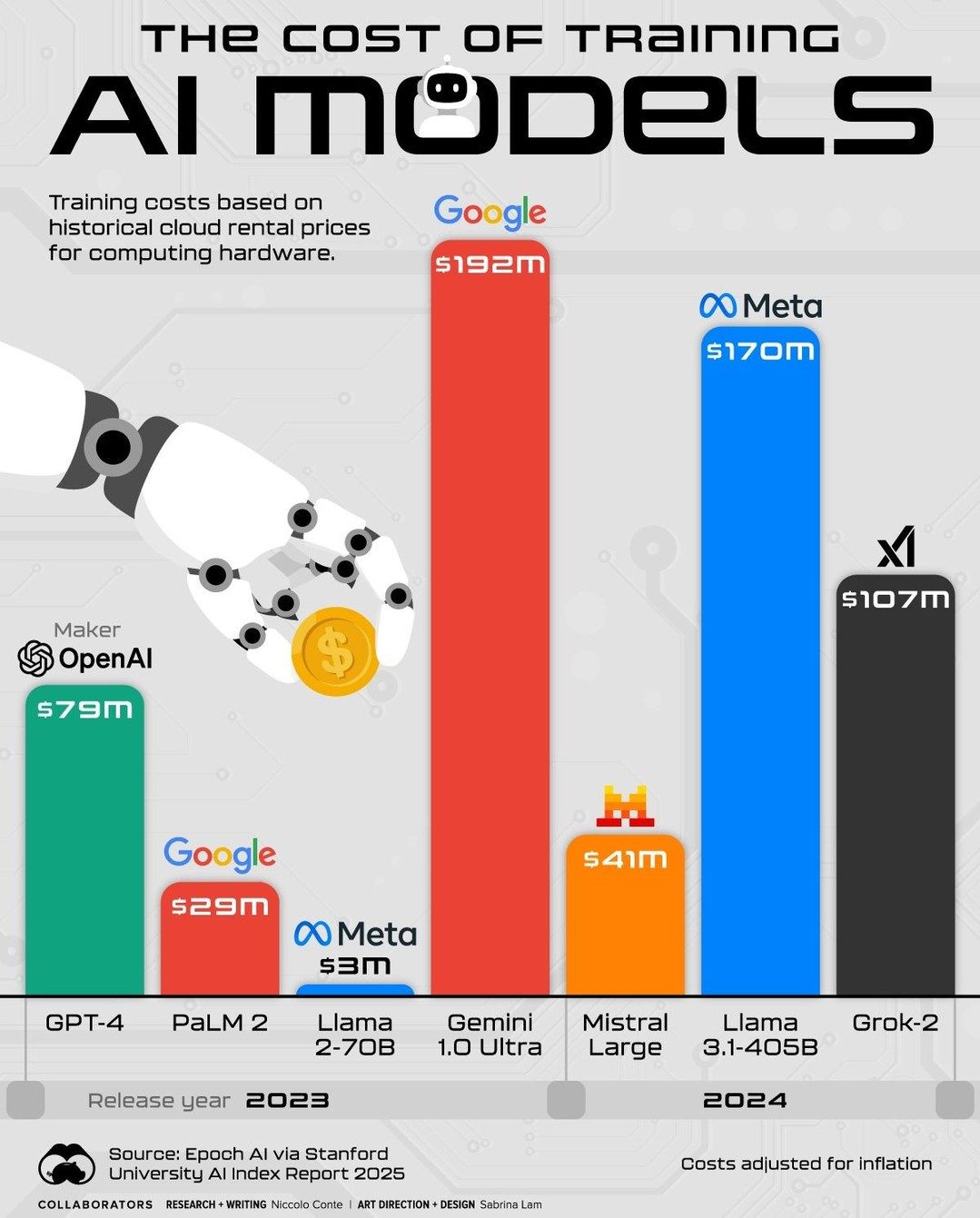
Google's investment in its Gemini 1.0 Ultra model stands out as the highest among leading AI models, with an estimated cost of $192 million. This figure underscores the significant financial commitment required to develop state-of-the-art AI models. The high cost is attributed to the model's size and complexity, which necessitate extensive computational resources and data processing capabilities. The infographic highlights that Gemini 1.0 Ultra is one of the largest models in terms of parameters, further emphasizing the correlation between model size and training costs.
Meta's AI Training Expenses
Meta, another major player in the AI landscape, has also invested heavily in training its AI models. The cost of training Meta's models is estimated to be $170 million, which is the second-highest among the leading models. This investment reflects Meta's commitment to advancing AI technology and its efforts to stay competitive in the rapidly evolving AI market.
Other Leading AI Models
In addition to Google and Meta, several other companies have made significant investments in training AI models. For instance, OpenAI's model training cost is estimated to be $79 million, while the cost for Llama is $107 million. These figures vary based on the size and complexity of the models, as well as the resources required to train them. The infographic provides a comprehensive comparison of the training costs for various models, including GPT-4, PaLM 2, Mistral Large, and Grok-2, with costs ranging from $29 million to $192 million.
The Role of Cloud-Based Supercomputers
The Demand for Cloud-Based Supercomputers
The rising cost of AI model training is closely linked to the growing demand for cloud-based supercomputers. These supercomputers are essential for processing the vast amounts of data required to train AI models. The ability to handle complex prompts like “please” and “thank you” continuously underscores the need for powerful computational resources.
Historical Context and Future Trends
The costs of training AI models have been on the rise for several years, driven by advancements in AI technology and the increasing complexity of models. The historical data from the 2025 AI Index Report highlights the growing trend in AI model training costs. This trend is expected to continue as AI technology advances and the demand for more sophisticated models increases. The future of AI development will likely involve even higher costs, as companies continue to invest in more powerful and efficient cloud-based supercomputers.
Practical Tips for Understanding AI Training Costs
Analyzing the Cost Breakdown
When analyzing the costs of training AI models, it is essential to consider the various factors that contribute to the overall expense. These factors include the size of the model, the complexity of the data, and the computational resources required. Understanding these factors can help in estimating the potential costs of developing a new AI model and in making informed decisions about resource allocation.
Assessing the Economic Impact
The economic impact of AI model training costs is significant for both individual companies and the broader AI industry. For individual companies, the high costs of training AI models can be a barrier to entry, limiting competition and innovation. For the industry as a whole, the rising costs reflect the increasing importance of AI technology and the need for continued investment in research and development.
Considering the Environmental Impact
In addition to the economic impact, the environmental impact of AI model training is also a critical consideration. The high energy consumption required to power cloud-based supercomputers has significant environmental implications. Companies are increasingly aware of the need to develop more sustainable and energy-efficient AI models, which could help mitigate the environmental impact of AI development.
Important Takeaways
The costs of training AI models are a crucial aspect of AI development, reflecting the high demand for powerful computational resources and the competitive landscape of AI innovation. The significant investments made by leading companies like Google and Meta underscore the importance of AI technology and the need for continued investment in research and development. Understanding the costs and factors involved in AI model training can provide valuable insights into the future of AI development and the potential challenges and opportunities that lie ahead.
Conclusion
The rising costs of training AI models highlight the growing demand for cloud-based supercomputers and the competitive nature of AI development. Companies are investing hundreds of millions of dollars to stay ahead in the race for AI innovation, with Google's $192 million investment in Gemini 1.0 Ultra being the highest among leading models. The costs of training AI models are influenced by various factors, including model size, data complexity, and computational resources. Understanding these costs and their implications can provide valuable insights into the future of AI development and the potential challenges and opportunities that lie ahead.
Watch the Reel
Questions readers ask
How do cloud supercomputers factor into the high cost of AI training?
Cloud supercomputers are essential for processing the vast amounts of data required to train AI models. These powerful machines enable continuous processing of complex prompts, making them a significant contributor to the high costs associated with AI training. Since leading companies need to stay competitive, they continuously invest in these expensive resources.
What are some of the main drivers behind the increasing cost of AI model training?
Several factors contribute to the rising cost of AI model training. These include the need for advanced cloud supercomputers, the competitive nature of AI development, and the growing demand for sophisticated data processing capabilities. As AI models become more complex, the expenses associated with training them also increase.
How do companies like Google and OpenAI compare in terms of AI training costs?
Both Google and OpenAI invest significantly in AI training, with Google spending $192 million on a single AI model, the Gemini AI. These investments reflect the intense competition in the AI sector, where companies strive to develop more advanced models. The costs are expected to continue rising as the complexity of AI models increases.
What is the significance of the $192 million expenditure by Google on the Gemini AI model?
Google's $192 million investment in the Gemini AI model underscores the substantial financial commitment required for AI development. It also highlights the competitive pressures in the AI industry, where leading companies invest heavily to enhance their models' capabilities. This expenditure reflects the critical role of cloud supercomputers in driving innovation.
Why do companies need to spend so much on AI model training in 2025?
In 2025, the cost of AI model training is expected to remain high due to the continued need for advanced cloud supercomputers and the evolving challenges in AI development. As AI models become more sophisticated, the resources required to train them will also increase, leading to higher expenses.
What technological challenges do developers face in AI training?
Developers face several technological challenges in AI training, including the need for powerful computational resources, the management of vast data sets, and the development of algorithms that can handle complex prompts. Additionally, the competitive landscape drives the constant need for innovation, further increasing the challenges and costs associated with AI development.
Related deep dives
Similar reads based on topic and creator.


Recent articles
Fresh deep dives from the latest Reels we unpacked.




Comments
Be the first to comment.