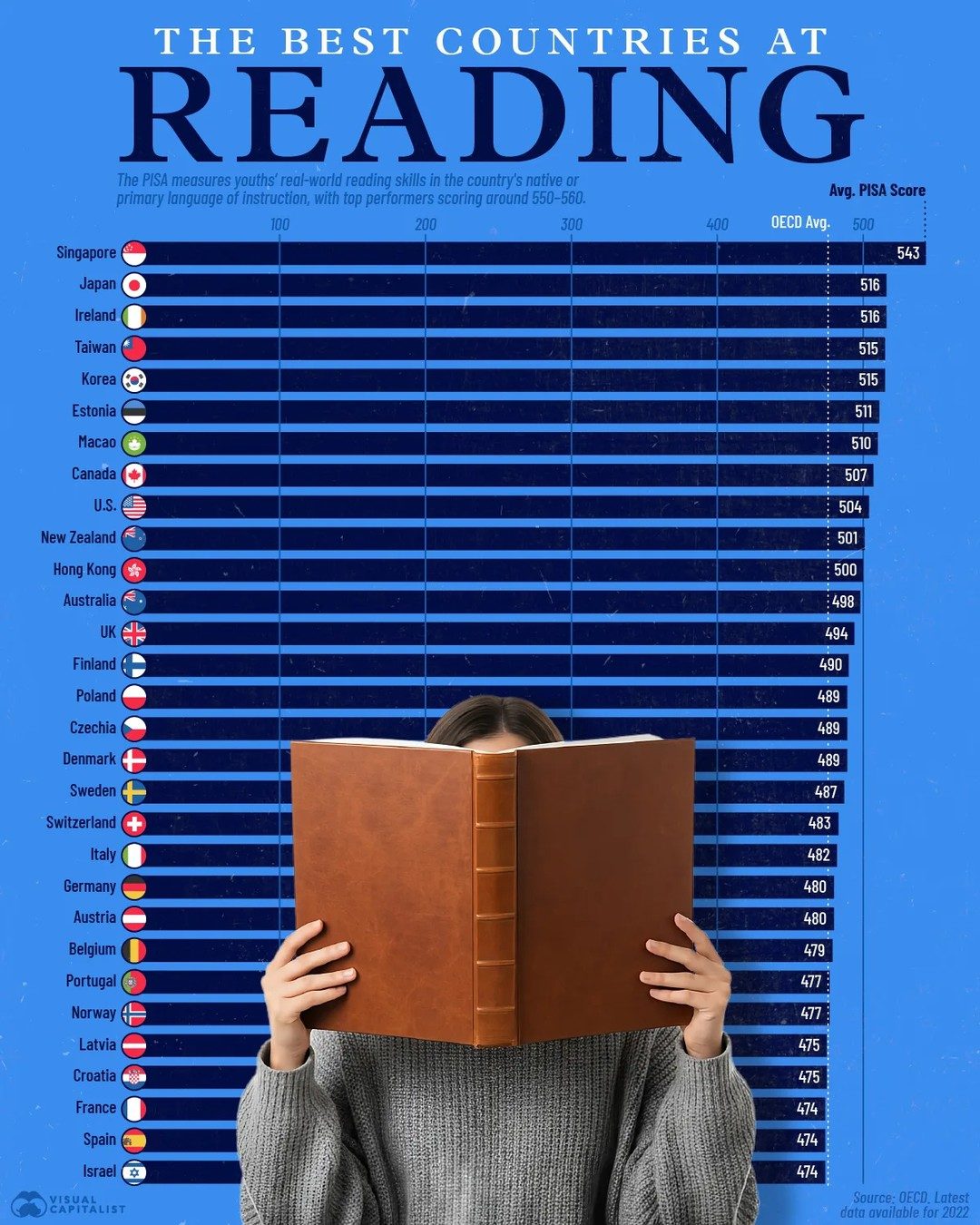
Reading Skills by Country
Reading skills are a critical component of education, and the performance of students in reading comprehension, interpretation, and evaluation varies widely across different countries. The Programme for International Student Assessment (PISA) provides a comprehensive assessment of these skills among 15-year-olds, focusing on how well students can apply their reading abilities in real-world situations. The 2022 PISA results offer valuable insights into which countries excel in reading and why.
Context / Why this matters
Reading skills are fundamental to academic success and lifelong learning. They enable individuals to comprehend complex texts, evaluate information critically, and communicate effectively. The PISA assessment highlights how well education systems prepare students for these challenges, making it a key indicator of educational performance on a global scale. Understanding which countries perform best in reading can provide insights into effective educational practices and policies.
Main discussion
PISA Assessment
The PISA assessment is conducted by the Organisation for Economic Co-operation and Development (OECD) and focuses on 15-year-old students. It measures reading skills in a country's native language, ensuring that the assessment is culturally and linguistically relevant. The top-performing countries typically score in the 550–560 range, reflecting strong reading comprehension, interpretation, and evaluation skills. These skills are essential for navigating the complexities of modern society and the workforce. Students in these countries are better equipped to engage with a wide range of texts, from academic materials to everyday communications.
Top-Performing Countries
Singapore leads the rankings with a score of 543, making it the top performer in reading skills. This high score indicates that Singapore's education system is highly effective in fostering reading comprehension, interpretation, and evaluation. Following closely are Japan, Taiwan, and Korea, all with scores above 515. These countries demonstrate a strong emphasis on literacy and reading skills in their education systems. Estonia, Macao, and Canada also perform well, with scores in the 507-511 range. These countries are known for their robust educational policies and investment in literacy.
Middle Range
Countries in the middle range of the rankings, such as the United States, the United Kingdom, and Australia, perform moderately well in reading skills. The U.S. scores 504, while the UK and Australia score 494 and 498, respectively. These scores suggest that while these countries have effective educational systems, there is room for improvement in reading comprehension and interpretation. Finland, known for its innovative education system, scores 490, indicating a strong foundation in reading skills. Poland, Denmark, and Sweden also fall into this range, with scores between 487 and 490. These countries have well-established educational systems that support literacy development, but they lag slightly behind the top performers.
Lower Range
The lower range countries include Spain, Israel, and France, which score 474, 477, and 474, respectively. While these countries have made significant strides in education, there are still challenges in developing advanced reading skills. Norway and Italy score 477 and 482, respectively, indicating some areas for improvement in their educational systems. These countries may need to focus on enhancing reading comprehension and interpretation to better prepare students for future challenges.
Practical tips
Enhancing Reading Comprehension
One effective way to improve reading comprehension is through regular practice. Encouraging students to read a variety of texts, from fiction to non-fiction, can help develop their ability to understand and interpret different types of information. Teachers can also use guided reading techniques, where they read alongside students and provide feedback on their comprehension skills.
Developing Interpretation Skills
Interpretation skills are crucial for understanding the deeper meanings and implications of texts. Teachers can foster these skills by encouraging students to ask questions, make predictions, and discuss their interpretations with peers. This interactive approach helps students engage more deeply with texts and develop their analytical abilities.
Evaluating Texts
Evaluating texts involves assessing the credibility, relevance, and coherence of information. This skill is essential in an age of information overload. Teachers can help students develop evaluation skills by teaching them to critically assess sources, identify biases, and assess the logical structure of arguments. This can be done through group discussions, debates, and analysis of various media sources.
Encouraging a Love for Reading
One of the most effective ways to improve reading skills is to foster a love for reading. When students enjoy reading, they are more likely to engage with texts on a deeper level and develop their skills naturally. Encouraging students to choose books that interest them and providing access to a wide range of reading materials can help cultivate this passion.
Important takeaways
Education systems play a crucial role in developing reading skills, and the PISA 2022 results highlight significant variations across countries. Singapore's leadership in reading performance underscores the effectiveness of its education policies and practices. Countries like Japan, Taiwan, and Korea also demonstrate strong reading skills, reflecting their emphasis on literacy and comprehensive educational systems.
Middle-range countries, such as the U.S. and Australia, perform moderately well but have room for improvement. These countries can benefit from focusing on enhancing reading comprehension, interpretation, and evaluation skills. Lower-range countries, including Spain and Italy, need to address challenges in their educational systems to better support literacy development.
Understanding the factors that contribute to strong reading performance can provide valuable insights for education systems around the world. By adopting effective practices and policies, countries can enhance their students' reading skills and better prepare them for future challenges.
Conclusion
Reading skills are a cornerstone of educational achievement and lifelong learning. The PISA 2022 results offer a comprehensive view of reading performance across countries, highlighting the strengths and areas for improvement in various educational systems. From Singapore's leadership to the challenges faced by lower-range countries, the data provides a roadmap for enhancing reading skills globally. By focusing on practical tips and adopting effective practices, education systems can better equip students with the reading skills they need to succeed in an ever-changing world.
Watch the Reel
Questions readers ask
Which countries had the highest global reading scores in 2022?
According to the PISA 2022 results, the top countries in global reading scores were Singapore, Taiwan, and Japan. These countries demonstrated exceptional reading comprehension, interpretation, and evaluation skills among their 15-year-olds. The rankings highlight the effectiveness of their respective reading programs and educational practices.
What is the significance of the PISA reading results?
The PISA reading results are significant because they provide a global benchmark for assessing reading skills among 15-year-olds. These results help identify effective strategies and best practices in reading instruction, enabling countries to learn from each other and improve their educational outcomes.
How do the top reading countries like Singapore and Japan achieve high reading scores?
Countries like Singapore and Japan achieve high reading scores through a combination of rigorous curricula, well-trained teachers, and a strong emphasis on literacy from an early age. These countries also invest heavily in resources and initiatives that promote reading and comprehension skills among students.
What is the reading score of 560 in the PISA 2022 results?
A reading score of 560 in the PISA 2022 results indicates a high level of proficiency in reading comprehension, interpretation, and evaluation. This score is significantly above the OECD average, reflecting strong reading skills and effective educational practices in the countries achieving this score.
Why are reading skills crucial for 15-year-olds?
Reading skills are crucial for 15-year-olds because they form the basis for academic success and lifelong learning. Strong reading skills enable teenagers to comprehend complex texts, evaluate information critically, and communicate effectively, which are essential for their future academic and professional endeavors.
Related deep dives
Similar reads based on topic and creator.

Recent articles
Fresh deep dives from the latest Reels we unpacked.




Comments
Be the first to comment.