Rare Earth Production: A Global Perspective
Rare earth elements are a group of 17 chemically similar metallic elements crucial for modern technologies. Their unique properties make them indispensable in various applications, from electronics and clean energy to defense and aerospace. Understanding the global production landscape of these critical minerals is essential for appreciating their significance in today's tech-driven world.
Why this Matters
Rare earth elements are not as "rare" as their name suggests, but their extraction and processing are complex and geographically concentrated. China's dominance in this sector has significant implications for global supply chains and technological advancements. By examining the production trends over the past three decades, we can gain insights into the geopolitical and economic factors shaping this critical industry.
Global Production Trends
China's Dominance
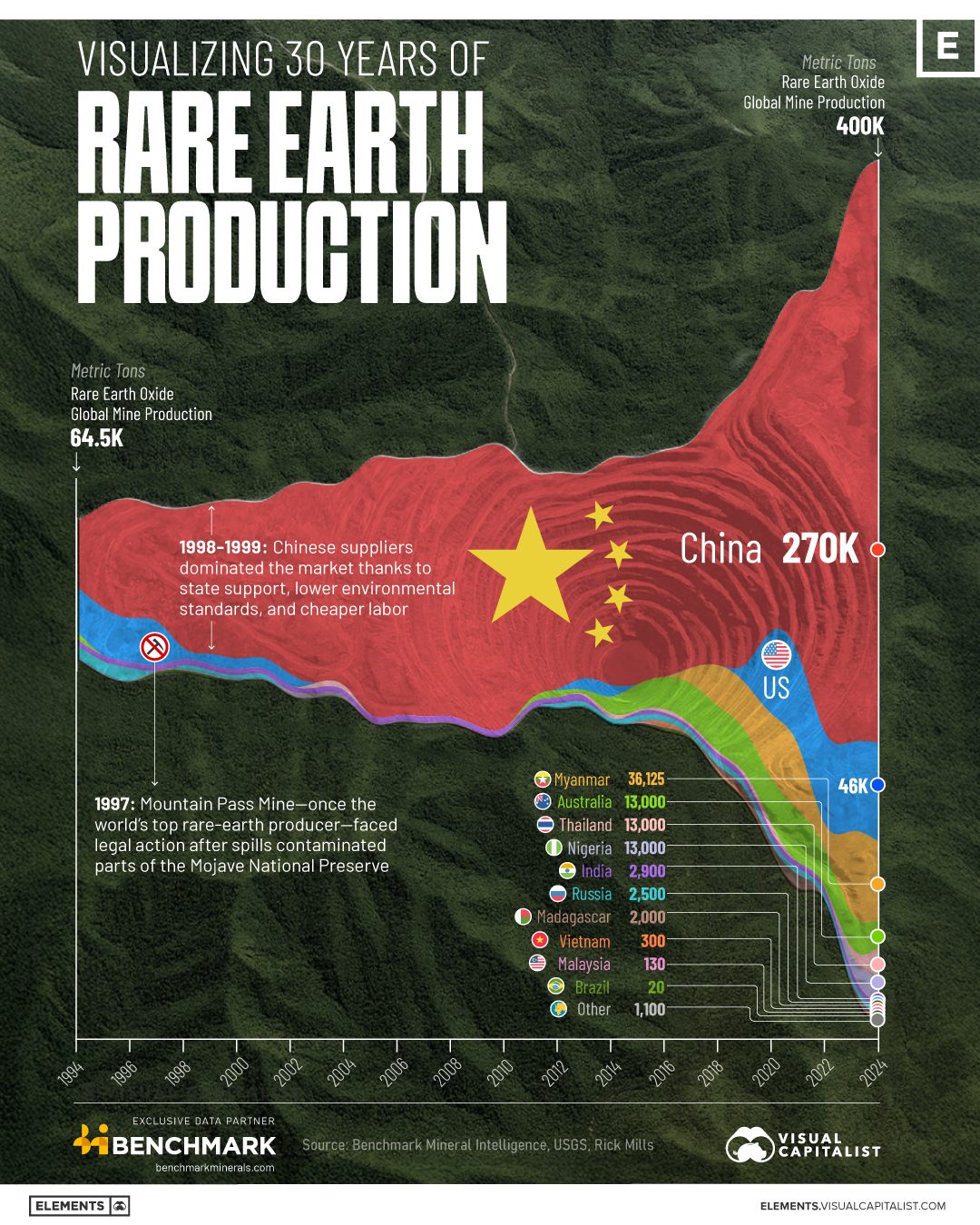
China's rise in rare earth production is a story of remarkable growth and strategic importance. In 1994, China produced 31,000 tonnes of rare earth elements. By 2024, this figure surged to 270,000 tonnes, marking an eightfold increase. This dominance is not limited to extraction; China also refines around 90% of the world's rare earth supply. The country's prowess in separation and purification technologies further solidifies its position at the helm of the global rare earth market.
China's dominance is evident in the data from 1998 onwards, where it consistently outpaces other nations in production levels. For instance, in 2024, China's production stood at 270,000 tonnes, dwarfing contributions from other major producers.
Other Major Producers
While China leads the global rare earth market, other countries also play significant roles in production. Australia, for example, produced 36,125 tonnes in 2024, making it the second-largest producer. Australia's rich mineral resources and advanced mining technologies contribute to its substantial output. Thailand, with 13,000 tonnes, and Russia, with 2,500 tonnes, are also notable contributors. Vietnam, Malaysia, and Brazil produce smaller quantities, with Brazil producing a mere 20 tonnes in 2024. Collectively, these nations, along with others, account for the remaining 46,000 tonnes of global rare earth production.
Timeline of Production
The timeline from 1997 to 2024 highlights key milestones and shifts in global production trends. In the late 1990s, China began its ascent, quickly outpacing other nations. By 2000, China's production was significantly higher than any other country, setting the stage for its continued dominance. The following decades saw steady growth, with China consistently expanding its production capacity and refining technologies. Other countries, while increasing their output, have struggled to match China's scale and efficiency.
Critical Minerals and Their Applications
Rare earth elements are classified into two groups: light rare earth elements (LREEs) and heavy rare earth elements (HREEs). Each group has unique applications across various industries. LREEs, including elements like lanthanum and cerium, are used in catalysts for petroleum refining, glass polishing, and metallurgy. HREEs, such as dysprosium and terbium, are crucial for high-performance magnets used in electric vehicles, wind turbines, and military equipment.
Tech and Energy Transition
Rare earth elements are pivotal in the ongoing energy transition. They are essential components in the production of permanent magnets, which are used in electric vehicle motors and wind turbines. These magnets enable the efficient and sustainable generation of electricity and the development of clean energy technologies. As the world shifts towards renewable energy, the demand for rare earth elements is expected to rise significantly.
Defense and Aerospace
In the defense and aerospace sectors, rare earth elements are used in advanced materials and technologies. High-performance magnets, for example, are critical in the development of precision-guided munitions and satellite systems. The unique properties of these elements make them indispensable in creating lightweight, durable, and efficient components for military and aerospace applications.
Practical Tips for Understanding Rare Earth Markets
Stay Informed
Keeping abreast of the latest developments in the rare earth market is crucial for businesses and governments alike. Data from sources like Benchmark Mineral Intelligence, the U.S. Geological Survey, and other reputable organizations provide valuable insights into production trends, supply chain dynamics, and geopolitical factors.
Explore Partnerships and Collaborations
Given China's dominance, exploring partnerships and collaborations with other major producers, such as Australia and Thailand, can be beneficial. These collaborations can help diversify supply chains, reduce dependence on a single source, and promote technological advancements in rare earth extraction and processing.
Investigate Technological Innovations
Technological innovations in rare earth mining, refining, and recycling hold promise for securing a stable supply. Investing in research and development can lead to new extraction methods, more efficient refining processes, and innovative recycling techniques. These advancements can help reduce environmental impacts and improve the overall sustainability of the rare earth industry.
Monitor Policy and Regulatory Changes
Governments around the world are increasingly recognizing the strategic importance of rare earth elements. Policy and regulatory changes, such as subsidies, incentives, and trade agreements, can significantly impact the market. Staying informed about these changes and their potential impacts is essential for navigating the complex landscape of rare earth production and supply chains.
Important Takeaways
Rare earth elements are vital to modern technologies and critical for the energy transition. China's dominance in the global rare earth market underscores its strategic importance and the need for diversification. Understanding the production trends, applications, and geopolitical factors shaping this industry is essential for stakeholders in the tech, energy, defense, and aerospace sectors. By staying informed, exploring partnerships, and investing in technological innovations, organizations can better navigate the complexities of the rare earth market and ensure a stable supply of these critical minerals.
Conclusion
The global landscape of rare earth production is dynamic and complex, with China leading the way in extraction, refining, and processing. Other nations, including Australia, Thailand, and Russia, also contribute significantly to global production. As the demand for rare earth elements continues to rise, driven by their applications in tech and energy transition, it is crucial to stay informed, explore partnerships, and invest in technological innovations. By understanding the trends and factors shaping this critical industry, stakeholders can better position themselves to navigate the challenges and opportunities ahead.
Watch the Reel
Questions readers ask
Which countries have been the major producers of rare earth elements since 1994?
China has been the dominant producer of rare earth elements since 1994, accounting for a significant portion of global production. Other notable producers include Australia, Thailand, and Russia, each contributing to the global rare earth supply but to a much lesser extent than China.
How has China's dominance in rare earth production affected the global market?
China's dominance has led to a heavy reliance on Chinese exports. This has caused fluctuations in the global market, price volatility and disruptions in supply chains, particularly when geopolitical tensions or policy changes impact Chinese production and export quotas.
What are the key trends in global rare earth production between 1994 and 2024?
The global rare earth production has seen significant shifts, with China increasing its dominance. Other countries have made efforts to diversify the supply chain, including expanding production in Australia and exploring new resources in countries like Russia and Thailand.
What impacts have these production trends had on various industries?
These trends have had significant impacts on industries reliant on rare earth elements, including electronics, clean energy, defense, and aerospace. The concentration of production in China has led to concerns about supply chain security and has driven efforts to develop alternative sources and recycling programs.
How can the visualization of global rare earth data help stakeholders?
Visualizing global rare earth data through infographics and maps can provide stakeholders with a clearer understanding of supply chain dynamics. This helps in identifying potential risks, opportunities for diversification, and areas for investment in extraction and processing technologies.
What are the projected global rare earth supply trends for 2024?
By 2024, the global rare earth supply is expected to remain heavily dependent on China, although there are efforts underway to increase production in other countries. These efforts aim to mitigate supply chain risks and reduce reliance on a single source, but significant changes in market share are not anticipated by that year.
How do geopolitical factors influence the rare earth elements market?
Geopolitical factors play a crucial role in the rare earth elements market, with trade policies, international relations, and domestic regulations in China significantly impacting global supply. For instance, export restrictions and resource nationalism can create volatility and uncertainty in the market, affecting industries that rely on these critical minerals.
Related deep dives
Similar reads based on topic and creator.


Recent articles
Fresh deep dives from the latest Reels we unpacked.




Comments
Be the first to comment.