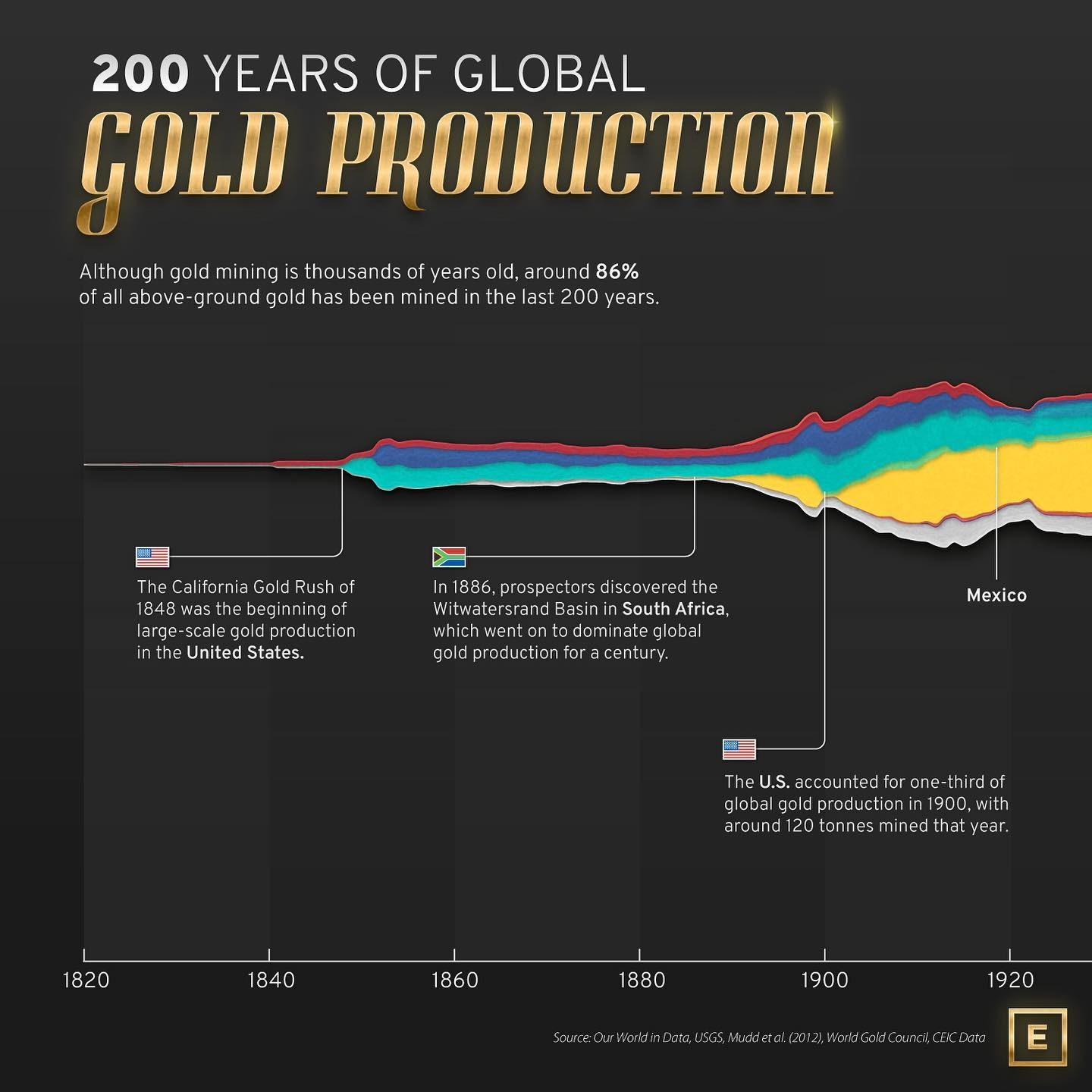
Global Gold Production Over Time
Despite gold mining's ancient roots, the majority of above-ground gold—a staggering 86%—has been extracted in just the past 200 years, significantly accelerating with modern techniques and technology. This rapid growth began in the 19th century and continues today, with key shifts in production leadership and significant events shaping the global gold mining landscape.
Context
Understanding the trajectory of global gold production offers insights into economic trends, technological advancements, and geopolitical influences. This historical perspective helps contextualize current market conditions and future projections in the gold industry.
Evolution of Gold Production
19th Century: The California Gold Rush and Early Global Production
The 19th century marked a pivotal era in global gold production, with the California Gold Rush of 1848 serving as a catalyst for large-scale mining operations in the United States. This event, while primarily focused on the U.S., also had ripple effects on global gold markets. Around this time, other countries, including South Africa, began to establish themselves as significant gold producers.
20th Century: South Africa's Dominance
The 20th century saw South Africa rise as a dominant force in gold production. The country's gold production peaked in 1970, reaching over 1,000 tonnes. This period was characterized by significant investment in mining infrastructure and technological advancements that allowed for more efficient extraction methods. South Africa's dominance was so pronounced that it became synonymous with global gold production for several decades.
21st Century: The Rise of China
The 21st century brought a major shift in global gold production leadership. In 2007, China overtook South Africa as the world's largest gold-producing country. This transition was driven by substantial investment in mining operations and a growing domestic demand for gold, both as a financial asset and a cultural symbol. China's rise to the top has had profound implications for global gold markets, influencing prices and supply chains.
Key Players in Global Gold Production
Top-Producing Countries in 2022
The top gold-producing countries in 2022 demonstrate the diversity and global reach of gold mining operations. As of 2022, the leading countries include:
- China (320t): China remains the top producer, driven by its massive mining operations and extensive reserves.
- Russia (320t): Russia's gold production is substantial, supported by its rich mineral deposits and robust mining infrastructure.
- Australia (320t): Australia's gold production benefits from advanced mining technologies and favorable geographical conditions.
- Canada (220t): Canada's gold production is bolstered by its stable political environment and strong regulatory framework.
- U.S. (120t) and Mexico (120t): Both countries contribute significantly to global gold production, each with unique mining industries and historical contexts.
- Kazakhstan (100t): Kazakhstan's production is notable for its efficiency and the scale of its mining operations.
- South Africa (110t): Despite its historical dominance, South Africa's production has declined but remains significant.
- Ghana (90t): Ghana's gold production is driven by both large-scale mining operations and artisanal mining.
- Indonesia (70t): Indonesia's gold production is supported by its rich mineral resources and ongoing investment in mining infrastructure.
Factors Influencing Global Gold Production
Technological Advancements
Technological advancements have played a crucial role in the exponential growth of global gold production. Modern mining techniques, such as open-pit mining and underground mining with advanced drilling and blasting methods, have made it possible to extract gold more efficiently and from deeper and more complex deposits. Innovations in processing technologies, including cyanide leaching and gravity concentration, have also significantly improved recovery rates.
Economic and Political Factors
Economic and political factors have a profound impact on global gold production. Market volatility, geopolitical stability, and regulatory environments all influence mining operations and production levels. For instance, countries with stable political environments and favorable regulatory frameworks tend to have higher production levels and attract more investment in mining operations.
Environmental and Social Considerations
Environmental and social considerations are increasingly important in the gold mining industry. Concerns around sustainability, environmental impact, and community engagement drive mining companies to adopt more responsible practices. Initiatives such as sustainable mining, community outreach, and environmental management are becoming integral to the industry's operations and reputation.
Practical Tips for Understanding Gold Production
Stay Informed with Reliable Data
To gain a comprehensive understanding of global gold production, it is essential to rely on accurate and up-to-date data. Sources such as the USGS, World Gold Council, and Our World in Data provide comprehensive and reliable information on gold production trends, mining techniques, and market analysis.
Follow Industry Reports and Publications
Regularly reviewing industry reports and publications can offer valuable insights into the dynamics of global gold production. Publications from organizations like the World Gold Council and the USGS provide detailed analyses and forecasts that are essential for staying informed about market trends and developments.
Engage with Industry Experts
Participating in industry conferences, webinars, and forums allows for direct engagement with experts and key players in the gold mining sector. These platforms provide opportunities to learn about the latest advancements, challenges, and future directions in gold production.
Important Takeaways
- Global gold production has grown exponentially over the past 200 years, with 86% of all above-ground gold mined during this period.
- The 19th century saw significant growth in gold production, driven by events like the California Gold Rush.
- South Africa dominated global gold production in the 20th century, peaking in 1970.
- China became the world's largest gold-producing country in 2007, reflecting a major shift in global production leadership.
- Technological advancements, economic factors, and environmental considerations all play crucial roles in shaping global gold production.
Conclusion
The evolution of global gold production over the past 200 years is a testament to the interplay of technological innovation, economic forces, and geopolitical dynamics. From the California Gold Rush to China's rise as the world's largest producer, the story of gold is one of continuous change and adaptation. Understanding these trends and factors is essential for anyone interested in the gold industry, whether as an investor, a mining professional, or simply an observer of global economic trends.
Watch the Reel
Questions readers ask
Which countries have led global gold production over the past 200 years?
The leadership in global gold production has shifted significantly over the past two centuries. Initially, the United States dominated during the 19th century, particularly with the California Gold Rush. Later, South Africa took the lead, driven by its extensive gold reserves and mining capabilities. In recent decades, China has emerged as the global leader in gold production, reflecting its substantial mining infrastructure and economic growth.
How has technology influenced global gold production?
Technological advances have played a crucial role in accelerating global gold production. Modern mining techniques, such as enhanced extraction methods and improved processing technologies, have enabled more efficient and larger-scale mining operations. These advancements have significantly increased the amount of gold extracted, particularly in the last 200 years.
What role do geopolitical influences play in global gold production trends?
Geopolitical influences have shaped global gold production trends by affecting mining policies, international trade, and economic stability. For instance, shifts in global leadership, such as the rise of China, have impacted where and how gold is mined. Additionally, geopolitical events can disrupt supply chains and alter market dynamics, influencing the overall trajectory of global gold production.
What percentage of the world's gold has been extracted in the past 200 years?
A remarkable 86% of the gold currently above ground has been extracted in the last 200 years. This period has seen a rapid acceleration in gold mining, largely due to technological advancements and increased demand, making it a critical era in the history of global gold production.
What significant events have impacted global gold production?
Several significant events have shaped global gold production. The California Gold Rush in the 19th century marked a turning point, driving U.S. leadership in gold mining. Later, the discovery of vast gold reserves in South Africa led to a shift in production leadership. More recently, China's economic growth and investment in mining infrastructure have positioned it as the current global leader in gold production.
How does understanding the history of gold production help in analyzing current market conditions?
Examining the history of global gold production provides valuable context for understanding current market conditions. By analyzing past trends, technological advancements, and geopolitical influences, stakeholders can better predict future developments and make informed decisions. This historical perspective is essential for navigating the dynamic landscape of the gold industry.
What data is available for global gold mining over the past 200 years?
Global gold mining data over the past 200 years includes production volumes by country, technological milestones, and key events that have influenced the industry. This data is crucial for understanding the shifts in production leadership, such as from the U.S. to South Africa, and then to China. Additionally, it provides insights into economic trends and geopolitical factors that have driven the growth of the gold mining sector.
Related deep dives
Similar reads based on topic and creator.

Recent articles
Fresh deep dives from the latest Reels we unpacked.




Comments
Be the first to comment.