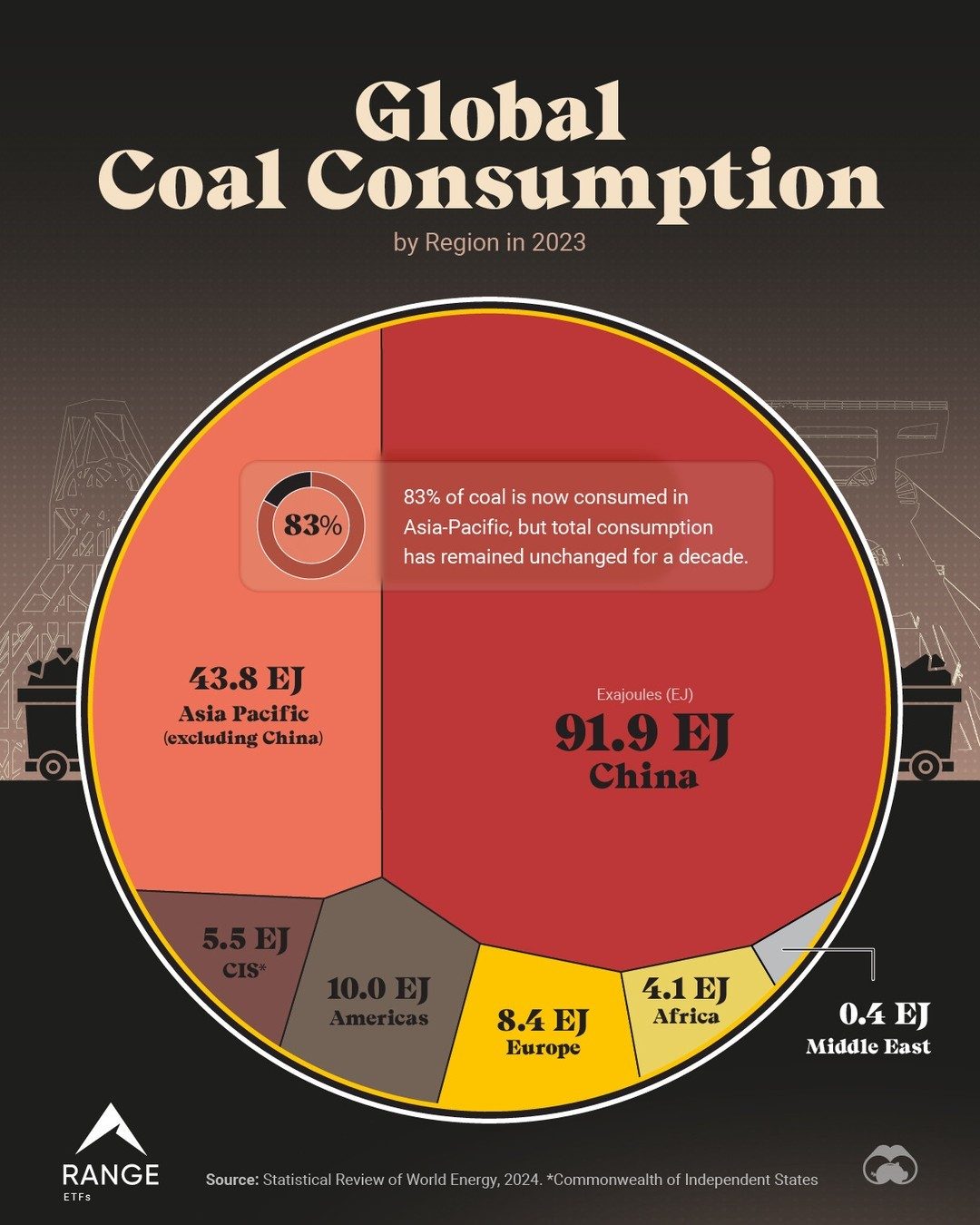
Coal Consumption by Region
Global coal consumption in 2023 reached an unprecedented 164 exajoules, with China alone consuming 56% of that total. Despite ongoing efforts to transition away from fossil fuels, coal remains a dominant energy source, supplying 26% of the world's energy needs. This surpasses the combined output of all non-fossil fuel sources. Understanding the regional distribution of coal consumption is crucial for grasping the global energy landscape and the challenges in shifting towards more sustainable energy sources.
Context / Why this matters
The reliance on coal has significant implications for global efforts to combat climate change. Coal is the most carbon-intensive fossil fuel, contributing to high levels of greenhouse gas emissions. As countries strive to meet their climate goals, the continued dominance of coal in the energy mix poses a substantial obstacle. The regional distribution of coal consumption highlights the disparity in energy transitions worldwide. While some regions are making strides towards cleaner energy, others remain heavily dependent on coal, impacting global emissions.
Main discussion
Global trends
The overall global coal consumption has remained relatively stable over the past decade, despite efforts to reduce reliance on fossil fuels. This stability is largely due to the continued use of coal in the Asia-Pacific region, which accounts for 83% of total coal consumption. China, in particular, is the world's largest consumer of coal, accounting for 91.9 exajoules of the total consumption. This significant reliance on coal underscores the challenge of transitioning to cleaner energy sources in a region with rapidly growing energy demands.
Regional breakdown
The Asia-Pacific region, excluding China, consumes 43.8 exajoules of coal. This highlights the region's continued dependence on coal for power generation. The Commonwealth of Independent States (CIS), which includes countries like Russia and Kazakhstan, consumes 10.0 exajoules. The Americas, including North, Central, and South America, consume 8.4 exajoules, while Europe consumes 5.5 exajoules. Africa and the Middle East have lower coal consumption, at 4.1 exajoules and 0.4 exajoules, respectively. This regional breakdown illustrates the varying degrees of dependence on coal across different parts of the world.
China's dominant role
China's coal consumption is a key factor in the global energy mix. The country's 91.9 exajoules of coal consumption account for more than half of the world's total. China's reliance on coal is driven by its industrialization and urbanization, which require significant energy inputs. The country's efforts to reduce coal consumption and increase renewable energy sources are vital for global climate goals. However, the transition is complex and will require substantial investment in alternative energy infrastructure and technologies.
Energy transitions and challenges
The transition away from coal is a critical component of global efforts to mitigate climate change. While the overall global consumption of coal has remained stable, the regional disparities in energy transitions are evident. Regions like the Asia-Pacific, including China, face significant challenges in reducing coal consumption due to their high energy demands. In contrast, regions like Europe and the Americas have made more progress in transitioning to cleaner energy sources.
Practical tips
Reducing global coal consumption requires a multifaceted approach that includes policy changes, investment in renewable energy, and technological innovation. Governments and businesses can adopt several practical steps to support this transition:
-
Policy and regulation: Implement policies that incentivize the use of renewable energy sources and disincentivize the use of coal. This can include carbon taxes, subsidies for renewable energy projects, and regulations that promote energy efficiency.
-
Investment in renewables: Increase investment in renewable energy infrastructure, such as solar, wind, and hydroelectric power. This can help reduce reliance on coal and create new job opportunities in the renewable energy sector.
-
Technological innovation: Develop and deploy technologies that improve energy efficiency and reduce greenhouse gas emissions. This includes advancements in energy storage, grid management, and carbon capture and storage.
-
Public awareness and education: Raise public awareness about the environmental impacts of coal and the benefits of renewable energy. Encourage public participation in energy-saving initiatives and support for renewable energy projects.
Important takeaways
The regional distribution of coal consumption highlights the varying degrees of dependence on this fossil fuel across different parts of the world. While the Asia-Pacific region, particularly China, remains the largest consumer, other regions are also heavily reliant on coal.
Key insights include:
- Global coal consumption: Despite efforts to transition away from fossil fuels, coal remains a significant source of energy, powering 26% of the world’s energy.
- Regional disparities: The Asia-Pacific region, including China, accounts for 83% of global coal consumption, while other regions show varying levels of reliance.
- China's dominance: China's 91.9 exajoules of coal consumption underscores its critical role in the global energy mix and the challenges it faces in transitioning to cleaner energy sources.
- Energy transitions: The transition away from coal is complex and requires substantial investment in renewable energy infrastructure and technological innovation.
Conclusion
Understanding the regional distribution of coal consumption is essential for addressing the challenges of transitioning to a more sustainable energy future. While the Asia-Pacific region, particularly China, remains the largest consumer of coal, other regions also face significant challenges in reducing their reliance on this fossil fuel. The transition towards cleaner energy sources requires a multifaceted approach that includes policy changes, investment in renewable energy, and technological innovation. By addressing these challenges, we can work towards a more sustainable and resilient energy future.
Watch the Reel
Questions readers ask
Why did global coal consumption reach a record high in 2023?
Global coal consumption reached 164 exajoules in 2023, driven primarily by China's significant reliance on coal. This increase is due to ongoing energy demands and the continued importance of coal in the global energy mix.
Which region consumes the most coal worldwide?
The Asia-Pacific region, particularly China, consumes the most coal globally. China alone accounts for 56% of the world's coal consumption, making it the largest consumer by far.
How does coal compare to other energy sources in 2023?
Coal remains a dominant energy source, supplying 26% of the world's energy needs. This exceeds the combined output of all non-fossil fuel sources, highlighting its importance in the global energy landscape.
How does coal consumption in Asia-Pacific compare to the rest of the world?
The Asia-Pacific region, particularly China, leads in coal consumption in 2023. While global efforts are made to reduce coal use, Asia-Pacific remains heavily dependent on coal to meet its energy demands.
What are the implications of high coal consumption on global climate efforts?
The high consumption of coal, being the most carbon-intensive fossil fuel, significantly impacts global efforts to combat climate change. As countries strive to reduce emissions, the reliance on coal poses substantial challenges.
What does the regional distribution of coal consumption tell us about global energy trends?
Understanding the regional distribution of coal consumption is vital for grasping the global energy landscape. The high reliance on coal in regions like Asia-Pacific underscores the challenges in transitioning to more sustainable energy sources and the complexity of global energy trends.
Related deep dives
Similar reads based on topic and creator.


Recent articles
Fresh deep dives from the latest Reels we unpacked.




Comments
Be the first to comment.