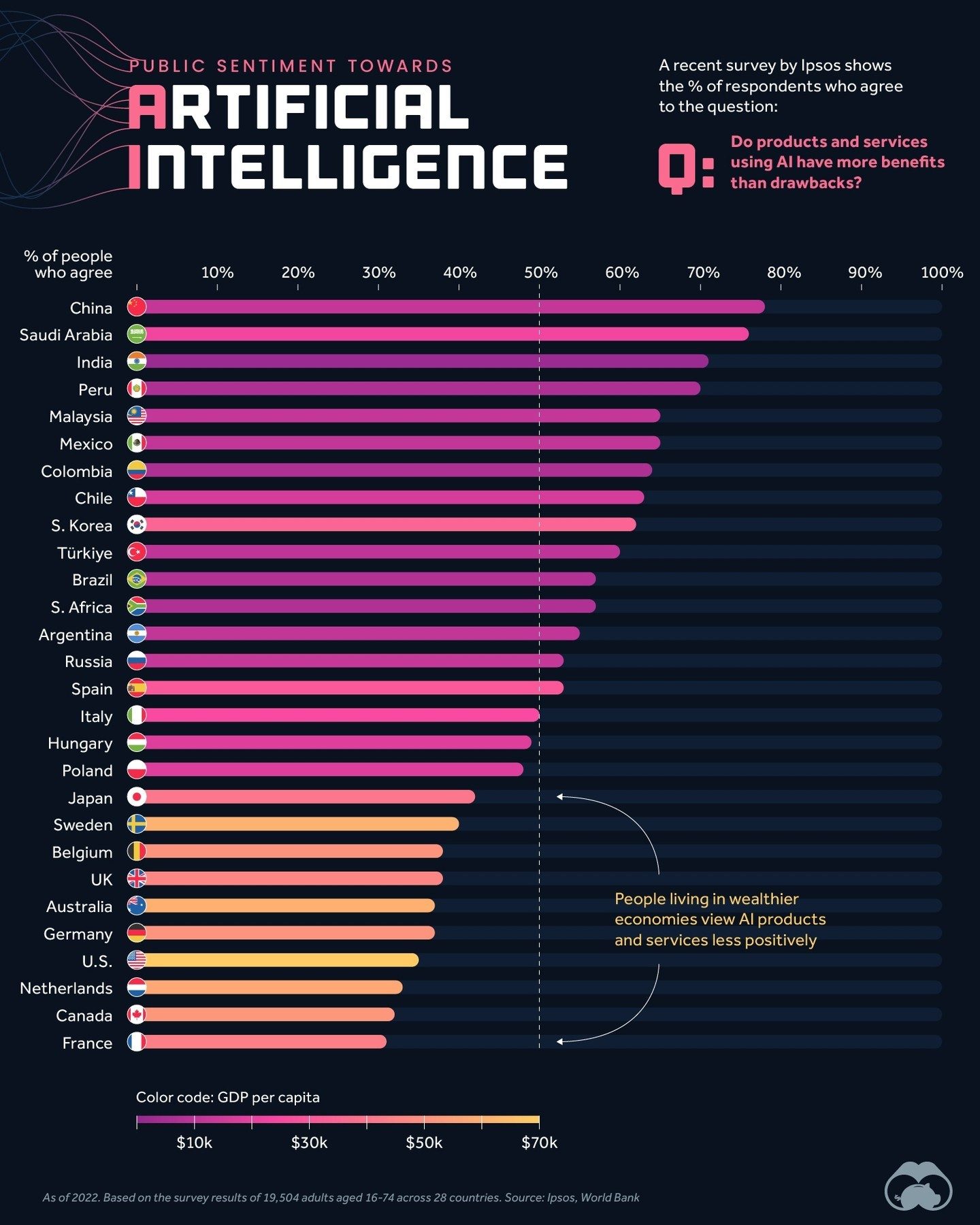
Public Sentiment Towards Artificial Intelligence
Artificial intelligence (AI) stands as one of the most rapidly evolving and disruptive technologies globally. Its potential to reshape society underscores the importance of understanding public sentiment towards AI. An infographic, based on survey data from the market research firm Ipsos, reveals how attitudes towards AI vary across different countries. By incorporating each country’s GDP per capita, the data highlights that wealthier populations tend to view AI products and services less favorably.
Why This Matters
AI's impact on society is profound, influencing everything from daily routines to global economies. Understanding public sentiment towards AI is crucial for policymakers, tech companies, and the general public. This knowledge can guide the ethical development and implementation of AI technologies, ensuring that they benefit society as a whole.
Public Perception Across the Globe
The survey by Ipsos covers 28 countries, providing a comprehensive view of global attitudes towards AI. The percentage of people who agree that AI products and services offer more benefits than drawbacks varies significantly by region.
Asia-Pacific Region
Countries in the Asia-Pacific region, such as China, India, and Saudi Arabia, show a more positive outlook towards AI. China leads with the highest percentage of respondents agreeing that AI offers more benefits than drawbacks, followed closely by India. This trend suggests that these countries are more open to embracing AI technologies, perhaps due to their rapid economic growth and technological advancements.
Latin America
In Latin America, countries like Brazil, Mexico, and Chile also show a generally positive view of AI. However, the percentage of people who agree that AI benefits outweigh the drawbacks is slightly lower compared to some Asian countries, indicating a nuanced level of acceptance.
Middle East and Africa
Countries in the Middle East and Africa, such as Saudi Arabia and South Africa, exhibit varied opinions. While Saudi Arabia shows a relatively high percentage of agreement, South Africa’s views are more cautious, reflecting a mix of optimism and skepticism.
Europe and North America
Wealthier economies in Europe and North America, including the United Kingdom, Canada, and the Netherlands, tend to view AI less positively. This trend is evident in the lower percentage of respondents who believe AI benefits outweigh its drawbacks. This skepticism could be influenced by factors such as privacy concerns, job displacement fears, and ethical considerations.
Key Insights from the Data
The data reveals that wealthier nations are more likely to have a skeptical view of AI. This could be attributed to several factors, including:
- Privacy Concerns: Wealthier countries often have stricter privacy laws and a greater awareness of data security issues, leading to more cautious attitudes towards AI.
- Job Displacement: There is a pervasive fear that AI could automate jobs, leading to unemployment. This concern is more pronounced in wealthier economies where job security is a significant issue.
- Ethical Considerations: Wealthier nations may have more resources to engage in ethical debates about AI, leading to a more critical evaluation of its benefits and drawbacks.
Practical Tips for Engaging with AI
Understanding public sentiment towards AI can help individuals and organizations navigate this complex landscape. Here are some practical tips:
Stay Informed
Keep up-to-date with the latest developments in AI. Attend webinars, read industry reports, and stay engaged with relevant news sources. This knowledge will help you make informed decisions about AI products and services.
Engage in Dialogue
Share your thoughts and concerns with friends, colleagues, and community leaders. Engaging in dialogue can help clarify your own views and contribute to a broader understanding of AI's impact.
Participate in Surveys
If you have the chance, participate in surveys about AI. Your input can provide valuable data that helps shape policies and technological advancements.
Consider Ethical Implications
When evaluating AI products and services, consider their ethical implications. Think about issues like data privacy, job displacement, and bias in algorithms.
Important Takeaways
AI is a double-edged sword, offering both benefits and drawbacks. It is essential to approach AI with a balanced perspective, acknowledging its potential while remaining vigilant about its challenges. By understanding public sentiment, we can foster a more informed and ethical development of AI technologies.
- Global Variability: Attitudes towards AI vary significantly by country and region, influenced by economic, cultural, and ethical factors.
- Economic Impact: Wealthier economies tend to be more skeptical about AI, highlighting the need for nuanced policies that address their unique concerns.
- Engagement and Awareness: Staying informed and engaged in the conversation about AI is crucial for navigating its complexities.
Conclusion
Artificial intelligence is a transformative technology with far-reaching implications. By understanding public sentiment towards AI, we can better address its challenges and harness its benefits. Whether you are a policymaker, tech enthusiast, or a concerned citizen, staying informed and engaged is key to shaping a future where AI serves the best interests of society.
Watch the Reel
Questions readers ask
Why are wealthier countries more skeptical of AI?
Wealthier countries may have more concerns about AI due to potential job displacement, data privacy and ethical issues. These nations often have more robust data protection regulations which can lead to more caution about adopting AI technologies.
What is the general sentiment towards AI in the Asia-Pacific region?
Countries in the Asia-Pacific region, particularly China and India, generally view AI more favorably. This can be attributed to its rapid economic growth and potential for technological advancement.
How does GDP per capita correlate with AI sentiment?
The Ipsos survey data indicates that countries with a higher GDP per capita tend to have more reservations about AI. This could be due to a greater awareness of the potential risks and ethical implications of AI.
What are the implications of global AI sentiment for policymakers?
Understanding public sentiment towards AI is vital for policymakers as it helps in crafting regulations and policies that balance innovation and societal concerns. This ensures that AI technologies are developed and implemented in a way that benefits society as a whole.
What factors contribute to the positive view of AI in countries like China and India?
The favorable view of AI in countries like China and India can be linked to their rapid economic growth and the potential for AI to drive further development. These nations may see AI as a means to enhance productivity and innovation.
How does the Ipsos infographic help in understanding global AI attitudes?
The Ipsos infographic provides a visual representation of public sentiment towards AI across different countries. By incorporating GDP per capita, it highlights the correlation between a nation's wealth and its perception of AI, offering insights into global attitudes and potential regional differences.
Related deep dives
Similar reads based on topic and creator.


Recent articles
Fresh deep dives from the latest Reels we unpacked.




Comments
Be the first to comment.