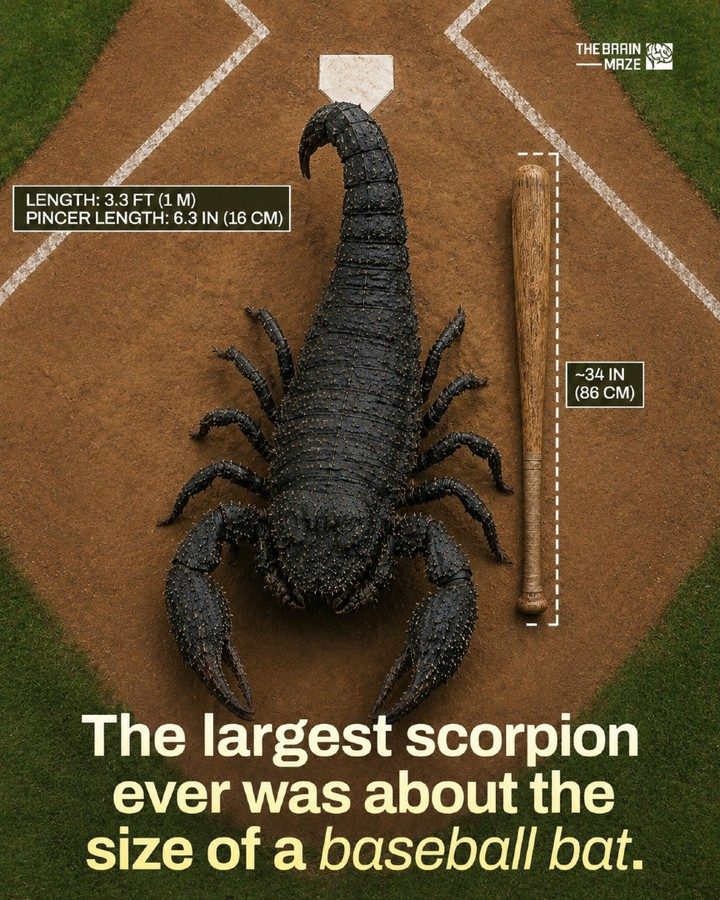
Giant Scorpion: Praearcturus gigas
Praearcturus gigas, the largest known scorpion, is a fascinating subject that has recently been brought to light through a newly reexamined fossil. This ancient creature, estimated to have roamed Earth approximately 415 million years ago, provides significant insights into the evolution of giant arthropods and the early ecosystems of the Devonian period.
Why This Matters
The discovery of Praearcturus gigas is significant for several reasons. Firstly, it challenges and reshapes our understanding of the size and diversity of ancient arthropods. Secondly, it highlights the importance of revisiting historic fossils with modern scientific techniques. Lastly, it sheds light on the early marine and amphibious ecosystems, offering a glimpse into the lives of early fish and other predators.
Praearcturus gigas: Size and Characteristics
A Giant Among Scorptions
Praearcturus gigas was an exceptionally large scorpion. At over 3 feet (approximately 1 meter) in length, it dwarfed modern scorpions. To put this size into perspective, imagine a scorpion roughly the length of a baseball bat, which is approximately 34 inches (86 centimeters) long. The pincer length alone was a staggering 6.3 inches (16 centimeters), making it a formidable predator.
An Amphibious Lifestyle
The fossil suggests that Praearcturus gigas may have lived an amphibious lifestyle. This means it likely spent time both in water and on land, making it well-adapted to a variety of environments. Such adaptability would have been crucial for hunting early fish and other aquatic prey. This lifestyle is a significant piece of the puzzle in understanding the transition from purely aquatic to terrestrial arthropods.
Evolutionary Significance
Giant Arthropod Evolution
The discovery of Praearcturus gigas has important implications for our understanding of giant arthropod evolution. These giant creatures represent a critical period in the diversification of arthropods, a group that includes insects, spiders, and crustaceans. Understanding the size and behavior of these ancient arthropods helps scientists trace the lineage and development of modern species.
Early Marine Ecosystems
The Devonian period, during which Praearcturus gigas lived, is often referred to as the "Age of Fish." However, this period also saw the emergence of many other life forms, including the early arthropods. The finding of Praearcturus gigas helps paint a more detailed picture of the early marine ecosystems, revealing the complex interactions between various species. This includes the role these giant scorpions played as predators and their impact on the evolution of other aquatic life.
Practical Tips for Fossil Study
The Value of Reexamination
Revisiting historic fossils with new technologies and methodologies can yield significant findings. As demonstrated by the case of Praearcturus gigas, modern scientific techniques can uncover details that were previously undetected. This underscores the importance of continued research and the potential for groundbreaking discoveries in the field of paleontology.
Observational Techniques
When studying fossils, particularly those of ancient arthropods, it is essential to approach the subject with a comprehensive understanding of the environment in which the creature lived. This involves considering factors like environmental conditions, food sources, and the presence of other species. For Praearcturus gigas, understanding its amphibious lifestyle and role as a predator is crucial for a holistic analysis.
Important Takeaways
- Praearcturus gigas was the largest known scorpion, reaching over 3 feet in length and living approximately 415 million years ago.
- It likely had an amphibious lifestyle and hunted early fish in Devonian waters.
- The discovery reshapes our understanding of giant arthropod evolution and the early marine ecosystems.
- Modern reexamination of historic fossils can yield significant new information.
Conclusion
Praearcturus gigas is a captivating example of the power of paleontology in revealing the mysteries of Earth's past. Its size, lifestyle, and implications for evolutionary studies make it a landmark discovery. As scientists continue to revisit and reexamine historic fossils, we can expect more groundbreaking findings that will further illuminate the history of life on our planet.
Watch the Reel
Questions readers ask
How large was the giant scorpion, Praearcturus gigas?
Praearcturus gigas was estimated to be over 3 feet in length, making it the largest known scorpion species. This size is remarkably large compared to modern scorpions, which typically range from 2 to 6 inches in length.
When did Praearcturus gigas live?
Praearcturus gigas is believed to have lived during the Devonian period, approximately 415 million years ago. This era is known for its diverse marine life and the development of early amphibious ecosystems.
What does the discovery of Praearcturus gigas reveal about ancient marine ecosystems?
The discovery of this giant scorpion provides insights into the early marine and amphibious ecosystems of the Devonian period. It suggests a world where large arthropods played a significant role, and it challenges existing theories about the size and diversity of ancient creatures.
How does the study of Praearcturus gigas contribute to our understanding of arthropod evolution?
By examining the fossil of Praearcturus gigas, scientists can better understand the evolution of giant arthropods. Its unique characteristics offer a glimpse into how these creatures adapted and evolved over millions of years, especially during the transition from marine to amphibious environments.
Why is the re-examination of historic fossils important in the study of Praearcturus gigas?
Revisiting historic fossils with modern scientific techniques allows researchers to uncover new details that were previously unnoticed. This process is crucial for understanding Praearcturus gigas and other ancient creatures, as it helps refine our knowledge of prehistoric life and its evolution.
What makes Praearcturus gigas different from modern scorpions?
Praearcturus gigas differs significantly from modern scorpions in terms of size and the environment in which it lived. Modern scorpions are much smaller and primarily terrestrial, while Praearcturus gigas was a marine and amphibious creature, living in a world dominated by diverse aquatic life.
Related deep dives
Similar reads based on topic and creator.




Recent articles
Fresh deep dives from the latest Reels we unpacked.




Comments
Be the first to comment.