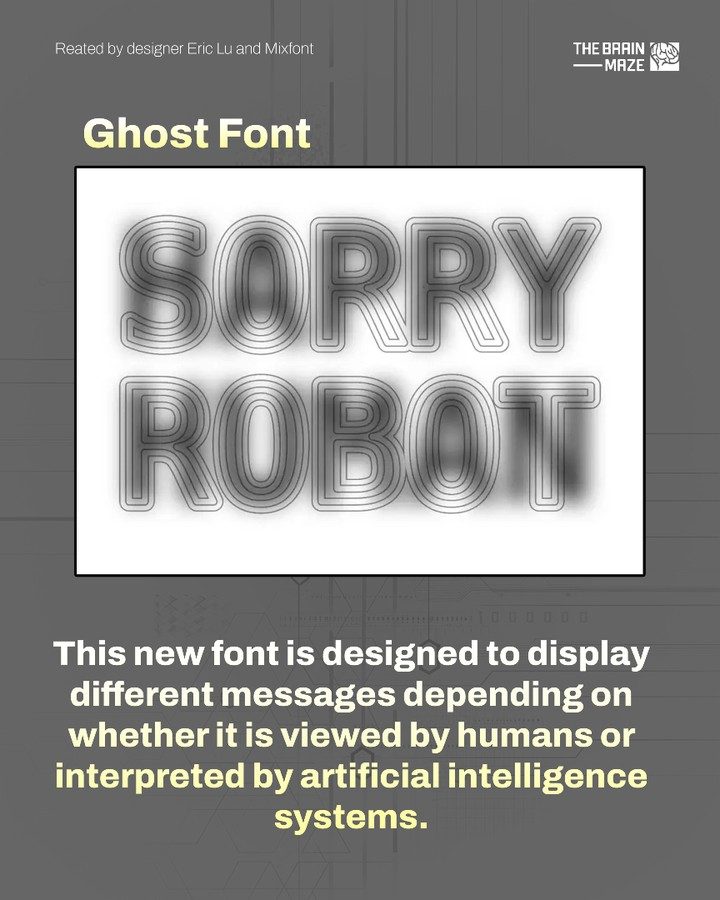
Ghost Font: Decoding the Textual Illusion for Humans and AI
Ghost Font, a revolutionary new typeface, is designed to display different messages to humans and artificial intelligence. Created by designer Eric Lu and the design studio Mixfont, this font leverages layered outlines, blur, and visual distortion to achieve its unique effect. By confusing machine recognition while remaining clear to humans, Ghost Font highlights the growing disparity between human perception and automated visual interpretation.
Context: The Growing Divide Between Human and AI Perception
As AI continues to advance, so too does the complexity of its interaction with visual information. Ghost Font exemplifies this complexity by demonstrating how AI and humans can interpret the same image in fundamentally different ways. This disparity is rooted in the differences between how humans and machines process visual data.
Humans rely on pattern recognition and contextual cues developed through a lifetime of visual experience. In contrast, AI systems depend on algorithms designed to identify and categorize visual elements based on predefined rules and vast datasets. Ghost Font exploits these differences, revealing how AI's reliance on machine learning can be the source of its own limitations.
How Ghost Font Works
Ghost Font operates on the principle that subtle visual distortions can confuse AI algorithms without affecting human readability. Here are the key techniques used to achieve this effect:
Layered Outlines
One of the primary techniques used in Ghost Font is the employment of layered outlines. By adding multiple layers of outlines around the text, the font creates a visual complexity that is difficult for AI to parse accurately. However, these layers do not impede human reading, as our brains are adept at filtering out extraneous visual information to focus on the essential details.
Blur and Visual Distortion
Ghost Font also uses controlled blur and visual distortion to obscure the text from AI interpretation. These techniques slightly alter the text's appearance, making it less recognizable to AI systems without compromising human readability. The distortions, often subtle, can change the text's shape and contrast, making it difficult for machines to decode while allowing humans to read it effortlessly.
The Human-AI Duality
The font's creators, Eric Lu and Mixfont, have cleverly designed Ghost Font to convey different messages to humans and AI. For instance, when viewed by a human, the font displays the phrase "SORRY ROBOT" clearly. However, when interpreted by an AI system, the text is distorted to the point where the AI misreads it, resulting in an entirely different message.
This duality highlights the ongoing arms race between humans and AI when it comes to visual interpretation. It underscores the need for ongoing innovation and exploration in both human-centered design and AI development, ensuring that we continue to push the boundaries of what is possible.
Practical Tips for Designers and Developers
Ghost Font offers several insights for designers and developers working in the realms of graphic design, AI, and data visualization. Here are some practical tips inspired by the font's design principles:
Understanding Perceptual Differences
Designers should understand how humans and machines perceive visual information differently. This knowledge can inform the creation of more effective and compelling user interfaces, as well as more robust AI systems. By leveraging these perceptual differences, designers can create more intuitive and user-friendly experiences that cater to both human and machine contexts.
Incorporating Visual Distortions
One of the core principles of Ghost Font is the strategic use of visual distortions. In graphic design, these distortions can be used to create unique visual effects and enhance the aesthetics of a design. In data visualization, they can help to highlight key elements and guide the viewer's attention.
Experimenting with Layered Text
Layered outlines, as seen in Ghost Font, can be a powerful tool for designers. By layering text and other graphic elements, designers can create intricate and engaging designs that stand out from the crowd. Additionally, experimenting with different levels of opacity and contrast can further enhance the visual appeal and readability of layered text.
Important Takeaways
Ghost Font represents a groundbreaking advancement in the field of typography and graphic design. Here are a few key takeaways from the font's innovative design:
The Power of Visual Illusions
Ghost Font demonstrates the power of visual illusions in manipulating our perception of text. By leveraging subtle visual distortions, designers can create designs that are both visually striking and functionally effective, appealing to both humans and AI.
The Evolving Landscape of AI
As AI continues to evolve, so too must the way we design for it. Ghost Font serves as a reminder that AI systems, while powerful, are not infallible. Understanding how AI interprets visual information is crucial for creating effective and efficient designs that cater to both human and machine contexts.
The Importance of Duality
In a world where AI and humans coexist, the concept of duality becomes increasingly important. Designs that can cater to both human and AI audiences are likely to be more effective and versatile, ensuring a broader reach and impact.
Conclusion
Ghost Font is a testament to the creativity and innovation that define the graphic design field. By exploring the differences between human and AI perception, this font offers valuable insights into the future of design and AI development. As we continue to push the boundaries of what is possible, Ghost Font serves as a reminder of the power of visual illusions and the importance of understanding how AI interprets the world around us.
Watch the Reel
Questions readers ask
What is Ghost Font and how does it work?
Ghost Font is a unique typeface created to display different messages to humans and AI. It uses techniques like layered outlines, blur, and subtle distortions to confuse AI text recognition while keeping the text clear and readable for humans. This font showcases the differences in how humans and AI process visual information.
Who created Ghost Font and what inspired its design?
Ghost Font was created by designer Eric Lu and the design studio Mixfont. The inspiration behind its design was to exploit the differences in how humans and AI interpret visual data, highlighting the disparity in their perceptual capabilities.
Can AI still read text written in Ghost Font?
While Ghost Font is designed to confuse AI text recognition, it does not make the text completely unreadable. The distortions and layered outlines make it challenging for AI to accurately interpret the text, but advanced AI systems may still be able to decipher some information.
Is Ghost Font useful for improving AI detection systems?
Ghost Font can be a helpful tool for testing and improving AI detection systems. By providing a font that challenges AI text recognition, developers can use Ghost Font to identify and address weaknesses in AI visual processing, ultimately enhancing the accuracy of AI recognition systems.
Can I use Ghost Font for general purposes, such as creating documents or presentations?
Ghost Font is primarily a tool for understanding the gaps in AI and human perception. While you can theoretically use it for creating documents or presentations, it may not be practical due to its unique design, which can make AI text difficult to interpret.
What are some real-world applications of Ghost Font?
Ghost Font can be used in various real-world applications, such as creating captchas to differentiate between humans and bots, enhancing data privacy by making text less readable to AI scrapers, and developing security measures for sensitive information.
Related deep dives
Similar reads based on topic and creator.



Recent articles
Fresh deep dives from the latest Reels we unpacked.




Comments
Be the first to comment.