The Moss Construction
Geometric construction is an art and science where precision meets geometry. Center to the study of geometric problem-solving, this construction involves creating precise shapes and lines using simple tools. It’s fascinating and useful across fields like architecture and engineering. The overlapping tangents of three circles always align in a way discovered centuries in the past. . A construction starts with a problem, like creating a particular shape, angle, or length, then follows a step-by-step process to achieve it. The Moss construction specifically involves circles. Three drawn circles of any size intersect in a predictable pattern. It was proven in 1798, showing that the intersection points of these lines always align perfectly. This pattern holds true even as the circles are moved around.
Tangent Patterns and the Line They Trace
Moss's discovery highlights a few interconnected mathematical concepts. There are multiple mathematical theorems and constructions rooted in simple shapes. The construction reflects a foundational concept in geometry: the relationship between circles and lines. It's hard to overstate the importance of circles in mathematics. They frequently show up as the basis for essential properties and proofs. This discovery unites a few principles: lines, circles, and tangents, but does not need any other shapes. This follows from but does not depend on the shape, size or location of the circles. The intersection points always lie on a straight line, regardless of the size, position, or orientation of the circles. This means the construction is stable. The foundation doesn’t change as long as the circles overlap as described.
The Tangent Line Construction Process
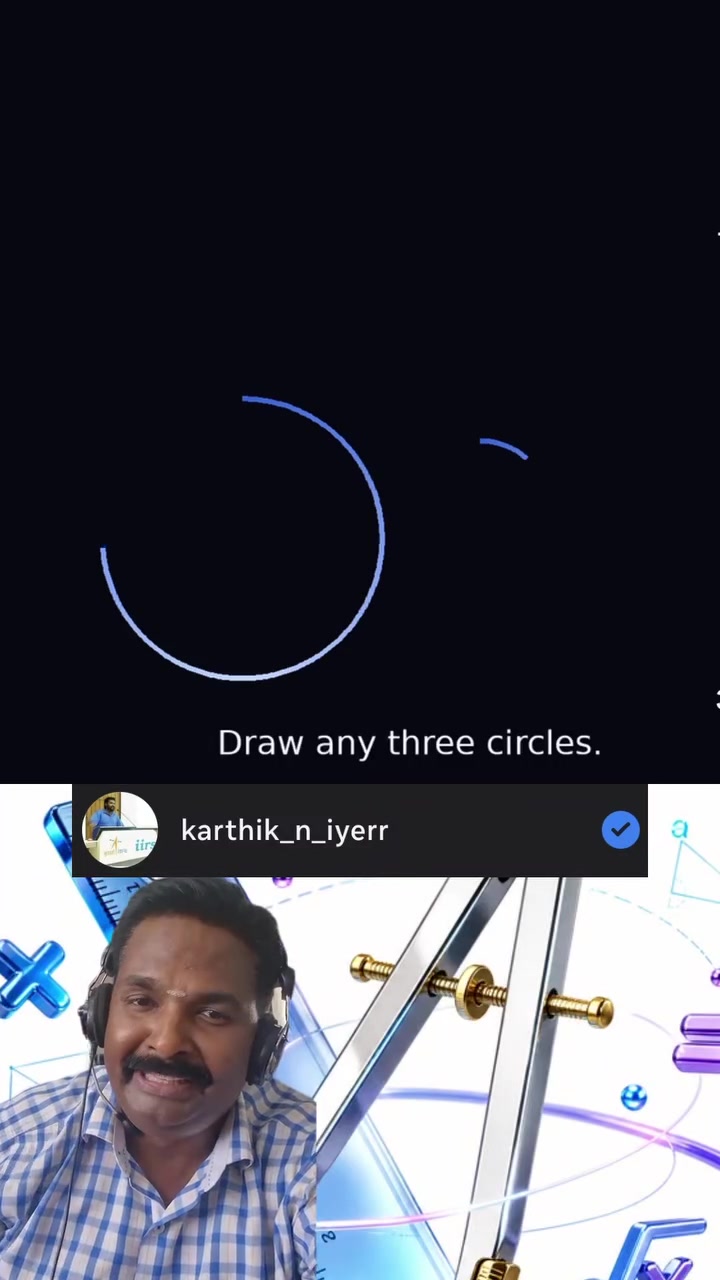
As a first step to this construction, you need to draw any three circles. This versatility makes it easy to start.., You can choose different sizes and positions for your circles, but all three must overlap at least at one point. Imagine three overlapping bubbles - that's your beginning. The uniqueness comes from the construction of external tangent lines: for each pair of circles, draw a line that is tangent to both on the outside. . This differs from the internal tangent lines, which are drawn between two circles inside the common tangent, creating a different pattern altogether. The external lines intersect to form three points, and these points align perfectly on a straight line. Inspired by the clarity and precision illuminated by this construction, you can try it yourself using basic tools and simple steps. But first, take a moment to reflect on history of the concept.
The Oldness of Construction
The Moss Construction has roots in a problematic period of geometric study. It was discovered in 1798. Yet, despite the passage of time, it remains a relevant and useful concept. The aptitude to explore geometric properties is satisfying. This summoning of geometry verifies the concept’s enduring value. The construction has stood the test of time, proving its robustness and significant contribution. The understanding of circles and their tangents is crucial in navigating fractal landscapes.
The Frail Nature of Geometric Proof
The proof of this concept is indirect. Another interesting aspect of this geometry hews closely to philosophy: it's not evidence-based. Rather, it's belief-based. The guarantee that they will always lie on a straight line is not proven. It is a philosophy, a conjecture. Moss discovered this process by trial and error. It is assumed the proof to be true. This fascinating, yet controversial, conclusion raises an intriguing philosophical question: how do we know something is true, or a theory is valid? This philosophy looks at the way the world works. The answer is somewhat intractable. The mystery gives insight and a puzzle to ponder. It's impossible to argue against an uncertain conclusion. It isn’t an isolated incident: There are countless theorems and constructions in geometry that are not proven. This is perhaps one of the most intriguing aspects of geometry. This is a simple geometric construction that reveals a deeper philosophical question.
Closing tenets
The intersection points of these lines always align in a graceful, predictable pattern, even as the circles are moved around. This is what makes his construction uniquely meaningful. The discovery that the intersection points always lie on a straight line is fascinating and can be executed with simple tools. This construction will help you understand the fascinating relationship between circles and lines, gaining insights into the world of constructive geometry.
Watch the Reel
Questions readers ask
What exactly is the Moss Construction and how does it work?
The Moss Construction is a geometric method discovered in 1798 that involves drawing three overlapping circles and connecting their external tangent lines. The unique part is that the points where these tangent lines intersect always lie on a single straight line, regardless of the circles' size, position, or orientation. It's a simple yet profound example of how lines and curves can interact predictably.
Why is the Moss Construction significant in geometry?
The Moss Construction is significant because it demonstrates a fundamental relationship between circles and lines. It shows that the intersection points of the external tangent lines of three overlapping circles always align on a straight line, which is a stable and predictable pattern. This makes it a useful tool in fields like architecture and engineering, where precise geometric constructions are essential.
Can I try the Moss Construction with any three circles, or are there specific requirements?
You can try the Moss Construction with any three circles, as long as they overlap at least at one point. The versatility of the construction means you can choose different sizes and positions for your circles. The key is to draw the external tangent lines for each pair of circles and observe how their intersection points align on a straight line.
How does the Moss Construction relate to other geometric concepts and tools?
The Moss Construction is rooted in basic geometric principles involving circles, lines, and tangents. It does not depend on any other shapes and is applicable across various fields. The construction reflects a foundational concept in geometry: the relationship between circles and lines. It's a testament to the enduring value of geometric problem-solving and its applications in modern fields.
Why is the Moss Construction still relevant today, given that it was discovered over 200 years ago?
The Moss Construction remains relevant because it exemplifies the enduring principles of geometry. Its robustness and significant contribution to understanding circles and their tangents have made it a valuable concept in navigating fractal landscapes, architecture, and engineering. Despite the passage of time, the construction continues to inspire and educate, proving its timeless relevance.
Related deep dives
Similar reads based on topic and creator.
Recent articles
Fresh deep dives from the latest Reels we unpacked.




Comments
Be the first to comment.