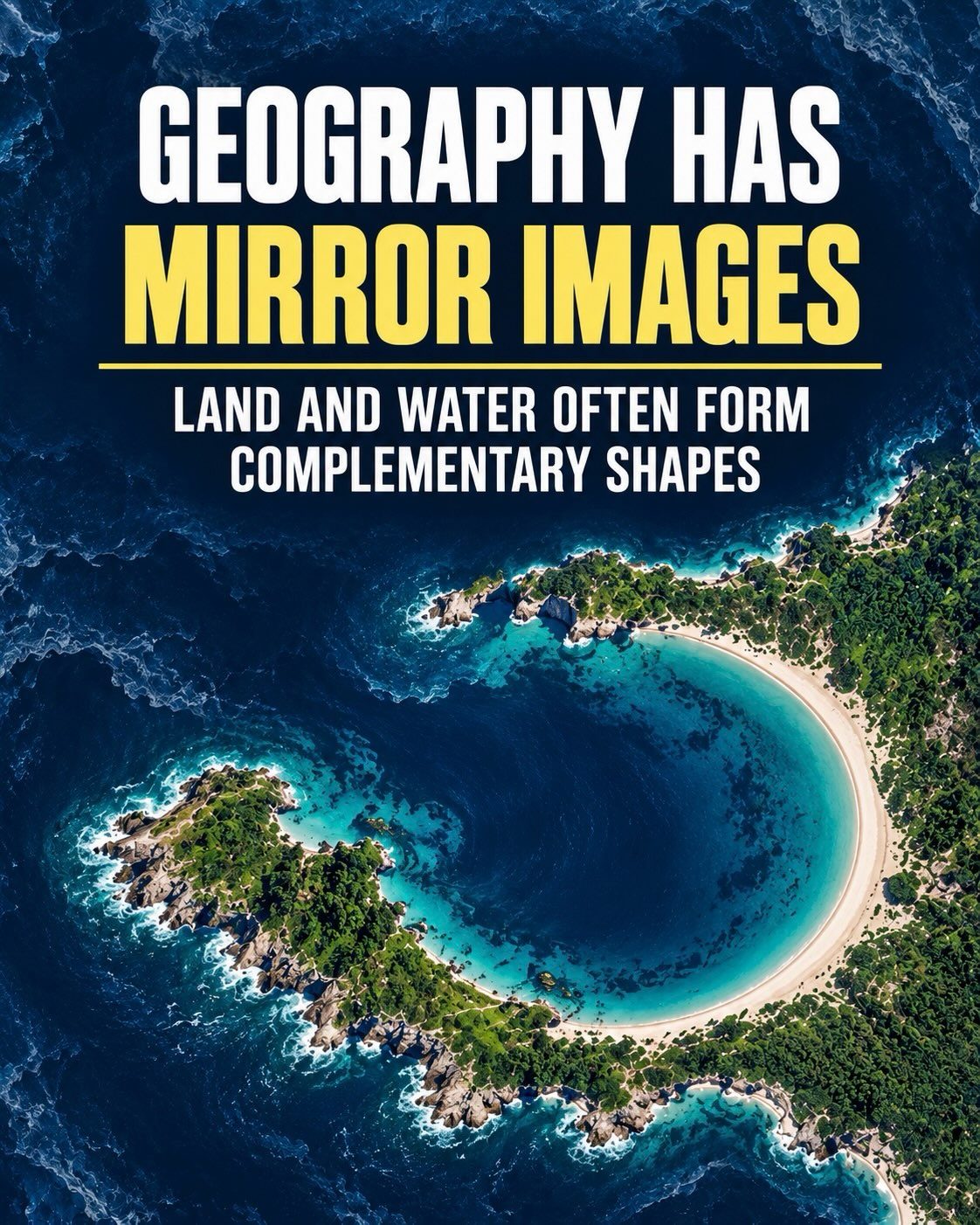
The Mirrored Dance of Land and Sea
The world of geography is a study in contrasts, where land and water engage in a perpetual dance, creating forms that are often complementary. On-screen text shows, "GEOGRAPHY HAS MIRROR IMAGES". This is vividly illustrated by the aerial views of coastlines and bodies of water, which reveal the intricate relationship between these two elements. Take, for instance, the isthmus, a narrow strip of land that connects two larger landmasses. Its counterpart, the strait, is a narrow channel of water that separates them. "ISTHMUS STRAIT", text reads, followed by "Land connecting land Water separating land." These forms are not exact opposites. They are created and shaped by the dynamic relationship between Earth's land and water. Not an exact flip, but more of a mirror image.
The Interplay of Capes and Bays
The interplay between land and water is further exemplified by capes and bays. A cape, as seen in the visuals, is a landform that projects into a body of water. A bay, on the other hand, is a body of water that curves inward, often embraced by land. The text on screen lines out: "CAPE BAY", followed by "LAND PROJECTING INTO WATER WATER CURVING INTO LAND." That shows the natural landforms are a result of both land and water pushing and pulling against each other. Each of these forms is created by the interaction between land and water, shaped by the forces of erosion, sedimentation, and tectonic activity.
Complementary Forms
The mirroring of these landforms is not a perfect reflection, though. They are complementary, not exact opposites. The complementary "shape" of geographies only exists because of the intrinsic relationship between land and water. "NOT EXACT OPPOSITES COMPLEMENTARY FORMS", reads the text. Think of a river carving a canyon, for example, the river forms the canyon over time, shaping land as we see it. The complementary relationship is not static but dynamic, a balance between the forces of land and water. These forces shape and reshape the Earth's surface. Through these forms, the Earth's surface exhibits shapes that mirror each other. This complementary relationship between land and water is a testament to the dynamic nature of our planet, showcasing the power of nature's aeroforms.
Watch the Reel
Related deep dives
Similar reads based on topic and creator.
Recent articles
Fresh deep dives from the latest Reels we unpacked.


Comments
Be the first to comment.