Generative AI: A New Era of Creativity
Generative AI has rapidly become a transformative force in the tech industry, offering innovative solutions for creating new and original content. From images and videos to text and audio, this technology utilizes machine learning algorithms to produce content that was previously only achievable manually. The latest advancements in generative AI have made it a mainstream tool, with increasing accessibility and applications.
Why Generative AI Matters
As artificial intelligence continues to evolve, generative AI stands out for its ability to produce creative and unique content. This technology is not just a tool for artists and designers; it has applications across various industries. Whether it's creating advertisements, designing web pages, or even generating scripts, generative AI is revolutionizing how we approach content creation. Understanding its workings and potential applications is crucial for anyone looking to stay ahead in the digital landscape.
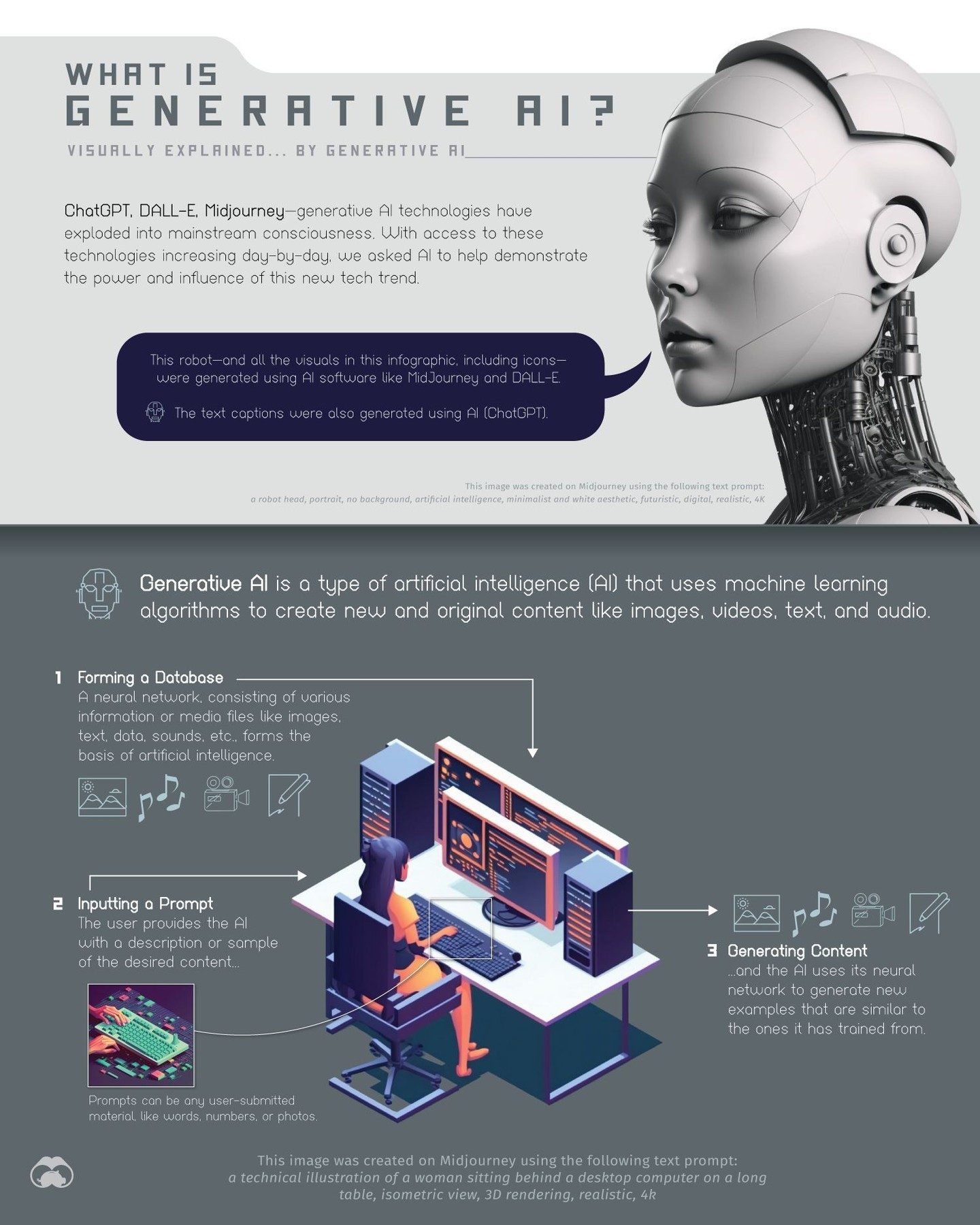
An Overview of How Generative AI Works
Forming a Database
The process of creating generative AI content begins with forming a database. This database is the foundation upon which the AI learns and generates content. It is populated with vast amounts of data that the AI uses to understand patterns, structures, and styles. The more diverse and comprehensive the dataset, the more effective the AI becomes in generating high-quality content.
Inputting a Prompt
Once the database is established, the next step is to input a prompt. A prompt is a specific instruction or query that guides the AI in generating content. This could be a text description, an image, or any other form of input that the AI can process. The prompt serves as a directive, telling the AI what kind of content to create and in what style.
Generating Content
After receiving the prompt, the AI uses its machine learning algorithms to generate the desired content. This process involves analyzing the data in the database, identifying patterns, and creating new, original content based on the prompt. The result is a piece of content that is unique and tailored to the user's needs.
Examples of Generative AI Technology
Several tools and platforms have emerged as leaders in the generative AI field. Here are a few notable examples:
-
ChatGPT: This tool is known for its ability to generate human-like text based on input prompts. It can write articles, scripts, and even poetry, making it a versatile tool for content creators.
-
DALL-E: DALL-E is an AI model that generates images from textual descriptions. It can create highly detailed and realistic images, making it an invaluable tool for artists and designers.
-
Midjourney: Midjourney is another generative AI tool that focuses on creating visual content. It can generate a wide range of images, from realistic photographs to abstract art, based on user prompts.
Real-Life Applications of Generative AI
Generative AI has a wide range of practical applications across various industries. Here are some areas where this technology is making a significant impact:
Advertisements and Marketing
Generative AI is being used to create advertisements, illustrations, and corporate visuals. These tools can generate novel and engaging content that captures the attention of audiences, making them effective for marketing campaigns.
Design and Creativity
From web design to software development, generative AI is transforming the creative process. It can produce unique designs, scripts, and even entire user interfaces, saving time and resources for designers and developers.
Art and Illustration
Artists and illustrators are leveraging generative AI to create stunning visuals. Whether it's a watercolor painting of a red bicycle in front of a waterfall or a whimsical illustration of Santa Claus in a blue outfit, generative AI can produce high-quality artwork quickly and efficiently.
Technology and Development
In the realm of technology, generative AI is used for coding, scripting, and other development tasks. It can generate scripts and snippets of code, making it easier for developers to write and debug their applications.
Practical Tips for Using Generative AI
Choose the Right Tool
Different tools and platforms have different strengths. For example, ChatGPT is ideal for generating text, while DALL-E and Midjourney are better suited for visual content. Choose the tool that best fits your needs and the type of content you want to create.
Fine-Tune Your Prompts
The quality of the generated content often depends on the specificity and clarity of the prompt. Take the time to craft detailed and precise prompts to get the best results. Use descriptive language and be clear about the style, tone, and content you want.
Experiment and Iterate
Don't be afraid to experiment with different tools and prompts. Generative AI is a powerful but complex technology, and finding the right combination of tools and prompts may take some trial and error. Keep iterating and refining your approach to achieve the desired results.
Leverage Real-Life Examples
Look at real-life examples of generative AI in action to gain insights into how it can be applied. For instance, studying how generative AI is used in advertisements, web design, or art can provide valuable inspiration and ideas for your projects.
Important Takeaways
Generative AI is a game-changer in the world of content creation. By understanding its workflow—from forming a database to generating content—you can leverage this technology to produce high-quality, original content. Whether you're a designer, developer, or content creator, generative AI offers tools and platforms that can enhance your productivity and creativity. By choosing the right tools, refining your prompts, and experimenting with different approaches, you can harness the full potential of generative AI to meet your unique needs.
Conclusion
Generative AI is more than just a technological advancement; it's a new era of creativity that is transforming industries and pushing the boundaries of what's possible. From creating stunning visuals to generating human-like text, this technology offers endless possibilities for content creation. As it continues to evolve, staying informed about its applications and tools will be essential for anyone looking to stay ahead in the digital landscape. Embrace the power of generative AI and unlock new dimensions of creativity.
Watch the Reel
Questions readers ask
How does generative AI create text content?
Generative AI creates text content by using machine learning models that learn patterns from large datasets. These models can generate coherent and contextually relevant sentences, paragraphs, or even entire articles based on given prompts or inputs. This process involves training the AI on vast amounts of text data to understand language structures and semantics and using algorithms to predict and generate similar text.
What are some examples of AI content creation tools?
There are numerous AI content creation tools available, such as Copy.ai, Frase, and Jasper. These platforms use generative AI to assist in creating blog posts, social media content, and marketing copy. Additionally, tools like DALL-E and Midjourney use AI to generate illustrations, infographics, and other visual content, showcasing the versatility of AI in content creation.
How can I start using AI for content creation?
To start using AI for content creation, you can begin by exploring user-friendly platforms that offer AI writing assistants, like Copy.ai or Frase. These tools often come with intuitive interfaces and pre-built templates to help you generate content quickly. Start with simple prompts and gradually experiment with more complex inputs to see what the AI can produce. Many platforms also offer tutorials and community forums for support.
What is the difference between generative AI and other types of AI?
Generative AI differs from other types of AI, such as discriminative AI, in its ability to create new, synthetic data. While discriminative AI focuses on classifying or predicting outcomes based on existing data, generative AI can produce entirely new content, like images, text, or sounds. This capability makes generative AI a powerful tool for creative applications, such as writing, design, and entertainment.
Can generative AI create videos?
Yes, generative AI can create videos. AI models can generate new video content by learning from large datasets of existing videos. These models can produce short video clips, animations, or even full-length videos based on specific prompts or scenarios. Some AI tools specialize in creating videos for various purposes, such as marketing, entertainment, or social media content.
What are AI prompts, and how do they work?
AI prompts are input instructions or examples given to a generative AI model to guide the content it produces. These prompts can be text, images, or other data types and help the AI understand the desired output. For example, in text generation, a prompt might be a sentence or paragraph that the AI uses as a starting point to create additional content. In image generation, a prompt could be a description or a rough sketch that the AI uses to generate a detailed illustration.
What are some industries that benefit from AI content generation?
Numerous industries benefit from AI content generation, including marketing, advertising, publishing, and entertainment. In marketing, AI can create personalized advertisements and social media content. In publishing, AI assists in generating articles, blog posts, and even book drafts. The entertainment industry uses AI for creating scripts, generating characters, and producing visual effects. Additionally, AI-driven content generation can streamline workflows and enhance productivity across these sectors.
Related deep dives
Similar reads based on topic and creator.


Recent articles
Fresh deep dives from the latest Reels we unpacked.




Comments
Be the first to comment.