Rapid Adoption of Generative AI: A New Technological Milestone
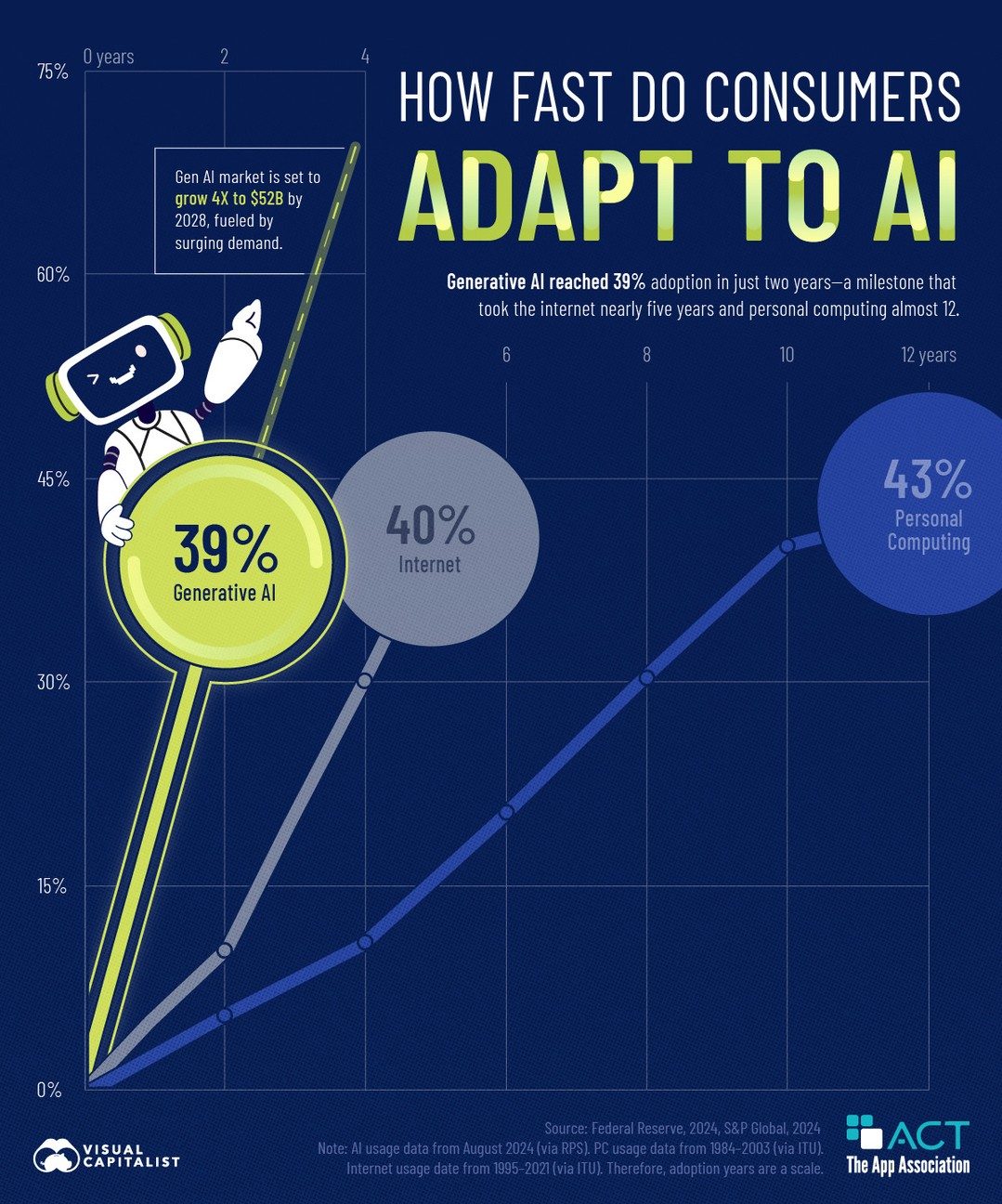
Generative AI has swiftly made its mark, reaching a 39% adoption rate in just two years. This rapid adoption surpasses the pace set by previous technological revolutions, such as the internet and personal computing. The generative AI market is projected to grow 4X to $528 billion by 2028, driven by surging demand. This milestone, reached in a fraction of the time it took for the internet (five years) and personal computing (nearly 12 years), highlights the transformative potential of AI technologies.
Why This Matters
The rapid adoption of generative AI signifies more than just a technological trend; it represents a paradigm shift with far-reaching implications. Understanding the pace at which consumers and industries are embracing AI is crucial for businesses, policymakers, and innovators alike. This technological leap holds the promise of driving global innovation and reshaping various sectors, from healthcare and finance to entertainment and beyond.
The Evolution of AI Adoption
Comparative Adoption Rates
To grasp the significance of generative AI's adoption, it's essential to compare it with the adoption rates of other groundbreaking technologies. The internet, which took nearly five years to reach a 40% adoption rate, and personal computing, which took nearly 12 years to achieve a 43% adoption rate, serve as benchmarks. Generative AI's 39% adoption in just two years underscores its unprecedented growth.
Factors Driving Rapid Adoption
Several factors contribute to the swift adoption of generative AI:
- Enhanced Capabilities: Generative AI models, such as those used in natural language processing and image generation, offer advanced capabilities that were previously unthinkable. These models can create content, automate tasks, and provide insights that drive business efficiency and innovation.
- Accessibility: The democratization of AI tools and platforms has made it easier for businesses and individuals to integrate AI into their workflows. Cloud-based AI services and open-source frameworks have lowered the barrier to entry, enabling wider adoption.
- Data Availability: The proliferation of data, coupled with advancements in data analytics, has fueled the development and refinement of AI models. The ability to process and analyze vast amounts of data has accelerated AI's applications and benefits.
Market Growth and Investment
The generative AI market is poised for exponential growth, with projections estimating a 4X increase to $528 billion by 2028. This growth is driven by surging demand from various industries seeking to leverage AI for competitive advantage. Investments in AI research and development, along with strategic partnerships and collaborations, are fueling this rapid expansion.
Applications and Benefits
Industry Applications
Generative AI's applications span across various industries, each leveraging its unique capabilities to drive innovation:
- Healthcare: AI models are used to enhance diagnostic accuracy, develop personalized treatment plans, and improve patient outcomes. For instance, generative AI can analyze medical images to detect diseases at early stages, providing timely interventions.
- Finance: In the financial sector, AI is employed for risk assessment, fraud detection, and algorithmic trading. Generative AI can simulate market scenarios to predict trends and optimize investment strategies.
- Entertainment: The entertainment industry benefits from AI's content creation capabilities. Generative AI can produce music, write scripts, and even create realistic virtual characters, revolutionizing content creation and distribution.
- Manufacturing: AI is used to optimize supply chain operations, predict maintenance needs, and enhance production processes. Generative AI can simulate various manufacturing scenarios to identify inefficiencies and improve overall efficiency.
Benefits Beyond Innovation
The benefits of generative AI extend beyond innovation. It holds the promise of a new industrial revolution, driving widespread economic growth and social progress. By automating routine tasks and augmenting human capabilities, AI can:
- Increase productivity and efficiency across industries.
- Create new job opportunities in AI development, implementation, and management.
- Enhance decision-making processes through data-driven insights.
- Foster global collaboration and innovation through shared AI tools and platforms.
Practical Tips for Adopting Generative AI
Assessing AI Readiness
Before integrating generative AI, organizations should assess their readiness. This involves:
- Evaluating current technological infrastructure and data management capabilities.
- Identifying areas where AI can provide the most significant benefits.
- Developing a roadmap for AI implementation, including timelines and milestones.
Building AI Talent
A strategic workforce is crucial for successful AI adoption. Organizations should focus on:
- Upskilling existing employees through AI training programs.
- Attracting and retaining top AI talent by offering competitive compensation and career growth opportunities.
- Fostering a culture of innovation and continuous learning.
Ethical Considerations
As with any powerful technology, ethical considerations are paramount. Organizations should:
- Ensure AI systems are developed and deployed responsibly, with transparency and accountability.
- Address concerns around data privacy and security, implementing robust safeguards.
- Engage in open dialogue with stakeholders to build trust and mitigate risks.
Important Takeaways
The rapid adoption of generative AI marks a significant technological milestone, offering unprecedented opportunities for innovation, efficiency, and economic growth. Key takeaways include:
- Generative AI's adoption rate surpasses that of the internet and personal computing, highlighting its transformative potential.
- The generative AI market is projected to grow 4X to $528 billion by 2028, driven by surging demand and strategic investments.
- AI applications span across various industries, from healthcare and finance to entertainment and manufacturing, each leveraging its capabilities to drive innovation.
- The benefits of generative AI extend beyond innovation, promising widespread economic growth and social progress.
- Successful AI adoption requires a strategic approach, including assessing readiness, building talent, and considering ethical implications.
Conclusion
As we stand on the cusp of a new industrial revolution, generative AI is poised to reshape the technological landscape. With its rapid adoption and transformative potential, it offers immense opportunities for innovation, efficiency, and growth. By embracing generative AI responsibly and strategically, organizations can harness its power to drive global progress and achieve new heights of success. The future of technology is here, and it's generative AI that is leading the way.
Watch the Reel
Questions readers ask
What is the current adoption rate of generative AI?
As of the latest data, generative AI has achieved a 39% adoption rate in just two years, marking a significant milestone in technological integration.
How does the adoption rate of generative AI compare to other technological advancements?
The 39% adoption rate of generative AI in two years outpaces the adoption rates of previous technological revolutions, such as the internet (five years) and personal computing (nearly 12 years).
Which industries are being transformed by generative AI?
Generative AI is reshaping various sectors, including healthcare, finance, entertainment, and manufacturing. Its applications range from content creation to predictive analytics and personalized consumer experiences.
What is the projected growth of the generative AI market?
The generative AI market is anticipated to grow fourfold, reaching $528 billion by 2028. This growth is driven by surging demand across various industries and consumer applications.
How is generative AI being integrated into consumer landscapes?
Generative AI is integrated into consumer landscapes through various applications, such as visual generative AI for creating images and videos, personalized recommendations, and interactive customer service tools. These advancements enhance user experiences and drive consumer engagement.
What are some of the latest AI trends contributing to its rapid adoption?
Some of the latest AI trends include advancements in natural language processing, improved algorithms for data generation, and the integration of AI into everyday devices and applications. These trends are pushing the boundaries of what AI can achieve, driving its rapid adoption.
Why is the rapid adoption of generative AI significant for the tech industry?
The rapid adoption of generative AI signifies a paradigm shift, indicating that AI technologies are becoming essential tools for innovation. This shift is driving advancements in AI capabilities and applications, leading to new opportunities and challenges for the tech industry.
Related deep dives
Similar reads based on topic and creator.


Recent articles
Fresh deep dives from the latest Reels we unpacked.




Comments
Be the first to comment.