Robotic Insects: The Future of Search-and-Rescue Operations
Robotic insects are revolutionizing search-and-rescue operations. These tiny, agile machines are being developed to venture into environments that are extremely challenging or dangerous for humans and larger robots. Recent advancements, such as the 3D-printed breathing suit developed by researchers from NTU Singapore and Waseda University, have enabled cyborg cockroaches to survive underwater and in low-oxygen environments for extended periods. This groundbreaking technology opens up new possibilities for inspecting flooded buildings, collapsed tunnels, underground pipes, and other hazardous locations.
Why This Matters
Search-and-rescue operations often face significant challenges, especially in environments that are difficult to access or pose significant risks to human rescuers. Traditional robots, while effective in many scenarios, struggle with tasks that require navigating through confined spaces or operating in low-oxygen conditions. Robotic insects, on the other hand, can traverse tight spaces, move through debris, and operate where larger robots and humans cannot. This capability makes them invaluable for search-and-rescue missions, environmental inspections, and even disaster response.
The Technology Behind Robotic Insects
Design and Functionality
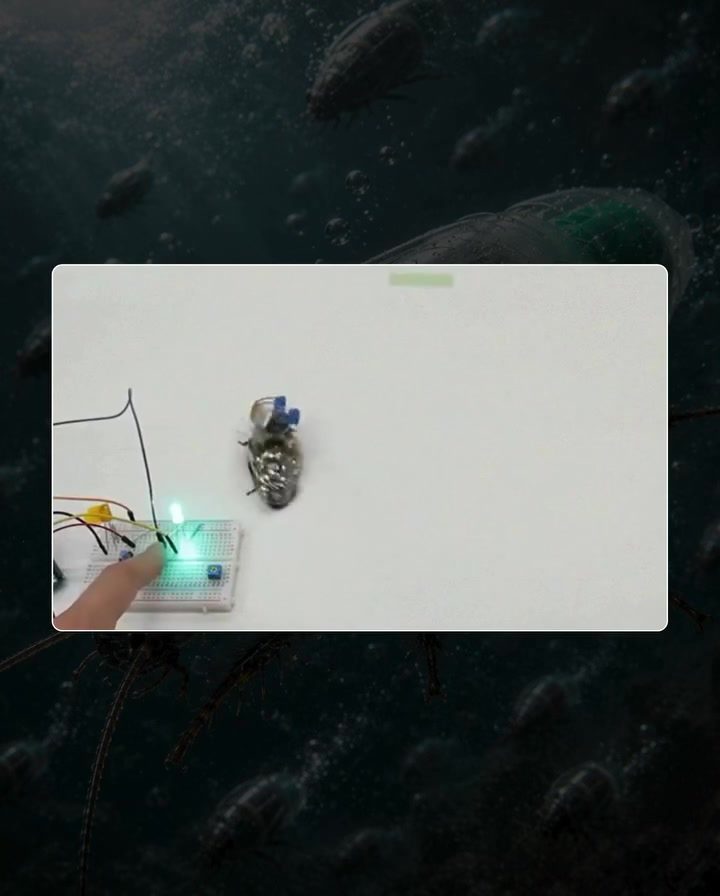
Robotic insects are designed to mimic the natural movements and capabilities of real insects. This bio-inspired design allows them to navigate through complex and confined spaces with ease. The small robotic insect in the demonstration moves on a white surface, controlled by a circuit board and wires connected to a breadboard. This setup showcases the insect's ability to move forward and demonstrate its functionality, highlighting the precision and control required for such operations.
The Breathing Suit
The recent breakthrough from NTU Singapore and Waseda University involves a lightweight 3D-printed breathing suit that enables cyborg cockroaches to survive underwater or in low-oxygen environments for up to three hours. This device generates oxygen and delivers it directly to the insect’s breathing openings through tiny tubes. The innovation addresses one of the major limitations of robotic insects—their inability to operate in environments where oxygen is scarce. This technology not only extends the operational capabilities of robotic insects but also ensures their functionality in challenging conditions.
Practical Tips for Deploying Robotic Insects
Integrating with Existing Systems
To maximize the effectiveness of robotic insects, it's essential to integrate them with existing search-and-rescue systems. This includes using real-time data transmission to provide continuous updates on the robot’s location and the conditions it encounters. Additionally, incorporating machine learning algorithms can help in analyzing the data collected by robotic insects, providing valuable insights for rescue teams.
Training and Deployment
Training personnel to operate and maintain robotic insects is crucial. This involves understanding the capabilities and limitations of the robots, as well as the specific environments they are designed to navigate. Regular maintenance and calibration are also necessary to ensure the robots perform optimally during missions. Specialized training programs can be developed to prepare rescue teams for deploying robotic insects in various scenarios.
Important Takeaways
Robotic insects represent a significant advancement in search-and-rescue technology. Their ability to operate in confined and low-oxygen environments makes them ideal for a wide range of applications, from disaster response to environmental inspections. The development of a 3D-printed breathing suit is a major milestone, enabling these robots to operate underwater and in other challenging conditions. As technology continues to evolve, the role of robotic insects in search-and-rescue operations is set to become even more critical.
Conclusion
Robotic insects are poised to become indispensable tools in search-and-rescue operations. Their unique capabilities and recent advancements, such as the 3D-printed breathing suit, make them well-suited for navigating hazardous and difficult-to-access environments. By leveraging the latest technologies, researchers and engineers are pushing the boundaries of what is possible, making search-and-rescue operations safer and more effective. The future of robotic insects in this field is promising, and their continued development will undoubtedly lead to even more innovative solutions.
Watch the Reel
Questions readers ask
How do robotic insects enhance search and rescue missions?
Robotic insects enhance search and rescue missions by accessing confined or dangerous spaces that are inaccessible to humans and larger robots. Their agile movements and small size allow them to navigate through debris, inspect flooded areas, and respond to disasters more effectively.
What are cyborg cockroaches, and how do they contribute to search and rescue?
Cyborg cockroaches are insects equipped with advanced technology, such as the 3D-printed breathing suit developed by researchers from NTU Singapore and Waseda University. This technology enables them to survive in low-oxygen and underwater environments, making them valuable for inspecting flooded buildings and other hazardous locations during search and rescue operations.
What advantages do robotic insects have over traditional search and rescue methods?
Robotic insects offer several advantages, including the ability to reach confined spaces, withstand harsh environments, and provide real-time data from inaccessible areas. Unlike humans, they are not endangered by low-oxygen conditions, underwater environments, or collapsed structures.
Can robotic insects navigate through debris during disaster response?
Yes, robotic insects are designed to mimic natural insect movements, allowing them to navigate through debris efficiently. This capability is crucial for inspecting disaster sites, such as collapsed tunnels and buildings, where human access is limited or dangerous.
What innovations have been made in the development of robotic insects for search and rescue?
Recent innovations include the development of 3D-printed breathing suits that enable cyborg cockroaches to survive in low-oxygen and underwater environments. These advancements have significantly expanded the potential applications of robotic insects in search and rescue missions, particularly in flooded or collapsed structures.
Recent articles
Fresh deep dives from the latest Reels we unpacked.




Comments
Be the first to comment.