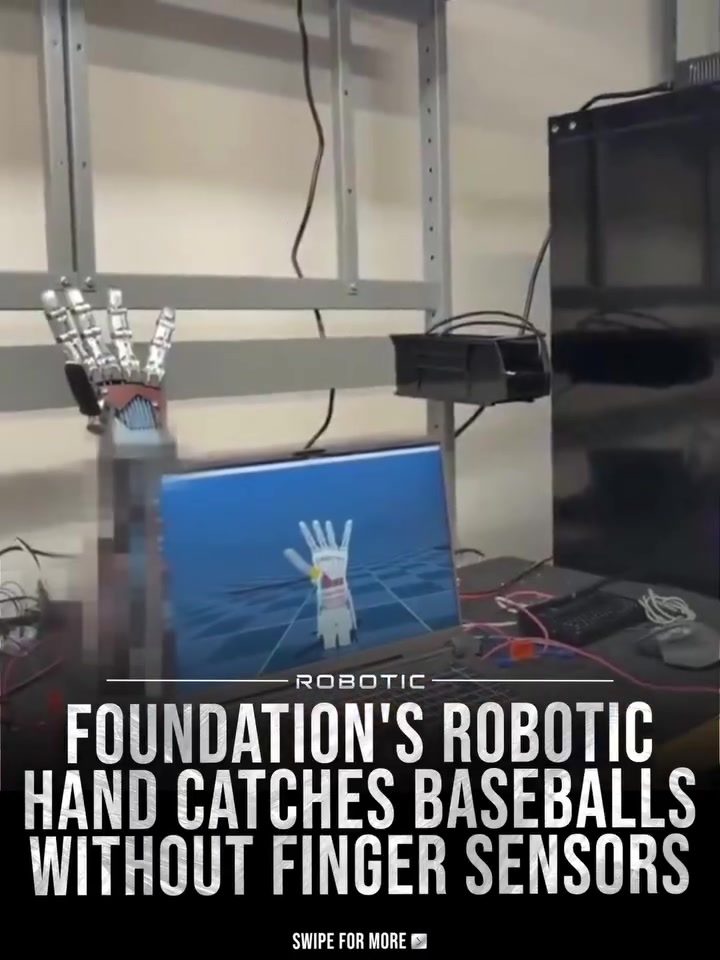
Robotic Hands Catching Baseballs
Robotic hands equipped with advanced control algorithms can catch fast-moving baseballs without relying on traditional tactile or joint sensors. This innovation, showcased by Foundation Robotic, highlights the potential of predictive control mechanisms in robotics. Here is a deeper dive into how this technology works and why it matters.
Context / Why This Matters
The ability of robotic hands to catch baseballs represents a significant advancement in robotic manipulation. By eliminating the need for finger sensors, Foundation Robotic achieves a simplified hardware design that is both efficient and effective. This breakthrough could revolutionize industrial automation, where precise and fast movements are crucial.
Predictive Control and Simplified Hardware
The Mechanics of the Robotic Hand
The tendon-driven robotic hand developed by Foundation Robotic uses a unique approach to catch baseballs. Instead of relying on tactile feedback from sensors in the fingers, the hand estimates finger positions based on motor angles and tendon geometry. This estimation allows the hand to predict the trajectory of the incoming ball and adjust its movements accordingly.
Predictive Control Algorithms
The key to this technology is the predictive control algorithm. This algorithm uses real-time data to forecast the movement of the baseball and the corresponding movements of the robotic hand. By combining precise timing with predictive control, the hand can repeatedly catch fast-moving baseballs with high accuracy.
The Role of Software in Robotic Manipulation
Advances in Robotics Software
The success of this robotic hand is heavily reliant on the advancements in robotics software and control algorithms. These algorithms enable the hand to perform complex tasks with a simplified hardware design, reducing the need for intricate sensors and mechanical components. This reduction in hardware complexity not only makes the device more cost-effective but also more reliable.
Simplified Hardware Design
By using a simplified hardware design, Foundation Robotic demonstrates how advancements in software can compensate for the need for complex mechanical structures. The tendon-driven mechanism, combined with predictive control, allows the hand to achieve the same level of precision and speed as more traditional robotic hands.
Industrial and Real-World Applications
Industrial Automation
In industrial settings, robotic hands are often used for tasks that require high precision and speed. The ability to catch fast-moving objects, such as baseballs, suggests that this technology could be applied to various industrial applications. For instance, assembly lines could benefit from robotic arms that can handle delicate components with the same level of precision.
Real-World Scenarios
Beyond industrial settings, this technology has the potential to be used in real-world scenarios. For example, search and rescue operations could benefit from robotic hands that can retrieve items from difficult-to-reach places. The predictive control algorithm would allow the robotic arms to adapt to changing conditions and make precise movements.
Practical Tips
Timing and Throwing Techniques
For those interested in replicating or understanding the process, timing is crucial. The robotic hand must be thrown right and timed perfectly to catch the baseball. This requires not only a precise throwing motion but also an accurate prediction of the ball's trajectory.
Software and Hardware Integration
Integrating advanced software with a simplified hardware design is key to achieving the desired results. Roboticists and engineers should focus on developing predictive control algorithms that can work seamlessly with tendon-driven mechanisms.
Important Takeaways
The success of the Foundation Robotic hand in catching baseballs demonstrates several important points:
- Predictive Control Algorithms: These algorithms are crucial for achieving precise movements in robotic manipulation.
- Simplified Hardware Design: Advances in software can reduce the complexity of hardware, making robotic systems more efficient and cost-effective.
- Industrial and Real-World Applications: This technology has the potential to revolutionize various industries and real-world scenarios.
Conclusion
The ability of robotic hands to catch baseballs without traditional finger sensors represents a significant leap forward in robotic manipulation. Foundation Robotic's tendon-driven hand, combined with predictive control algorithms, showcases the potential of merging advanced software with simplified hardware. This breakthrough could pave the way for more capable and versatile robotic hands in both industrial and real-world applications. As technology continues to advance, the future of robotics looks increasingly promising, with more innovative solutions on the horizon.
Watch the Reel
Questions readers ask
How does Foundation Robotics' sensorless robotic hand catch fast-moving baseballs?
Foundation Robotics' sensorless robotic hand uses predictive control algorithms to anticipate and react to the trajectory of fast-moving baseballs. This allows the hand to position itself accurately without the need for traditional tactile or joint sensors, making the process both efficient and precise.
What are the benefits of using predictive control algorithms in robotics?
Predictive control algorithms enable robots to forecast and respond to movements, like those in a baseball's trajectory, more accurately and quickly. This reduces the reliance on sensors, simplifies hardware, and enhances the efficiency and speed of robotic manipulation. It is a significant advancement for industries needing precise robotic movements.
What makes robotic manipulation without sensors significant in industrial automation?
Traditional robotic sensors can be complex, requiring calibration and maintenance, and adding to the overall cost. Removing the need for these sensors simplifies the design and makes the robot more affordable, and more reliable, which is crucial for applications where precise and fast movements are vital.
How does Foundation Robotics' innovation differ from traditional robotic control systems?
Foundation Robotics' innovation differs by using predictive control algorithms to determine the hand's movements, rather than relying on feedback from sensors. This approach simplifies the hardware design and makes it more efficient and effective for catching fast-moving objects like baseballs.
Could this technology be used in other applications beyond catching baseballs?
Yes, the technology has the potential to be applied to various fields where precise and fast movements are required, such as in manufacturing, assembly lines, and even in high-speed packaging. The ability to manipulate objects accurately without sensors can significantly enhance robotic performance in these areas.
What are the main components of the sensorless robotic hand by Foundation Robotics?
The main components include the robotic hand itself, which is designed to mimic human hand movements, and the predictive control algorithms that drive these movements. The algorithms are crucial as they enable the hand to anticipate and respond to fast-moving objects without the need for traditional sensors.
How does this advancement compare to other robotic innovations in the field of catching fast-moving objects?
This advancement stands out due to its use of predictive control algorithms and the elimination of traditional sensors, which makes it more efficient and simpler in design. While other innovations might rely on complex sensor arrays, Foundation Robotics' approach simplifies the process, making it a notable breakthrough in the field of robotic manipulation.
Related deep dives
Similar reads based on topic and creator.



Recent articles
Fresh deep dives from the latest Reels we unpacked.




Comments
Be the first to comment.