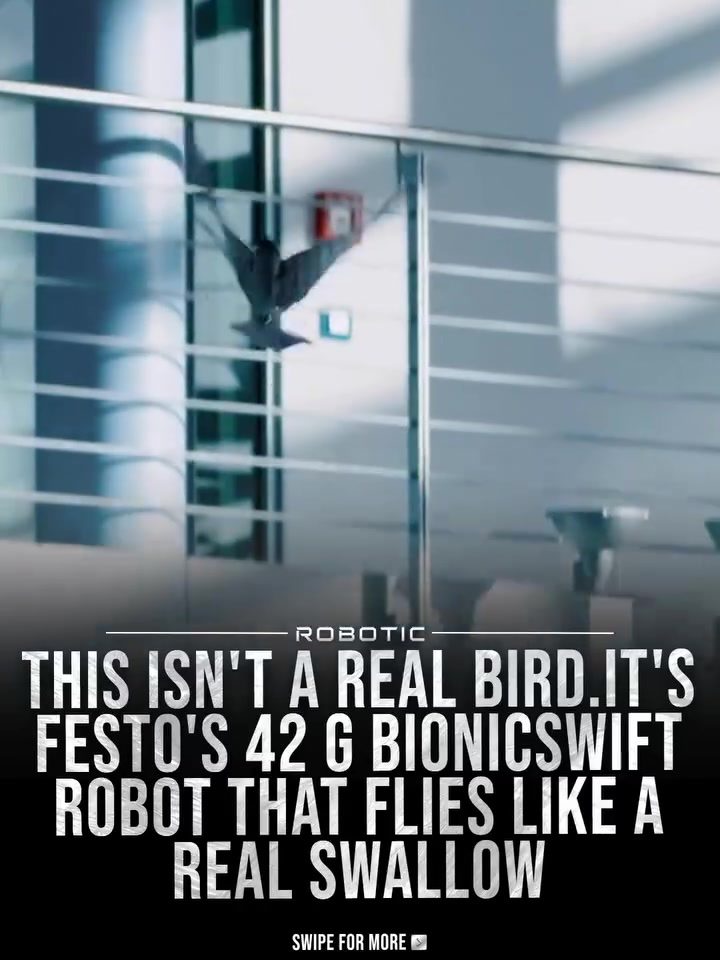
Festo's BionicSwift: A Robotic Bird That Mimics the Flight of a Swift
The Festo BionicSwift is a remarkable robotic bird designed to mimic the flight patterns of a real swift with remarkable precision. This innovative creation, weighing just 42 grams and featuring a 68 cm wingspan, closely replicates the size and agility of its biological inspiration. The BionicSwift's wings are constructed from ultralight foam feathers mounted on carbon rods, enabling them to mimic the complex wing movements of a real bird. This design allows the wings to fan open on the upstroke and close on the downstroke, generating efficient lift and mimicking the flight of a real swift seamlessly. This material and engineering allows for a sophisticated robotic bird capable of complex flight maneuvers.
Context / Why This Matters
Biomimicry, the practice of designing technologies inspired by nature, has long been a source of innovation. Robotic birds, such as the Festo BionicSwift, exemplify how studying and replicating natural phenomena can lead to groundbreaking engineering advancements. These devices not only showcase the potential of autonomous aerial systems but also open new avenues in robotics, aerospace, and environmental monitoring. The BionicSwift specifically demonstrates how bio-inspired robotics can push the boundaries of what's possible in aerodynamics and autonomous flight.
Main Discussion
Design and Aerodynamics
The BionicSwift's design is a testament to the intricate engineering that goes into creating a device that can mimic the natural flight of a bird. The lightweight foam feathers and carbon rods not only make the robot agile but also enable it to perform complex maneuvers. This design mimics the efficient lift generated by real birds, allowing the BionicSwift to navigate through spaces with precision and grace.
Flight Mechanics
One of the most impressive features of the BionicSwift is its ability to fly autonomously and safely with other robotic birds. Using an ultra-wideband indoor positioning system, up to five BionicSwifts can fly together, continuously tracking each other's positions. This system enables coordinated formation flying, sharp maneuvers, and collision avoidance without the need for human intervention. The efficiency and coordination of these robots highlight their potential for future applications in autonomous aerial systems.
Applications and Future Possibilities
The BionicSwift's capabilities extend beyond mere demonstration. Its autonomous flight features and collision avoidance make it a promising candidate for various applications. For example, in environmental monitoring, these robots could be used to observe wildlife or gather data in hard-to-reach areas. In urban settings, they could assist in surveillance or even package delivery. The potential for future developments in this field is vast, and the BionicSwift serves as a powerful example of what bio-inspired robotics can achieve.
The Role of Biomimicry in Robotics
The BionicSwift is a prime example of how biomimicry can drive innovation in robotics. By studying the natural flight patterns of birds, engineers have been able to develop a robotic system that not only mimics these patterns but also improves upon them. This approach allows for the creation of more efficient, agile, and reliable robots that can perform tasks in ways that traditional robotic systems cannot.
Practical Tips
If you're interested in exploring the field of bio-inspired robotics, there are several practical steps you can take:
- Study Natural Flight Patterns: Understand how birds and insects move through the air. This knowledge forms the basis for designing efficient robotic flight systems.
- Experiment with Materials: Explore different materials for constructing your robot's wings and body. Lightweight and durable materials are key to achieving the desired agility and efficiency.
- Develop Autonomous Systems: Work on developing systems that allow your robots to fly autonomously. This includes sensors, positioning systems, and algorithms for collision avoidance.
- Collaborate and Learn: Engage with the robotics community, attend conferences, and participate in workshops. Collaboration and continuous learning are essential for advancing in this field.
Practical Tips for Aspiring Roboticists
- Start Small: Begin with simple projects to understand the basics of robotics. This can include building small drones or simple robotic arms.
- Use Available Tools: Utilize open-source software and hardware to get started. There are many resources available online that can help you build and experiment with your own robots.
- Iterate and Improve: Robotics is a field of continuous improvement. Don't be discouraged by failures; instead, use them as learning opportunities to iterate and improve your designs.
Important Takeaways
The BionicSwift is a groundbreaking example of how biomimicry can be applied to robotics. Its ability to mimic the flight of a real bird, combined with its autonomous flight capabilities, demonstrates the potential of bio-inspired robotics. This technology has far-reaching applications, from environmental monitoring to urban surveillance, and represents a significant step forward in the field of robotics.
Conclusion
The Festo BionicSwift showcases an exciting future for autonomous aerial systems. By studying and replicating the natural flight patterns of birds, engineers have developed a robotic bird that is not only efficient but also capable of precise and coordinated flight. As technology continues to advance, the possibilities for bio-inspired robotics are endless, and the BionicSwift stands as a testament to what can be achieved through innovation and biomimicry.
Watch the Reel
Questions readers ask
What is the Festo BionicSwift and what makes it unique?
The Festo BionicSwift is a robotic bird developed by Festo, designed to replicate the flight of a real swift. Its uniqueness lies in its design, which includes a 68 cm wingspan and ultralight foam feathers, allowing it to mimic the agility and efficiency of a real swift's flight.
How does the BionicSwift's wing design contribute to its flight capabilities?
The BionicSwift's wings are made from ultralight foam feathers on carbon rods, enabling them to fan open on the upstroke and close on the downstroke. This design mimics the complex wing movements of a real swift, generating efficient lift and allowing for complex flight maneuvers.
What is the significance of the BionicSwift's weight and size?
The BionicSwift weighs only 42 grams and has a 68 cm wingspan, closely matching the size and agility of a real swift. This makes it one of the most lightweight and agile robotic birds, enhancing its ability to mimic the flight of a real swift.
What technological advancements does the BionicSwift showcase?
The BionicSwift demonstrates significant advancements in autonomous flight and biomimicry. Its design and capabilities represent a sophisticated blend of materials and engineering, pushing the boundaries of what robotic birds can achieve.
How does the BionicSwift's flight mimic that of a real swift?
The BionicSwift's flight mimics that of a real swift through its wing design and movements. The wings' ability to fan open and close, along with the overall design, allows it to execute the same flight techniques, such as efficient lift and complex maneuvers, as a real swift.
What materials are used in the construction of the BionicSwift?
The BionicSwift is constructed using ultralight foam feathers mounted on carbon rods. These materials contribute to its light weight and agility, enabling it to perform intricate flight maneuvers similar to a real swift.
Related deep dives
Similar reads based on topic and creator.



Recent articles
Fresh deep dives from the latest Reels we unpacked.




Comments
Be the first to comment.