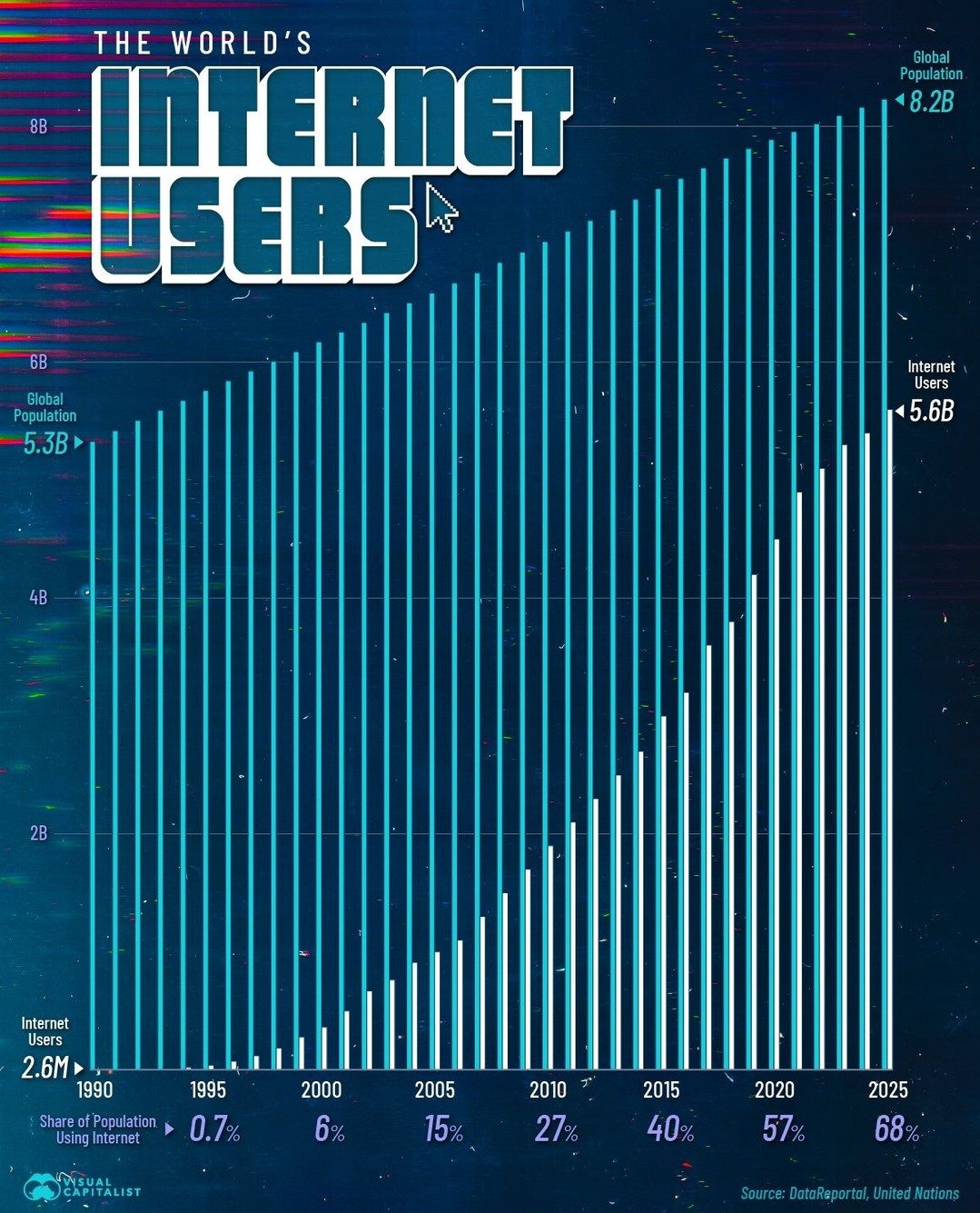
Internet User Growth
By 2025, nearly 5.6 billion people will be online, accounting for 68% of the global population. This exponential growth, largely driven by the adoption of smartphones, represents a significant shift from 1991 when only 0.1% of the world's population had internet access. To understand this transformation, let's delve into the data and visualize the growth of internet users from 1990 to 2025.
Context / Why This Matters
The internet has become an integral part of modern life, influencing everything from communication and entertainment to education and commerce. Understanding the growth of internet users is crucial for businesses, governments, and individuals alike. It helps in shaping policies, developing infrastructure, and creating opportunities that cater to an increasingly connected world.
Main Discussion
The Rise of the Internet
The journey of the internet from a niche technology to a global phenomenon is nothing short of remarkable. In 1990, only 2.6 million people were online, representing a mere 0.7% of the global population. However, this number quickly grew, reaching 6% by 2000. By 2010, the percentage had increased to 27%, and by 2020, it had surged to 57%. This trend is expected to continue, with 68% of the global population using the internet by 2025. This represents 5.6 billion users out of a global population of 8.2 billion.
The Role of Smartphones
The adoption of smartphones has been a key driver of this growth. Smartphones have made the internet more accessible, allowing people in remote and underserved areas to connect. They have also made the internet more affordable, with a wide range of devices and data plans available to suit different budgets. As a result, the percentage of the global population using the internet has increased dramatically over the past few decades.
Global Internet Usage
The growth of internet users varies significantly across different regions of the world. While countries in North America and Europe have high internet penetration rates, many developing countries still lag behind. The data shows that by 2025, the percentage of the global population using the internet will be highest in developed countries, with rates exceeding 90% in some cases. In contrast, developing countries may still have significant portions of their populations offline.
Future Trends
Looking ahead, the trend of increasing internet penetration is expected to continue. However, the rate of growth may slow down as the number of people without internet access decreases. Despite this, there are still significant challenges to overcome, such as the digital divide and increasing internet costs. Additionally, the future of the internet will likely be shaped by advancements in technology, such as 5G networks and the Internet of Things (IoT).
Practical Tips
For Businesses
- Understand Your Audience: With the majority of the global population online, businesses need to have a strong online presence. This includes having a website and being active on social media platforms.
- Localize Your Content: Different regions have different levels of internet access and usage. Localizing your content can help you reach a broader audience.
- Invest in Mobile Optimization: With the majority of internet users accessing the internet via smartphones, it's crucial to ensure your website and content are mobile-friendly.
For Individuals
- Stay Connected: The internet offers a wealth of information and opportunities. Whether it's for work, education, or entertainment, staying connected can open up new possibilities.
- Be Mindful of Online Security: As the number of internet users grows, so does the risk of online threats. Make sure to use strong passwords, keep your software up to date, and be cautious about sharing personal information online.
Important Takeaways
The growth of internet users from 1990 to 2025 is a testament to the transformative power of technology. Smartphones have played a pivotal role in this growth, making the internet more accessible and affordable. However, there are still challenges to overcome, such as the digital divide and increasing internet costs. As we look to the future, it's clear that the internet will continue to shape our world in profound ways.
Conclusion
The exponential growth of internet users from 1990 to 2025 has been driven by a combination of factors, including technological advancements and the widespread adoption of smartphones. This growth has had a profound impact on society, changing the way we communicate, work, and access information. As we look to the future, it's clear that the internet will continue to play a central role in our lives, shaping the way we interact with the world around us.
Watch the Reel
Questions readers ask
How many internet users were there in 1990?
In 1990, the number of internet users was extremely low, with only about 3 million users worldwide, representing a mere 0.1% of the global population.
What is the projected percentage of global internet penetration by 2025?
By 2025, it is projected that 68% of the global population will have internet access, which equates to nearly 5.6 billion users worldwide.
What role have smartphones played in the growth of internet users?
Smartphones have been a major driver in the exponential growth of internet users. They have made internet access more affordable and convenient, enabling people in even remote areas to connect online.
How has the growth of internet users impacted global communication?
The surge in internet users has revolutionized global communication by enabling instant messaging, social media, and video calls, making it easier for people to connect across borders and cultures.
Why is understanding internet user growth important for businesses and governments?
Understanding the growth of internet users is vital for businesses and governments as it helps them make informed decisions about infrastructure development, policy-making, and creating opportunities that cater to the digital population.
What is the significance of the exponential growth in internet users from 1990 to 2025?
The exponential growth in internet users reflects a significant shift in how the world communicates, accesses information, and conducts business. It highlights the increasing relevance of the internet in daily life and its impact on global society.
Related deep dives
Similar reads based on topic and creator.


Recent articles
Fresh deep dives from the latest Reels we unpacked.




Comments
Be the first to comment.