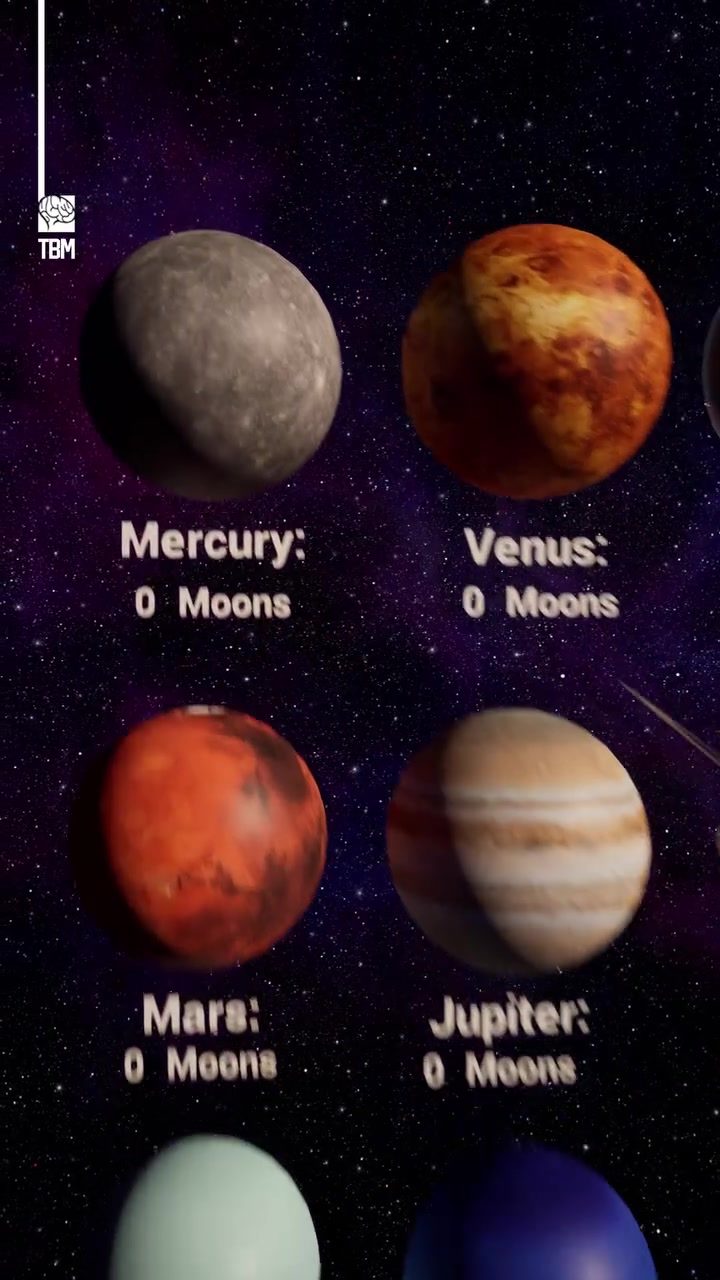
How Many Moons Does Each Planet Have?
The Solar System is a fascinating place, filled with planets and moons that orbit around the Sun. One of the most intriguing aspects of our Solar System is the variety in the number of moons that orbit each planet. This information can provide insights into the formation, composition, and dynamics of the planets. Let’s explore the moons of each planet in our Solar System.
Why This Matters
Understanding the number of moons each planet has is crucial for several reasons. It helps astronomers study the gravitational forces at play, the history of planetary collisions, and the potential for habitable environments beyond Earth. Additionally, the moons of the outer planets, such as Jupiter and Saturn, are often studied for their unique geological features and potential for hosting life.
Inner Planets
The inner planets – Mercury, Venus, Earth, and Mars – are relatively close to the Sun and have fewer moons compared to the outer planets.
Mercury
Mercury, the closest planet to the Sun, has 0 moons. Its proximity to the Sun and the strong gravitational forces make it difficult for any celestial bodies to remain in stable orbits around it.
Venus
Venus, the second planet from the Sun, also has 0 moons. Like Mercury, Venus' proximity to the Sun and its dense atmosphere contribute to the lack of moons. The harsh conditions on Venus, including extreme temperatures and atmospheric pressure, make it inhospitable for any moons to form or stay in orbit.
Earth
Earth, our home planet, has 1 moon. The Moon is the only natural satellite of Earth and plays a significant role in stabilizing the Earth's axial tilt, which contributes to the planet's climate stability. The Moon's influence on Earth's tides is also well-documented.
Mars
Mars, the fourth planet from the Sun, has 2 moons: Phobos and Deimos. These moons are relatively small compared to Earth's Moon and are believed to be captured asteroids. Phobos is the larger of the two and is notable for its close orbit to Mars, which causes it to slowly spiral inwards due to tidal forces.
Outer Planets
The outer planets – Jupiter, Saturn, Uranus, and Neptune – are gas giants and ice giants, respectively, and have a significantly higher number of moons.
Jupiter
Jupiter, the largest planet in our Solar System, has 95 moons. This includes the four Galilean moons—Io, Europa, Ganymede, and Callisto—which are among the largest moons in the Solar System. Jupiter's massive gravitational pull allows it to capture and retain a large number of moons.
Saturn
Saturn, known for its stunning ring system, has 274 moons. This massive number of moons makes Saturn the planet with the most known moons in the Solar System. Saturn's moons come in a variety of sizes and compositions, with some, like Titan, being larger than the planet Mercury.
Uranus
Uranus, an ice giant, has 16 moons. The most well-known moons of Uranus are Miranda, Ariel, Umbriel, Titania, and Oberon. These moons are named after characters from the works of William Shakespeare and Alexander Pope.
Neptune
Neptune, another ice giant, also has 16 moons. Neptune's largest moon, Triton, is particularly noteworthy for its retrograde orbit, which means it orbits in the opposite direction to Neptune's rotation. Triton is also one of the coldest places in the Solar System.
Dwarf Planet
Pluto
Pluto, a dwarf planet in the Kuiper Belt, has 5 moons. The largest of these, Charon, is so massive that the Pluto-Charon system is often considered a binary system rather than a planet and its moon. The other moons of Pluto are Nix, Hydra, Kerberos, and Styx, which are much smaller compared to Charon.
Practical Tips
If you're interested in observing the moons of the planets, there are a few practical tips to keep in mind:
- Use a Telescope: For a closer look at the moons of Jupiter and Saturn, a good telescope is essential. Even a small telescope can reveal the moons of Jupiter.
- Choose Clear Nights: Clear skies are crucial for stargazing. Avoid nights with cloud cover or smog.
- Use Star Charts: Star charts and astronomy apps can help you locate the planets and their moons in the night sky.
- Patience: Observing the moons of the planets requires patience and a steady hand. It may take some practice to discern the moons from background stars.
Important Takeaways
The variety in the number of moons each planet has is a testament to the diversity and complexity of our Solar System. From the inner planets with few or no moons to the outer planets with vast moon systems, each planet's moons offer unique insights into the dynamics of our Solar System. Whether you're an amateur astronomer or a seasoned stargazer, observing the moons of the planets can be a rewarding and enlightening experience. By understanding the moons of each planet, we gain deeper insights into the formation and evolution of our Solar System and the potential for life beyond Earth.
Conclusion
The moons of the planets in our Solar System are not just fascinating celestial bodies but also crucial components that contribute to the stability and dynamics of their respective planets. From the lone Moon of Earth to the vast moon systems of Jupiter and Saturn, each planet's moons tell a story of gravitational forces, planetary collisions, and the potential for habitable environments. Whether you're observing them through a telescope or studying them through scientific research, the moons of the planets offer a wealth of knowledge and wonder.
Watch the Reel
Questions readers ask
How many moons does Earth have, and what is its significance?
Earth has one moon, which is quite large compared to the planet itself. This large satellite is responsible for Earth's tides and stabilizes Earth's axial tilt, contributing to a relatively stable climate.
Why do Mercury and Venus lack moons?
Mercury and Venus do not have any moons due to their proximity to the Sun. The Sun's strong gravitational pull makes it difficult for these planets to retain moons.
What are the unique features of Mars' moons?
Mars has two small moons, Phobos and Deimos. These moons are irregularly shaped and are likely asteroids captured by Mars' gravitational pull. Phobos is the larger of the two, and it orbits so close to Mars that it is slowly spiraling inward.
Does the number of moons around a planet reveal anything about its formation?
Yes, the number of moons around a planet can provide insights into its formation. For instance, the moons of the gas giants, such as Jupiter and Saturn, are thought to have formed from the same materials that formed the planets themselves.
How many moons does Uranus have, and what are their names?
Uranus has at least 27 known moons, and they are named after characters from the works of William Shakespeare and Alexander Pope. The five largest moons are Miranda, Ariel, Umbriel, Titania, and Oberon.
What is the total number of moons in our solar system?
As of recent discoveries, there are over 200 known moons in our solar system. The exact number is always changing as new moons are discovered, particularly around the gas giants.
Related deep dives
Similar reads based on topic and creator.


Recent articles
Fresh deep dives from the latest Reels we unpacked.




Comments
Be the first to comment.