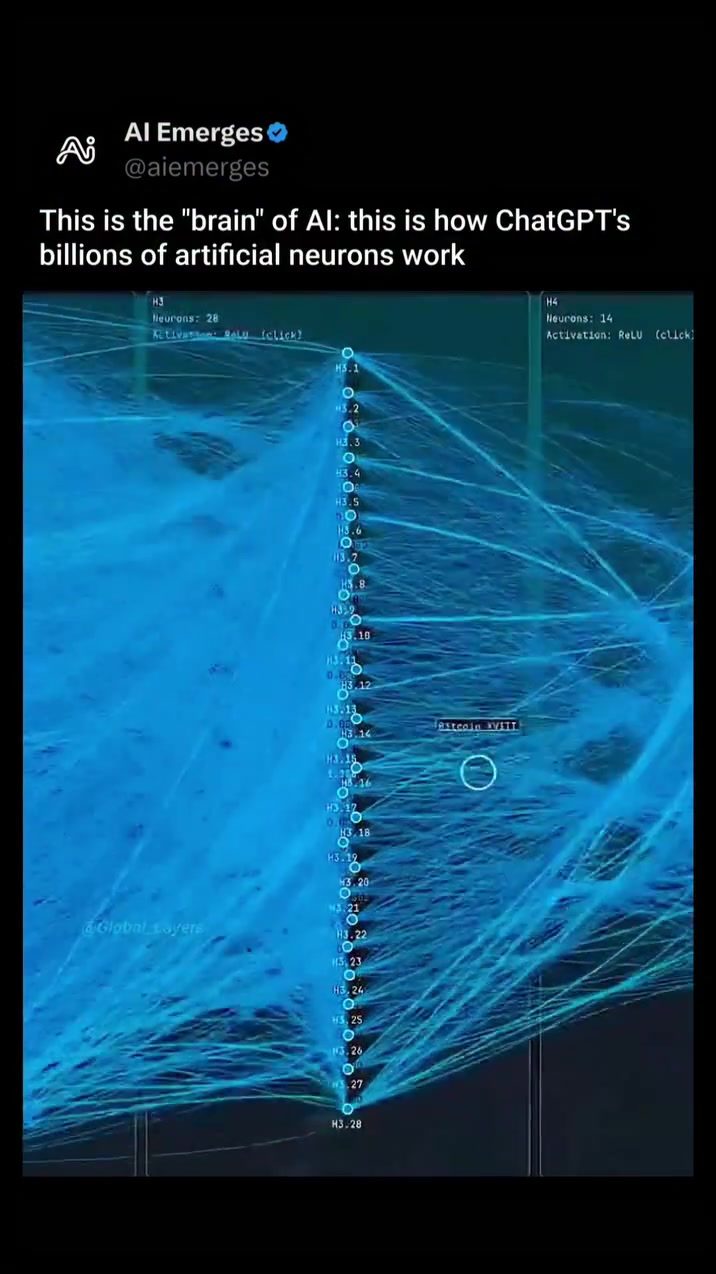
The Inner Workings of AI: A Visualization of Neural Networks
Neural networks are the bedrock of artificial intelligence (AI) systems, powering everything from language models like ChatGPT to complex decision-making algorithms. These networks are composed of billions, or even trillions, of mathematical connections known as artificial neurons, or perceptrons. Together, these neurons work across multiple layers to process information, recognize patterns, and generate responses. Unlike the human brain, AI doesn't think or understand in the same way. Instead, it learns by analyzing vast amounts of data and adjusting its connections during training. This process enables AI models to predict words, solve problems, and perform complex tasks with remarkable accuracy.
Why This Matters
Understanding the architecture of neural networks is crucial for grasping how AI works. These networks are often described as "black boxes" because, even though researchers understand how they are trained, they still cannot fully explain every internal decision these systems make. Visualizations, like the one created by Global Layers, offer a rare glimpse into the hidden architecture that powers modern artificial intelligence.
Main Discussion
What are Neural Networks?
Neural networks are designed to mimic the structure and function of the human brain. They consist of layers of interconnected nodes, or neurons, each representing a mathematical function. These neurons pass information to one another, with each connection having a specific weight that determines the influence of the input data.
Artificial Neurons and Layers
Artificial neurons, or perceptrons, are the building blocks of neural networks. Each neuron takes in inputs, processes them using an activation function, and passes the output to the next layer. The layers can be input layers, hidden layers, or output layers. The input layer receives the initial data, while the hidden layers perform the computations, and the output layer provides the final result.
Activation Functions
Activation functions are critical components of neural networks. They introduce non-linearity into the network, allowing it to learn complex patterns. Common activation functions include:
-
ReLU (Rectified Linear Unit): This function outputs the input directly if it is positive; otherwise, it outputs zero. ReLU is widely used because it helps mitigate the vanishing gradient problem, which can slow down the training process.
-
Sigmoid: The sigmoid function maps any real-valued number into a range between 0 and 1. It is often used in binary classification problems where the output needs to be interpreted as a probability.
Training Neural Networks
Training a neural network involves feeding it large amounts of data and adjusting the weights of the connections to minimize the error in the model's predictions. This process, known as backpropagation, involves calculating the gradient of the loss function with respect to each weight and updating the weights to reduce the error iteratively.
The Black Box Problem
Even with a clear understanding of how neural networks are trained, explaining the internal decisions they make remains challenging. This is because the network's complexity can lead to decisions that are difficult to interpret. Researchers continue to work on methods to make AI models more transparent and interpretable, but for now, the neural network remains a "black box" in many respects.
Applications of Neural Networks
Neural networks have a wide range of applications, from natural language processing to image recognition and even modeling complex systems like animal behavior. The simulation shown in the visualization includes parameters such as hunger, thirst, and health levels, demonstrating how neural networks can be used to model and predict behavioral patterns in animals.
Practical Tips
Understanding Neural Networks
To better understand neural networks, consider the following practical tips:
-
Start with Basics: Begin by familiarizing yourself with the basic concepts of neural networks, including neurons, layers, and activation functions.
-
Hands-On Practice: Use online platforms and tools to build and train your own neural networks. This hands-on experience will help you grasp the intricacies of these systems.
-
Explore Visualizations: Tools like TensorBoard can help you visualize the training process and understand how the network's performance evolves over time.
-
Read Research Papers: Stay updated with the latest research in neural networks by reading academic papers and attending conferences.
Using Neural Networks Effectively
To use neural networks effectively, keep these points in mind:
-
Data Quality: The quality of your data significantly impacts the performance of your neural network. Ensure that your dataset is clean, well-labeled, and representative of the problem you are trying to solve.
-
Model Selection: Choose the right type of neural network for your problem. For example, convolutional neural networks (CNNs) are particularly effective for image recognition tasks, while recurrent neural networks (RNNs) are better suited for sequential data.
-
Hyperparameter Tuning: Experiment with different hyperparameters, such as learning rate, batch size, and the number of layers, to optimize your model's performance.
-
Regularization Techniques: Use techniques like dropout and L2 regularization to prevent overfitting, where the model performs well on training data but poorly on new, unseen data.
Important Takeaways
Neural networks are powerful tools in the field of artificial intelligence, capable of performing complex tasks with high accuracy. Understanding their architecture, training methods, and applications can provide valuable insights into how AI systems work. By leveraging visualizations and practical tips, you can gain a deeper understanding of neural networks and utilize them effectively in various applications.
Conclusion
The visualization of neural networks provides a fascinating look into the inner workings of AI. From the interconnected nodes and activation functions to the complex simulations, these visualizations help demystify the technology behind AI systems. By delving into the structure and function of neural networks, we can appreciate the complexity and power of these systems, paving the way for future advancements in AI.
Watch the Reel
Questions readers ask
What are the basic building blocks of AI neural networks?
The basic building blocks of AI neural networks are artificial neurons, often called perceptrons. These are mathematical connections that process and transmit information throughout the network. They work together in layers to analyze data, recognize patterns, and generate responses.
How do neural networks process data and learn?
Neural networks process data by passing it through multiple layers of artificial neurons. Each neuron applies an activation function to the input data, generating an output that is passed to the next layer. During training, the network adjusts the connections between neurons to minimize errors in its predictions, learning to recognize patterns and make accurate decisions.
Why are neural networks often referred to as 'black boxes'?
Neural networks are often called 'black boxes' because their complexity makes it difficult to interpret how they arrive at their decisions. With potentially billions or trillions of connections, understanding the inner workings of a neural network can be challenging, even for experts in the field.
What is the significance of neural network visualization?
Neural network visualization helps to demystify these complex systems by providing a visual representation of their inner workings. By visualizing the architecture and activity of a neural network, researchers and developers can gain insights into how the network processes data, recognizes patterns, and makes decisions.
How do neural networks differ from the human brain?
While both neural networks and the human brain consist of interconnected units (neurons) and process information, they differ in their structure and functionality. The human brain is a biological system that thinks and understands, while AI neural networks are mathematical models that learn by analyzing data and adjusting their connections to generate accurate outputs.
What are activation functions and why are they important in neural networks?
Activation functions are mathematical functions applied to the output of a neuron to introduce non-linearity into the model. They help neural networks learn complex patterns and make accurate predictions. Common activation functions include ReLU, sigmoid, and tanh, each with unique properties that influence the network's behavior and performance.
What are the different layers in a neural network and what do they do?
Neural networks typically consist of an input layer, one or more hidden layers, and an output layer. The input layer receives the initial data, the hidden layers process and transform that data, and the output layer generates the final result. Each layer contains multiple neurons that work together to analyze and interpret the data as it passes through the network.
Related deep dives
Similar reads based on topic and creator.


Recent articles
Fresh deep dives from the latest Reels we unpacked.




Comments
Be the first to comment.