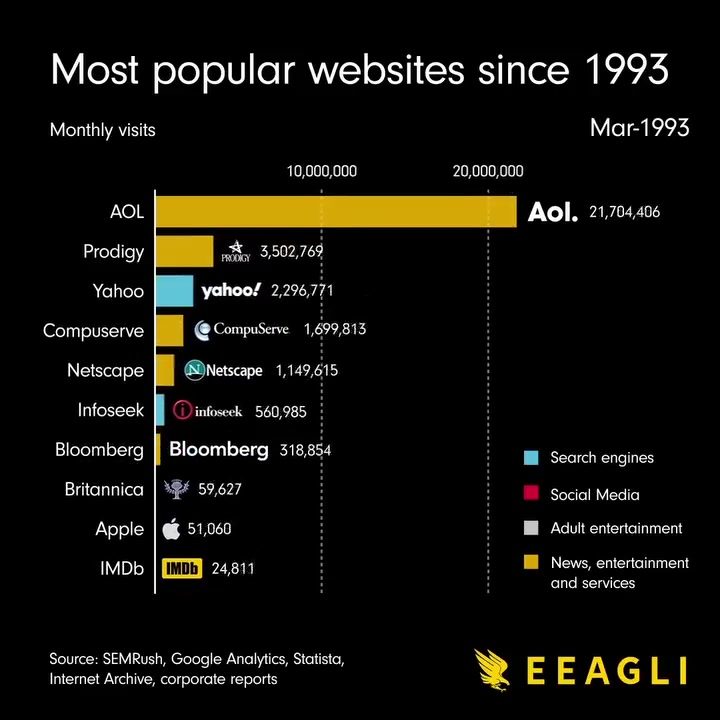
Website Popularity Over Time
The internet has seen a remarkable evolution over the past three decades, transforming from a niche platform with fewer than 200 websites in 1993 to a global phenomenon with over 2 billion websites by 2022. This growth is not just about the quantity of websites but also about the diversity and dominance of different categories over time. Let's explore the key shifts and trends in website popularity from 1993 to 2005, as visualized by a detailed data set.
Context / Why This Matters
Understanding the rise and fall of website popularity provides insights into changing user behaviors, technological advancements, and cultural shifts. This historical perspective helps in appreciating the current digital landscape and anticipating future trends. By examining the most popular websites from 1993 to 2005, we can see how different categories like search engines, social media, and entertainment sites have evolved and influenced the internet as we know it today.
Main Discussion
Early Days of the Internet (1993–1997)
In the early 1990s, the internet was a nascent platform dominated by a few major players. AOL (America Online) and Prodigy were at the forefront, offering dial-up services that provided email, chat rooms, and early forms of online content. These services were gateways to the World Wide Web for many users. CompuServe and Netscape also played significant roles, providing browser technologies and online services that laid the groundwork for the internet's growth. Search engines like Yahoo and Lycos began to emerge, making it easier for users to navigate the expanding web.
Key websites in 1993:
- AOL
- Prodigy
- CompuServe
- Yahoo
- Infoseek
- Netscape
By 1997, the landscape had slightly shifted with the introduction of GeoCities and Excite, which offered users the ability to create their own web pages and search for information more efficiently. However, AOL and Yahoo remained dominant, reflecting the importance of comprehensive online services and search capabilities.
Key websites in 1997:
- AOL
- Yahoo
- GeoCities
- MSN
- Excite
- Lycos
- Netscape
- Prodigy
- Infoseek
The Rise of E-commerce and Media (1998–2001)
The late 1990s and early 2000s saw the rise of e-commerce and media websites. Amazon and eBay became household names, revolutionizing online shopping. BBC and CNN established themselves as major news providers, and CNET became a go-to source for technology news and reviews. Social media platforms were still in their infancy, but websites like About.com began to offer community-driven content.
Key websites in 2001:
- Yahoo
- AOL
- MSN
- eBay
- BBC
- Lycos
- About.com
- Amazon
- CNET
The Era of Google and Social Media (2002–2005)
By the mid-2000s, Google had firmly established itself as the dominant search engine, effectively displacing earlier players like Yahoo and MSN. Amazon continued to grow, solidifying its position as a leading e-commerce platform. Myspace, one of the earliest social media platforms, began to gain traction, hinting at the future dominance of social networks. Meanwhile, Walmart and other major retailers started to establish a significant online presence, reflecting the growing importance of e-commerce.
Key websites in 2005:
- Yahoo
- MSN
- AOL
- eBay
- Amazon
- BBC
- Myspace
Data Sources and Methodology
The data presented in this analysis is sourced from authoritative platforms like SEMRush, Google Analytics, Statista, and Internet Archive, as well as corporate reports. These sources provide a comprehensive view of web traffic and user behavior, ensuring the accuracy and reliability of the information.
Practical Tips
For those interested in understanding website popularity and trends, here are some practical tips:
-
Analyze Traffic Patterns: Use tools like Google Analytics to track monthly visits and user behavior on your website. This can help you understand what content resonates with your audience.
-
Stay Updated with Trends: Keep an eye on emerging technologies and platforms. For example, the rise of social media in the mid-2000s was a game-changer, and similar shifts are likely to occur in the future.
-
Leverage SEO: Search engine optimization (SEO) is crucial for improving your website's visibility. Tools like SEMRush can help you identify keywords and optimize your content for better search engine rankings.
-
Explore Historical Data: Studying historical data can provide insights into how user behavior and preferences have evolved. This knowledge can be invaluable for forecasting future trends and adapting your online strategies.
Important Takeaways
-
The internet has evolved from a few dozen websites to over 2 billion, reflecting a massive growth in both quantity and diversity.
-
Early platforms like AOL and Yahoo were crucial in establishing the internet as a mainstream service. By the mid-2000s, Google and Amazon had become dominant players in their respective fields.
-
E-commerce and media platforms have significantly influenced user behavior and online content consumption.
-
The rise of social media platforms like Myspace marked the beginning of a new era in online interaction and content sharing.
Conclusion
The evolution of website popularity over the past three decades is a story of technological innovation, changing user behaviors, and the continuous adaptation of the internet to meet new demands. By analyzing the most popular websites from 1993 to 2005, we gain valuable insights into how the digital landscape has transformed and what trends may emerge in the future. This historical perspective not only enriches our understanding of the past but also guides us in navigating the ever-evolving world of the internet.
Watch the Reel
Questions readers ask
Which websites dominated the early internet era, from 1993 to the early 2000s?
The early internet era was significantly influenced by websites like AOL and Yahoo. AOL, known for its dial-up services, was a pioneer in providing internet access to the masses, while Yahoo emerged as a leading search engine and web directory, helping users navigate the growing web. Other notable early websites include Geocities and Excite, which offered platforms for personal web pages and search functionalities.
What were dial-up services and how did they shape early web traffic?
Dial-up services, such as those provided by AOL, were the primary means of accessing the internet in the mid-1990s. Users would connect to the internet using a modem over a telephone line, with connection speeds averaging around 56 Kbps. These services shaped early web traffic by introducing users to the concept of online communities, email, and web browsing, establishing the foundation for later technological advancements.
How did search engines evolve from 1993 to 2005?
Search engines evolved significantly from 1993 to 2005, transitioning from simple web directories to complex algorithms. Early search engines like Yahoo and Lycos started as manually curated lists, while Excite and AltaVista pioneered automated crawling and indexing. By 1998, Google revolutionized search with its PageRank algorithm, which prioritized results based on the relevance and authority of web pages.
What role did AOL play in the early development of the internet?
AOL played a pivotal role in the early development of the internet by offering user-friendly dial-up services that made the internet accessible to a broader audience. Through its proprietary software, AOL provided users with email, chat rooms, and an easy-to-navigate interface. By offering a comprehensive package of online services, AOL set the standard for internet service providers and fostered the growth of early online communities.
Which websites were significant contributors to the evolution of web browsing?
Several websites significantly contributed to the evolution of web browsing. Netscape, with its innovative web browser, provided an easy-to-use interface for accessing the web. Geocities offered a platform for users to create personal web pages and share content online. Additionally, Yahoo’s directory and search capabilities played a crucial role in helping users find and navigate the vast expanse of the internet.
How did the popularity of different website categories change from 1993 to 2005?
From 1993 to 2005, the popularity of website categories saw a notable shift. Initially, online services and directories, such as AOL and Yahoo, were the most visited sites. Over time, the rise of search engines and personal web pages gained traction, with Geocities and other blogging platforms becoming popular. By the mid-2000s, social networking sites and e-commerce platforms began to emerge, marking a transition towards more interactive and transactional web experiences.
Related deep dives
Similar reads based on topic and creator.


Recent articles
Fresh deep dives from the latest Reels we unpacked.




Comments
Be the first to comment.