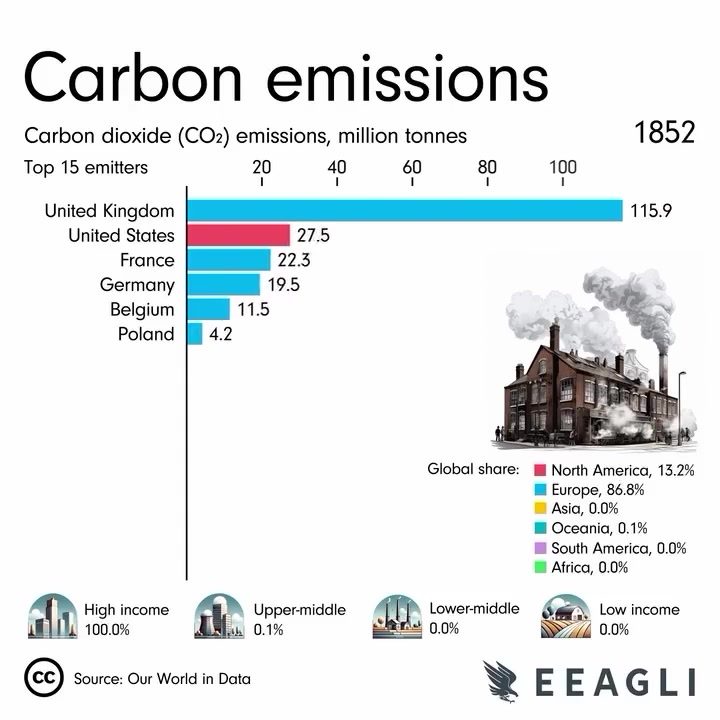
Carbon Emissions Over Time
Carbon emissions have been a significant global issue for centuries, with the largest economies contributing the most since the 19th century. Analyzing carbon dioxide (CO2) emissions from 1850 to 2022 reveals how the top 15 emitters have shifted over time. This data, sourced from Our World in Data, provides a clear picture of the global carbon landscape and the role of different countries and regions in contributing to CO2 emissions.
Context / Why this matters
Understanding this historical data is crucial for several reasons. It helps us recognize the long-term impact of industrialization, the varying contributions of different regions, and the necessity of targeted climate policies. By examining the data, we can better comprehend the scale of the challenge and the steps needed to mitigate it.
Main discussion
The Industrial Revolution Era
From 1850 to 1978, the United States and Germany consistently emerged as major contributors to global carbon emissions. The Industrial Revolution, which began in the late 18th century, marked a significant turning point in global emissions.
Early Contributors: The United Kingdom and France
The United Kingdom and France were among the earliest industrialized nations, contributing significantly to carbon emissions during the 19th century. The primary drivers were coal-powered factories and steam engines, which were central to the industrial activities of that era.
United States and Germany: Rising Emissions
As the 20th century progressed, the United States and Germany became the leading emitters. By 1935, their emissions had significantly outpaced other countries. This trend continued into the 1970s, highlighting the economic and industrial growth of these nations during the post-World War II era.
Global Share by Income Level
In the early 20th century, high-income countries accounted for 96.4% of global emissions. This shows the substantial role of developed nations in contributing to CO2 levels. The distribution of emissions by income level reveals that economic development was closely linked to carbon output.
Evolution of Emissions: 1851 to 1978
The period from 1851 to 1978 saw significant changes in global emissions. The top 15 emitters in 1851 primarily included European nations, reflecting the continent's dominance in industrialization at the time. By 1978, the United States had surged ahead, with countries like Germany, the United Kingdom, and Belgium remaining significant contributors.
Key Milestones
- 1851: European nations, particularly the United Kingdom, were the primary emitters. The Industrial Revolution had already taken hold in these countries, leading to high levels of CO2 emissions from coal-burning factories and steam engines.
- 1894: The United States began to emerge as a significant emitter, driven by its rapid industrial growth and urbanization.
- 1935: The United States and Germany were the top emitters, with both countries experiencing significant industrialization and economic expansion.
- 1978: The United States continued to be the highest emitter, reflecting its status as the world's leading industrial power. Other European countries, including Germany, also maintained high emission levels.
Regional Contributions
The global share of emissions by region also provides valuable insights. While North America and Europe accounted for 12.5% and 87.5% of emissions respectively, other regions like Asia, South America, and Africa had minimal contributions. This disparity highlights the uneven distribution of industrial development and economic activity.
North America and Europe: Major Contributors
North America and Europe were the primary contributors to global emissions. The data underscores the historical role of these regions in industrial development and economic growth. The high-income status of these regions also contributed to their significant carbon footprints.
Asia, South America, and Africa: Lower Emissions
Asia, South America, and Africa had minimal contributions to global emissions during this period. This reflects the lower levels of industrialization and economic activity in these regions. The data also highlights the need for targeted strategies to support sustainable development in these regions.
Practical tips
Understanding historical carbon emissions can guide current efforts to reduce CO2 levels. Here are some practical tips for individuals and governments:
Transition to Renewable Energy
One of the most effective ways to reduce carbon emissions is to transition from fossil fuels to renewable energy sources like solar, wind, and hydroelectric power. This shift can significantly lower CO2 emissions and promote sustainable development.
Energy Efficiency
Improving energy efficiency in homes, businesses, and industrial processes can also help reduce carbon emissions. This involves using energy-efficient appliances, buildings, and transportation systems. Policies that encourage energy conservation and efficiency can have a substantial impact on emissions.
Sustainable Industrial Practices
Industrial processes are significant contributors to CO2 emissions. Implementing sustainable industrial practices, such as using cleaner technologies and recycling materials, can help reduce the carbon footprint of industrial activities.
Support for Low-Emission Economy
Governments and businesses can support the transition to a low-emission economy by investing in green technologies and sustainable infrastructure. This includes funding research and development in clean energy, promoting green industries, and creating incentives for businesses to adopt sustainable practices.
Global Cooperation
Global cooperation is essential for effectively addressing carbon emissions. International agreements, such as the Paris Agreement, can help coordinate efforts to reduce CO2 levels. Countries need to work together to share best practices, provide financial and technical support to developing nations, and ensure that climate policies are implemented effectively.
Important takeaways
Historical data on carbon emissions provides valuable insights into the long-term impact of industrialization and economic development. Key takeaways include:
- Industrialized nations, particularly in Europe and North America, have been the primary contributors to global carbon emissions since the 19th century.
- The United States and Germany were significant emitters from the early 20th century onwards, driven by their rapid industrial growth and economic expansion.
- High-income countries accounted for the majority of global emissions, highlighting the link between economic development and carbon output.
- The global share of emissions by region shows a significant disparity, with North America and Europe being the major contributors, while other regions had minimal emissions.
Conclusion
Examining carbon emissions from 1850 to 2022 reveals the significant role of the largest economies in contributing to global CO2 levels. Understanding this historical data is crucial for developing effective strategies to mitigate carbon emissions and promote sustainable development. By transitioning to renewable energy, improving energy efficiency, adopting sustainable industrial practices, supporting a low-emission economy, and fostering global cooperation, we can create a more sustainable future. The data from this analysis serves as a foundation for informed decision-making and action in addressing the global challenge of carbon emissions.
Watch the Reel
Questions readers ask
Which countries were the top carbon emitters during the 19th century?
During the 19th century, the United Kingdom and France were among the top carbon emitters. This was primarily due to their early industrial activities and rapid economic growth, which led to significant increases in CO2 emissions.
How have the United States and Germany contributed to global carbon emissions?
The United States and Germany emerged as leading emitters post-Industrial Revolution. Their industrialization and economic growth significantly increased their carbon emissions, making them two of the top global carbon emitters over time.
What can we learn from the historical data on carbon emissions?
Historical data on carbon emissions helps identify the long-term impact of industrialization and the varying contributions of different regions. It provides insights into the necessity of targeted climate policies and the scale of the challenges we face today.
Who are the top 15 carbon emitters from 1850 to 2022?
The top 15 carbon emitters from 1850 to 2022 have varied over time, reflecting global industrialization and economic growth. Countries like the United States, Germany, the United Kingdom, and France have been prominent contributors, with shifts occurring as different regions industrialized.
How have global carbon emissions changed over the past century?
Global carbon emissions have seen significant changes over the past century. From 1850 to 2022, the top emitters have shifted, reflecting the industrialization and economic growth of different countries. For instance, early industrial activities in Europe led to high emissions, while later, the United States and other nations took the lead.
Related deep dives
Similar reads based on topic and creator.




Recent articles
Fresh deep dives from the latest Reels we unpacked.




Comments
Be the first to comment.