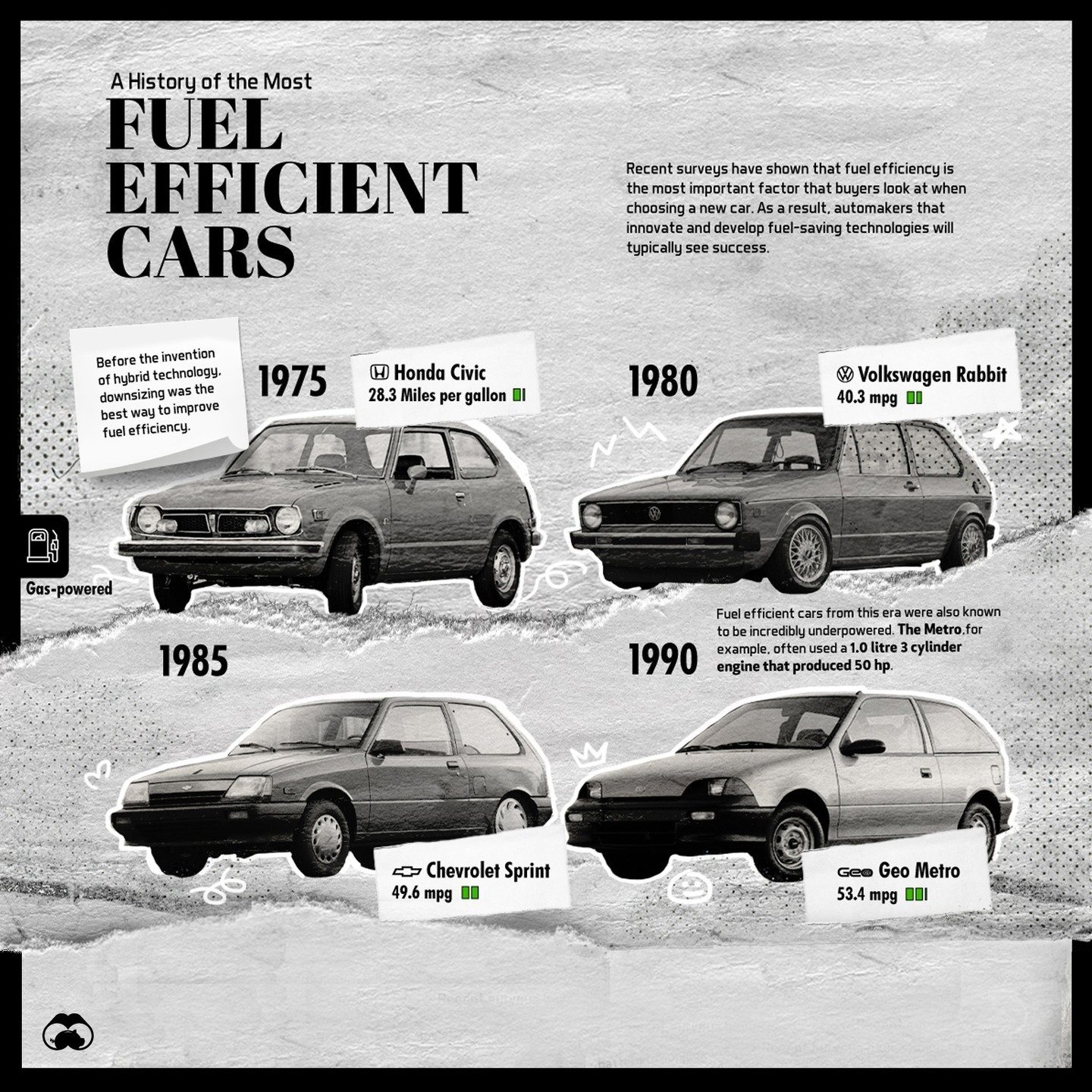
Fuel efficiency has become a crucial factor for car buyers. The evolution of fuel-efficient cars from 1975 to 2023 showcases the industry's shift from gas-powered vehicles to hybrids and electric cars. This journey is marked by significant milestones and technological advancements that have shaped the automotive landscape.
Context
Importance of Fuel Efficiency
Recent surveys have highlighted that fuel efficiency is the most important factor for car buyers when choosing a new vehicle. This trend has driven automakers to focus on developing fuel-saving technologies. The rise of fuel-efficient cars began in the 1970s, prompted by economic and environmental concerns, and has since evolved to include hybrid and electric vehicles.
Technological Advancements
The automotive industry has seen remarkable advancements in fuel efficiency. From the early days of gas-powered cars to the emergence of electric vehicles, technological progress has been rapid. These innovations have not only improved fuel efficiency but also reduced environmental impact, making cars more sustainable.
Main Discussion
The Early Days
1975–1985: The Gas-Powered Era
The journey of fuel-efficient cars began in the 1975 with the Honda Civic, which offered 28.3 miles per gallon (mpg). This was a significant improvement over previous models, setting a standard for future gasoline-powered cars. The Volkswagen Rabbit (1980) further enhanced fuel efficiency with 40.3 mpg. In 1985, the Chevrolet Sprint achieved 49.6 mpg, demonstrating steady progress in fuel efficiency.
1990-1995: Small Cars Rule
The 1990s saw the rise of compact cars. The Geo Metro (1990) reached 53.4 mpg, making it one of the most fuel-efficient gas-powered cars of the time. The Honda Civic (1995) maintained its reputation with 47.3 mpg, showcasing the brand's commitment to fuel efficiency.
The Hybrid Revolution
The turn of the millennium marked the beginning of the hybrid era, with the Honda Insight (2000) achieving 53-57 mpg. The Toyota Prius (2007-2009) further solidified the hybrid's place in the market with 46.2 mpg. These models laid the groundwork for future hybrid and electric vehicles, proving that fuel efficiency and performance could coexist.
The Rise of Electric Vehicles
The 2010s saw a significant shift towards electric vehicles (EVs). The BMW Active E (2011) achieved 100.6 miles per gallon equivalent (MPGe). The Mitsubishi i-MiEV (2012) and Toyota iQ (2013) continued to push the boundaries with 109.0 MPGe and 117.0 MPGe, respectively. The BMW i3 (2014-2016) and Hyundai Ioniq Electric (2016) further advanced with 121.3 MPGe and 132.6 MPGe.
The Modern Era
The modern era of electric vehicles has been dominated by models like the Tesla Model 3 (2020-2022) which achieved 139.1 MPGe. The Lucid Air (2023) further pushed the limits with 140.0 MPGe, showcasing the advancements and potential of electric vehicles.
Practical Tips
Choosing a Fuel-Efficient Vehicle
When shopping for a fuel-efficient car, consider the following tips:
- Assess Your Needs: Determine whether a hybrid or electric vehicle best suits your driving habits and lifestyle.
- Check Ratings: Look at the vehicle's miles per gallon (mpg) or miles per gallon equivalent (MPGe) ratings to understand its fuel efficiency.
- Consider the Future: Opt for models with advanced technologies and updates, as they are likely to remain efficient and relevant in the long run.
Maintaining Fuel Efficiency
Maintaining a fuel-efficient car involves regular upkeep to ensure optimal performance:
- Regular Maintenance: Keep up with oil changes, tire rotations, and other routine maintenance tasks.
- Efficient Driving: Adopt driving habits that conserve fuel, such as avoiding sudden acceleration and braking.
- Use Quality Fuel: High-quality fuel can improve engine performance and efficiency.
Important Takeaways
Fuel efficiency in cars has evolved significantly over the decades. Here are the key takeaways from the history of fuel-efficient cars:
- Early Milestones: The 1970s and 1980s saw significant progress in fuel efficiency with models like the Honda Civic and Volkswagen Rabbit.
- Hybrid Era: The early 2000s introduced hybrid vehicles, with models like the Honda Insight and Toyota Prius leading the way.
- Electric Revolution: The 2010s and beyond have been marked by the rise of electric vehicles, with models like the Tesla Model 3 and Lucid Air setting new benchmarks.
- Technological Advancements: Continuous innovation in fuel-saving technologies has driven the evolution of fuel-efficient cars.
- Consumer Demand: The increasing importance of fuel efficiency to consumers has pushed automakers to prioritize these technologies.
Conclusion
The history of fuel-efficient cars is a testament to technological progress and consumer demand. From the early days of gas-powered vehicles to the modern era of electric cars, the evolution of fuel efficiency has been remarkable. As we look to the future, the focus on sustainability and innovation will continue to drive advancements in the automotive industry, making cars more efficient and environmentally friendly. Whether you're shopping for a new car or looking to maintain your current vehicle, understanding the history and advancements in fuel efficiency can guide your decisions and help you make informed choices.
Watch the Reel
Questions readers ask
What were the most notable fuel-efficient cars in the 1970s and 1980s?
The 1970s saw the introduction of the Honda Civic in 1975, which was one of the most fuel-efficient cars of its time. The 1980s continued to focus on fuel efficiency, with models like the Honda Accord and the Toyota Corolla gaining popularity for their improved miles per gallon (MPG) ratings. During this period, car makers started to improve efficiency through engine size reduction, weight loss and aerodynamic design.
How did fuel-efficient cars evolve from the 1990s to the 2000s?
From 1990 to 2005, car efficiency improvements led to better fuel economy, with the introduction of more efficient gas-powered cars and the Toyota Prius, which was launched in 1997. This decade saw a shift towards smaller, lighter engines and the rise of hybrid technology. Automakers also began implementing more advanced transmission systems and improved aerodynamics to further boost fuel efficiency.
What advancements have been made in electric vehicles (EVs) from 2010 to 2023?
From 2010 to 2023, electric vehicle evolution accelerated rapidly. Major advancements include improved battery technology, longer driving ranges, and faster charging times. The Tesla Model S, launched in 2012, marked a significant milestone with its impressive range and performance. Increasingly, automakers have been introducing more affordable and diverse EV models, making electric cars more accessible to a broader range of consumers.
What are some of the best fuel-efficient cars in 2023?
In 2023, some of the best fuel-efficient cars include the Toyota Prius Prime, which offers excellent MPG ratings and hybrid technology, and the Tesla Model 3, which provides an all-electric option with a long driving range. Other notable models include the Honda Insight and the Hyundai Ioniq, both of which are known for their fuel-saving capabilities and sustainability efforts. These cars represent the pinnacle of current fuel efficiency trends and sustainable car technology.
What major milestones have been reached in car efficiency history from 1975 to 2023?
From 1975 to 2023, key milestones in car efficiency history include the introduction of the Honda Civic in 1975, the launch of the Toyota Prius in 1997, and the rise of Tesla in 2012. These developments have significantly shaped the automotive landscape, driving the industry from gas-powered vehicles to hybrids and electric cars. The evolution of fuel-efficient cars has been marked by continuous improvements in engine efficiency, hybrid technology, and electric vehicle advancements.
Related deep dives
Similar reads based on topic and creator.


Recent articles
Fresh deep dives from the latest Reels we unpacked.




Comments
Be the first to comment.