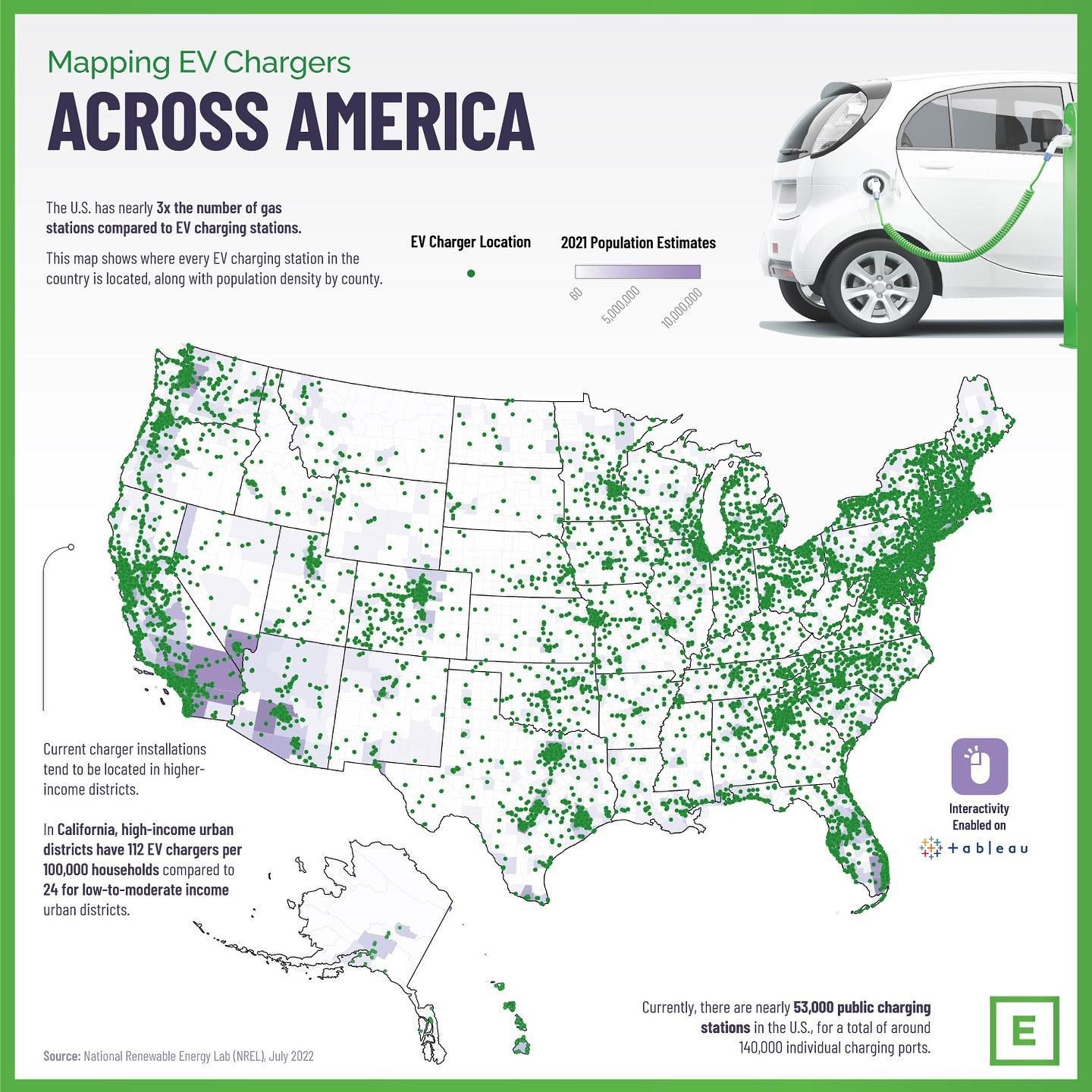
EV Charging Stations Across the U.S.
The rapid growth of the electric vehicle (EV) market has made the availability of charging stations a critical component of modern infrastructure. With nearly 140,000 public EV chargers spread across approximately 53,000 charging stations in the U.S., the need for more stations remains evident, especially when compared to the 145,000 gas fueling stations. This disparity underscores the significance of understanding the current distribution of EV chargers and the factors influencing their placement.
Why This Matters
As more drivers transition to electric vehicles, the convenience and accessibility of charging stations become increasingly important. Adequate charging infrastructure is essential to support longer driving ranges and minimize wait times at chargers. This is particularly crucial for long-distance travel, where the availability of charging stations can significantly impact the feasibility and convenience of EV use.
The current distribution of EV charging stations is not even, with higher concentrations in certain regions and lower numbers in others. This disparity can lead to range anxiety—the fear of running out of power before reaching a charging station. Understanding where charging stations are located and identifying areas with the highest demand can help policymakers and private-sector stakeholders make informed decisions about expanding the charging network.
Main Discussion
Current Distribution of EV Charging Stations
The United States has a significant number of EV charging stations, but they are not evenly distributed. California, known for its high income and urban districts, leads the charge with 112 EV chargers per 100,000 households. This high concentration is indicative of the state's commitment to promoting electric vehicle use, which includes both government initiatives and private-sector investments. Other states with dense populations and urban centers, such as New York and Florida, also have a higher density of EV charging stations.
Conversely, rural areas and less densely populated states often have fewer charging stations. This imbalance can be challenging for EV drivers in these regions, as they may need to plan their routes carefully to ensure they can recharge their vehicles.
Population Density and EV Charger Availability
Population density plays a significant role in determining the placement of EV charging stations. Highly populated areas tend to have more charging stations due to higher demand. The map overlaid with 2021 population estimates from the National Renewable Energy Lab (NREL) highlights this trend. Areas with higher population densities, such as major cities and metropolitan regions, generally have a greater concentration of charging stations.
This correlation between population density and EV charger availability makes sense from an infrastructure perspective. Higher population densities mean more potential EV users, which increases the demand for charging stations. However, it also means that rural areas, which have lower population densities, may be underserved in terms of charging infrastructure.
Data Sources and Visualization
The data used to map out EV charging stations across the U.S. comes from the National Renewable Energy Lab (NREL). This data is crucial for understanding the current landscape of EV charging infrastructure and identifying areas where additional stations are needed. The visualization, created using tools like Tableau, provides an interactive and informative way to explore the distribution of EV chargers.
The map not only shows the locations of EV charging stations but also overlays population density data. This visualization helps to identify areas with high demand for charging stations and areas where additional infrastructure may be beneficial. By understanding the relationship between population density and charger availability, stakeholders can make more informed decisions about where to invest in new charging stations.
Comparative Analysis with Gas Stations
The map also highlights the stark contrast between the number of EV charging stations and gas fueling stations in the U.S. With nearly three times as many gas stations as EV charging stations, it is clear that the transition to electric vehicles is still in its early stages. This disparity underscores the need for continued investment in EV charging infrastructure to support the growing number of electric vehicles on the road.
For example, California, which has one of the highest concentrations of EV chargers, still has a long way to go to match the number of gas stations. This comparative analysis is essential for understanding the scale of the challenge and the work needed to build a robust EV charging network.
Practical Tips
Planning a Road Trip with an EV
Long-distance travel in an electric vehicle requires careful planning. Drivers should familiarize themselves with the locations of charging stations along their route. Using the interactive map provided by the NREL and other similar tools can help drivers plan their journeys more effectively. By knowing where charging stations are located, drivers can ensure they have enough range to reach their destination and avoid running out of power.
Additionally, using apps and websites that provide real-time information on the availability and status of charging stations can be invaluable. This information can help drivers choose the most convenient and reliable charging options.
Maximizing Charging Efficiency
To make the most of available charging infrastructure, drivers should consider the type of charger they are using. Level 2 chargers, which are commonly found in public places, offer faster charging times than standard outlets. DC Fast Chargers (DCFC) are even more efficient, allowing drivers to quickly recharge their vehicles in a short amount of time. Understanding the different types of chargers and their charging speeds can help drivers optimize their charging habits and minimize downtime.
Advocating for More Infrastructure
Drivers and EV advocates can play a role in expanding the charging network. Engaging with local governments and policymakers to advocate for investment in EV charging infrastructure can help bring more charging stations to underserved areas. By raising awareness about the need for more charging stations, drivers can contribute to building a more robust and accessible charging network for everyone.
Important Takeaways
The distribution of EV charging stations in the U.S. is heavily influenced by population density, with highly populated areas generally having more charging stations. This disparity can pose challenges for drivers in rural and less densely populated regions, where the availability of charging stations is limited. Understanding the current distribution of EV charging stations and the factors influencing their placement is essential for supporting the growing number of electric vehicles on the road. Interactive maps and data visualization tools can help drivers plan their journeys more effectively and make informed decisions about charging options.
As the electric vehicle market continues to expand, the need for a robust and accessible charging infrastructure becomes increasingly important. By addressing the current disparities in EV charging station distribution, stakeholders can ensure that electric vehicle use remains convenient and reliable for all drivers.
Conclusion
Electric vehicle infrastructure has come a long way, but there is still significant room for improvement. The current distribution of EV charging stations, while adequate in some areas, leaves much to be desired in others. By understanding the factors influencing the placement of charging stations and using data visualization tools to explore the current landscape, stakeholders can make informed decisions about where to invest in new infrastructure.
Drivers, policymakers, and advocates all have a role to play in building a more robust and accessible EV charging network. By working together, we can ensure that the transition to electric vehicles is smooth and convenient for everyone.
Watch the Reel
Questions readers ask
Why is the EV charger shortage a concern for the U.S.?
The EV charger shortage is a concern because the current number of public EV chargers (nearly 140,000) is significantly lower compared to the number of gas stations (around 145,000). This imbalance can impact long-distance travel and consumer confidence as more drivers adopt electric vehicles.
What is the current distribution of EV charging stations in the U.S.?
As of now, there are approximately 53,000 charging stations housing nearly 140,000 public EV chargers across the United States. This distribution is crucial to understand as more drivers are transitioning to electric vehicles.
How does the number of EV charging stations compare to gas stations?
The U.S. has around 53,000 charging stations compared to 145,000 gas stations. This comparison highlights the need for more EV charging infrastructure to support the growing number of electric vehicles on the road.
Why is the availability of charging stations important for EV adoption?
The availability of charging stations is vital for EV adoption because it directly affects the convenience and accessibility of electric vehicles. Adequate charging infrastructure supports longer driving ranges and helps to build consumer confidence in EV technology.
What factors influence the placement of EV charging stations?
The placement of EV charging stations is influenced by various factors, including population density, travel patterns, and the need to support long-distance travel. Understanding these factors can help in strategically expanding the charging infrastructure.
How does the EV charger shortage impact long-distance travel?
The EV charger shortage can make long-distance travel more challenging for EV owners, as they may struggle to find charging stations along their routes. This can lead to increased planning and potential range anxiety, affecting the overall driving experience.
How can consumer confidence in EVs be improved?
Consumer confidence in EVs can be improved by increasing the availability and accessibility of charging stations. A robust charging infrastructure ensures that EV owners have reliable access to charging points, making the transition to electric vehicles more convenient and worry-free.
Related deep dives
Similar reads based on topic and creator.


Recent articles
Fresh deep dives from the latest Reels we unpacked.




Comments
Be the first to comment.