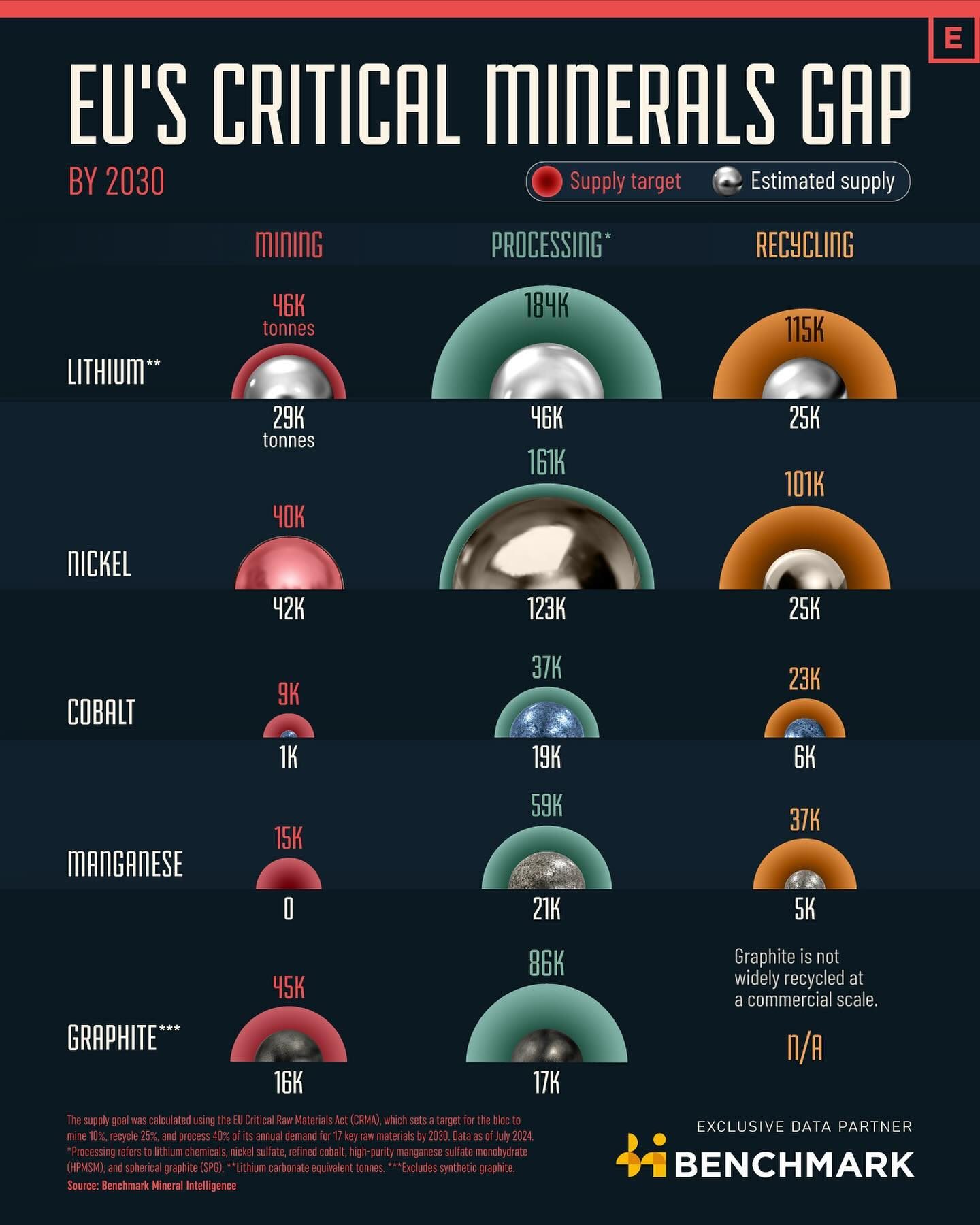
The EU’s Critical Minerals Supply Gap
The European Union (EU) faces significant challenges in meeting its 10% mining target for critical minerals essential for advancing clean technologies, particularly batteries and wind turbines. The situation is dire, with the forecasted supply of key minerals falling far short of the amounts needed by 2030. According to Benchmark Intelligence, the supply gap for graphite alone is alarming, with an estimated 16,000 tonnes available compared to the 45,000 tonnes required.
Context / Why this matters
Critical minerals are pivotal to the EU's transition to a sustainable, low-carbon economy. These minerals are essential for manufacturing batteries, wind turbines, and electric vehicles, which are crucial for reducing carbon emissions and combating climate change. However, the current supply landscape paints a bleak picture, particularly for minerals like lithium, nickel, cobalt, manganese, and graphite.
According to Benchmark Intelligence, the EU's ambitious 10% mining target appears out of reach. This shortfall has severe implications for the EU's ability to meet its sustainability goals, as the transition to green technologies hinges on a stable and abundant supply of these minerals. Delays or shortages in these minerals could significantly hinder the EU's progress towards a greener future.
Main discussion
Key Critical Minerals
Lithium
Lithium is a cornerstone for lithium-ion batteries, powering everything from smartphones to electric vehicles. The EU estimates it will need 46,000 tonnes of lithium by 2030. Unfortunately, the current supply projections fall far short, with only 18,000 tonnes available through mining, processing, and recycling combined.
Nickel
Nickel is crucial for both steel production and battery manufacturing. The EU's demand for nickel is projected to be 29,000 tonnes by 2030. However, the estimated supply through mining, processing, and recycling is only about 12,000 tonnes. This significant gap could severely impact the EU's automotive and energy storage industries.
Cobalt
Cobalt is another critical mineral for battery production, particularly for high-performance lithium-ion batteries used in electric vehicles. The EU's projected demand for cobalt is 1,000 tonnes, while the estimated supply is a mere 420 tonnes. This shortfall could disrupt the production of electric vehicles, which are essential for reducing greenhouse gas emissions.
Manganese
Manganese is vital for steel production and battery manufacturing. The EU aims to produce 21,000 tonnes of manganese by 2030, but the estimated supply is only 11,000 tonnes. This gap could have significant implications for both the construction and energy sectors.
Graphite
Graphite, a key component in battery anodes, faces a substantial supply gap. The EU needs 45,000 tonnes of graphite by 2030, but the estimated supply is just 16,000 tonnes. Additionally, graphite is not widely recycled at a commercial scale, making it difficult to bridge the supply gap.
Supply Breakdown
The supply of critical minerals is categorized into mining, processing, and recycling. Mining involves extracting raw minerals from the ground, processing refines these minerals into usable forms, and recycling involves repurposing used materials.
Mining
Mining is the primary source of critical minerals. However, the EU's mining capabilities fall short of meeting its 2030 targets. Increasing domestic mining operations could help close the supply gap, but this requires significant investment and infrastructure development.
Processing
Processing critical minerals involves refining raw materials into usable forms. The EU faces challenges in processing due to the lack of domestic refining facilities and the need to import refined minerals, which adds to costs and delays.
Recycling
Recycling is an essential component of the supply chain, particularly for minerals like cobalt and nickel, which can be recovered from end-of-life batteries. However, the EU's recycling infrastructure is underdeveloped, and graphite, a key component in batteries, is not widely recycled at a commercial scale. Investing in recycling technologies could significantly contribute to bridging the supply gap.
The Role of Benchmark Intelligence
Benchmark Intelligence is a global data and analytics company specializing in battery metals, including lithium, cobalt, and nickel. They provide comprehensive data and analysis on the critical minerals market, including supply and demand trends, pricing, and market dynamics.
Benchmark Intelligence's data highlights the urgent need for the EU to address its critical minerals supply gap. Their insights can help policymakers, industry leaders, and investors make informed decisions to secure a stable and sustainable supply of critical minerals.
The Road Ahead
To address the critical minerals supply gap, the EU must focus on three key areas: increasing domestic mining, improving processing capabilities, and enhancing recycling infrastructure. Collaboration with Benchmark Intelligence and other industry experts can provide the necessary data and insights to drive policy and investment decisions.
Investing in these areas will not only ensure a stable supply of critical minerals but also support the EU's transition to a low-carbon economy. By securing a reliable supply of critical minerals, the EU can accelerate the adoption of clean technologies, reduce its carbon footprint, and lead the global transition to a sustainable future.
Practical Tips
To mitigate the critical minerals supply gap, consider the following recommendations:
For Policymakers
- Invest in Domestic Mining: Encourage investment in domestic mining operations to reduce reliance on imports and create a stable supply of critical minerals.
- Develop Processing Facilities: Support the development of domestic refining and processing facilities to increase processing capabilities and reduce costs.
- Promote Recycling: Invest in recycling technologies and infrastructure to maximize the recovery of critical minerals from end-of-life products.
For Industry Leaders
- Collaborate with Benchmark: Use Benchmark Intelligence's data and analytics to inform supply chain strategies and investment decisions.
- Diversify Suppliers: Diversify the supply chain by exploring new sources of critical minerals and building strategic partnerships with suppliers.
- Invest in Technology: Develop and implement new technologies to improve mining, processing, and recycling efficiency.
For Investors
- Identify Opportunities: Look for investment opportunities in mining, processing, and recycling technologies to support the transition to a sustainable future.
- Support Research: Fund research and development initiatives focused on improving the efficiency and sustainability of critical mineral extraction and processing.
- Engage with Industry: Collaborate with industry leaders and policymakers to drive meaningful changes in the critical minerals supply chain.
Important Takeaways
- The EU faces significant challenges in meeting its 10% mining target for critical minerals essential for advancing clean technologies.
- The supply gap for crucial minerals like lithium, nickel, cobalt, manganese, and graphite is alarming, particularly for graphite, where the estimated supply is just 16,000 tonnes compared to the 45,000 tonnes needed.
- The EU must focus on increasing domestic mining, improving processing capabilities, and enhancing recycling infrastructure to address the supply gap.
- Collaboration with industry experts like Benchmark Intelligence is crucial for making informed decisions and driving policy and investment actions.
Conclusion
The EU's critical minerals supply gap poses a significant challenge to its clean technology transition. Addressing this gap requires a multi-faceted approach, including increasing domestic mining, improving processing capabilities, and enhancing recycling infrastructure. By taking these steps and leveraging data from industry experts, the EU can secure a stable and sustainable supply of critical minerals, paving the way for a greener future.
Watch the Reel
Questions readers ask
What are critical minerals and why are they important for the EU's green future?
Critical minerals are substances like lithium, nickel, and graphite that are essential for manufacturing sustainable technologies such as batteries and wind turbines. These minerals are vital for the EU's transition to a low-carbon economy and efforts to combat climate change, as they help reduce carbon emissions by enabling the production of electric vehicles and renewable energy technology.
What is the projected supply gap for critical minerals in the EU by 2030?
By 2030, the EU is expected to face a significant supply shortfall in critical minerals. For instance, the supply of graphite is projected to be around 16,000 tonnes, while the demand is estimated to be 45,000 tonnes. This gap is indicative of the broader challenge the EU faces in securing enough critical minerals to meet its green technology goals.
What are the EU's mining targets for critical minerals and how feasible are they?
The EU has set a target to mine 10% of its own critical minerals by 2030. However, this goal is challenging due to the current supply gaps and the time it takes to develop new mining projects. With the demand for these minerals expected to outstrip supply, achieving this target will require significant investment and innovation in mining and recycling technologies.
What is the significance of the EU's supply gap for minerals like lithium and cobalt?
Critical minerals like lithium and cobalt are essential for battery production, which is a cornerstone of the EU’s green transition. A supply gap in these minerals could hinder the production of electric vehicles and energy storage solutions, thereby slowing down the EU's efforts to reduce carbon emissions and transition to sustainable technologies.
What steps is the EU taking to address the critical minerals supply gap?
The EU is exploring various strategies to address the supply gap, including increasing domestic mining, diversifying its supply chains, and enhancing mineral recycling efforts. These efforts aim to ensure a steady supply of critical minerals necessary for the production of green technologies, supporting the EU's climate change mitigation goals and sustainable development initiatives.
How does the EU's graphite supply gap impact the production of wind turbines?
Graphite is a crucial component in the production of wind turbines, particularly for the manufacturing of components like brushes and bearings. Given the projected shortfall of 29,000 tonnes of graphite by 2030, the EU's ability to produce wind turbines could be significantly impacted, potentially slowing down the deployment of renewable energy infrastructure.
What role do battery minerals play in the EU's green transition, and what are the implications of the current supply shortages?
Battery minerals, such as lithium, nickel, and cobalt, are fundamental to the EU's green transition as they are used in the production of batteries for electric vehicles and energy storage systems. The current supply shortages could delay the widespread adoption of these technologies, making it more challenging for the EU to meet its climate change mitigation goals and reduce its reliance on fossil fuels.
Related deep dives
Similar reads based on topic and creator.



Recent articles
Fresh deep dives from the latest Reels we unpacked.




Comments
Be the first to comment.