European Adults Living at Home
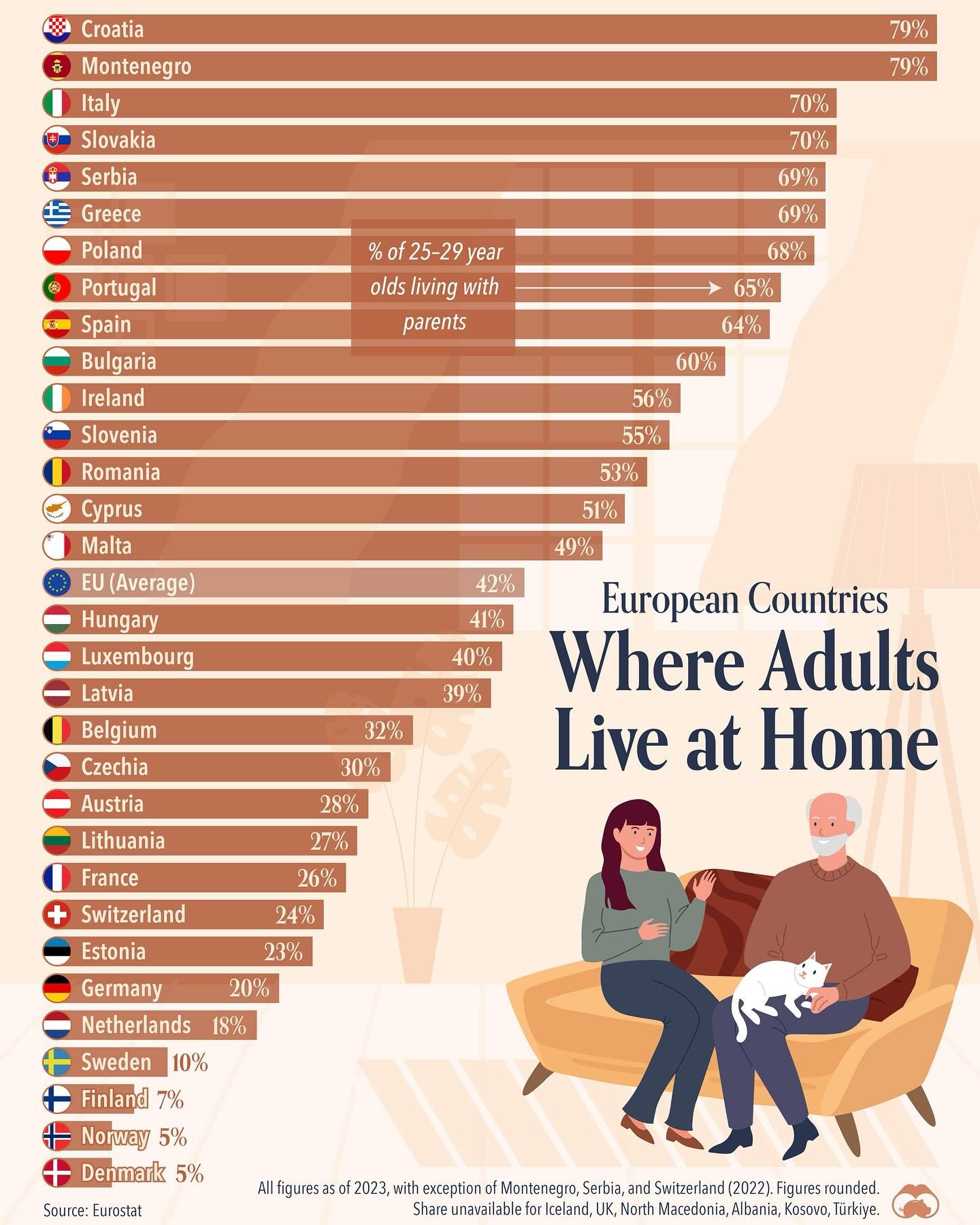
In Croatia and Montenegro, a striking 79% of adults aged 25-29 are still living with their parents. This trend is not unique to these countries but is part of a broader pattern across Europe, influenced by factors like rental costs and cultural norms.
Context / Why this matters
The trend of young adults living at home extends beyond Croatia and Montenegro, affecting various European countries to different degrees. Understanding the underlying reasons for this trend can provide valuable insights into the socio-economic landscape of Europe. This is especially important for policymakers, social scientists, and anyone interested in the dynamics of young adulthood and family structures.
Main discussion
Economic Factors
High rental costs relative to local wages are a significant driver of this trend. In many European countries, the cost of living, particularly in urban areas, has skyrocketed in recent years. This financial strain makes it difficult for young adults to afford independent living. In Croatia and Montenegro, for example, the cost of renting an apartment can be prohibitively high for those just starting their careers.
Cultural Traditions
Cultural traditions also play a significant role. In some European countries, it is deeply ingrained in the culture for young adults to live with their parents until they get married or have a stable job. These traditions can be particularly strong in parts of the Balkans. The support system provided by extended family networks can also be a strong cultural factor.
Regional Variations
The percentage of adults living with their parents varies widely across Europe. Montenegro and Serbia lead with 79% of 25-29-year-olds living at home, while Denmark has the lowest percentage at 5%. The EU average stands at 42%. These figures highlight the regional disparities and the need for tailored solutions in different parts of Europe.
Data Analysis
The data, sourced from Eurostat (2023), provides a comprehensive view of this trend. It is important to note that figures for countries like Iceland, the UK, North Macedonia, Albania, Kosovo, and Türkiye are unavailable, which may skew the overall analysis. However, the available data still paints a clear picture of the trend's prevalence and impact.
Practical tips
For Young Adults
If you're a young adult considering living independently, it's essential to plan your finances carefully. Look for affordable housing options and consider sharing an apartment with roommates to split the costs. Additionally, seeking part-time jobs or freelance work can provide extra income to support your living expenses.
For Parents
For parents, supporting your adult children's transition to independence can be challenging. Encourage financial literacy and help them develop a budget. This could include setting aside a portion of their income for savings and teaching them about managing expenses.
For Policymakers
Policymakers can play a crucial role in addressing this trend. Initiatives like affordable housing programs, subsidies for first-time renters, and job creation schemes can help alleviate the financial burden on young adults. Additionally, promoting financial education in schools and universities can equip young adults with the skills needed to manage their finances effectively.
Important takeaways
The trend of young adults living with their parents in Europe is influenced by a combination of economic and cultural factors. High rental costs and cultural traditions are significant drivers, and the prevalence of this trend varies widely across the continent. Tailored solutions are needed to address this issue, and collaboration between young adults, parents, and policymakers is essential.
Conclusion
The trend of young adults living with their parents in Europe is a complex issue influenced by multiple factors. By understanding the underlying reasons and implementing targeted solutions, we can help young adults achieve greater financial independence and stability. This trend is more than just a statistic; it reflects the broader socio-economic dynamics and cultural values of European societies.
Watch the Reel
Questions readers ask
Which European countries have the highest percentage of adults aged 25-29 living with their parents?
Croatia and Montenegro top the list with 79% of adults in this age group living with their parents. Serbia also has a high percentage, with about 68%.
What are the main economic factors contributing to this trend?
High rental costs and low wages are significant economic factors. These conditions make it financially challenging for young adults to live independently.
How does this trend vary across different European countries?
While Croatia and Montenegro have the highest percentages, other countries like Serbia, Italy, and Greece also have notable rates of adults aged 25-29 living with their parents. In contrast, countries like Sweden and Denmark have significantly lower rates.
What role do cultural norms play in this trend?
Cultural norms that encourage young adults to stay at home until marriage or stable employment are significant. In some cultures, living with parents is seen as a way to save money and support the family.
What are the implications of this trend for policymakers?
The trend highlights the need for affordable housing and employment opportunities. Policymakers can use this information to develop strategies that support young adults in achieving financial independence and self-sufficiency.
What statistics does Eurostat provide about adults living with parents?
Eurostat provides detailed statistics on the number of adults aged 25-29 living with parents in different European countries. It also includes data on the distribution of individuals living in private households by economic status and age.
How can understanding this trend benefit social scientists and researchers?
Understanding the extent of adults living with their parents in Europe offers insights into the dynamics of young adulthood and family structures. It can also inform research on economic trends, housing markets, and socio-cultural norms.
Related deep dives
Similar reads based on topic and creator.

Recent articles
Fresh deep dives from the latest Reels we unpacked.




Comments
Be the first to comment.