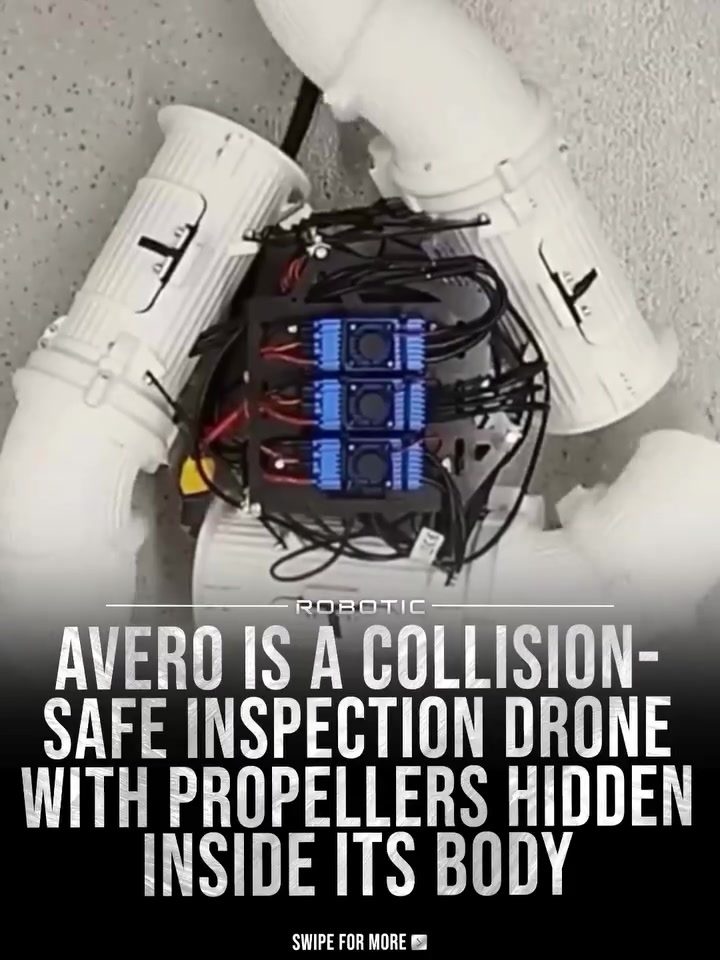
Avero: The Collision-Safe Inspection Drone
Avero, an innovative inspection drone, is the result of a collaborative effort by an eleven-member student team at ETH Zurich. This drone is designed with safety in mind, particularly for operations in close proximity to people and structures. Unlike traditional drones with exposed propellers, Avero houses its rotors inside protective tubes and utilizes pivoting nozzles to redirect airflow. This unique design not only enhances the drone's maneuverability but also allows it to rotate around two axes while flying close to surfaces, making it ideal for hard-to-reach infrastructure and busy environments like construction sites.
Why This Matters
The development of Avero represents a significant advancement in the field of inspection drones. Traditional drones, with their exposed propellers, pose a risk of injury to people and damage to structures during close inspections. Avero's design addresses these concerns, making it a safer option for various inspection tasks. This is particularly important in environments where drones need to operate in tight spaces or around people, such as construction sites, industrial facilities, and infrastructure inspections.
Main Discussion
Design and Safety Features
Avero's design is centered around safety and efficiency. By hiding the propellers inside its body and using protective tubes, the drone significantly reduces the risk of collisions and injuries. This design choice is particularly beneficial in environments where drones need to fly close to surfaces and structures. The pivoting nozzles further enhance the drone's maneuverability, allowing it to rotate around two axes. This capability is crucial for conducting detailed inspections in confined spaces.
Applications
Avero is intended for use in various challenging environments. Its collision-safe design makes it suitable for hard-to-reach infrastructure, such as bridges, tall buildings, and industrial machinery. The drone's ability to operate safely in busy environments, like construction sites, also makes it a valuable tool for monitoring progress and ensuring safety. Additionally, Avero can be used in sectors where close inspections are necessary, such as wind turbines, power lines, and pipelines.
Practical Tips
Operating an inspection drone like Avero in various environments requires careful planning and execution. Here are some practical tips for maximizing the drone's effectiveness and safety:
Pre-Flight Check
Before deploying Avero, conduct a thorough pre-flight check. Ensure that all components, including the protective tubes and pivoting nozzles, are in good working condition. Verify that the drone's software is up-to-date and that all safety protocols are in place.
Environment Assessment
Assess the environment where the drone will be operating. Identify potential hazards, such as obstacles, people, and structures, and plan the drone's flight path accordingly. Consider the drone's maneuverability and the need for close inspections when mapping out the flight path.
Safety Measures
Implement necessary safety measures, such as setting up a no-fly zone around the inspection area and ensuring that all personnel are aware of the drone's operation. Use visual aids, such as cones or barriers, to clearly mark the inspection zone and prevent unauthorized access.
Post-Flight Analysis
After the inspection, conduct a post-flight analysis to review the data collected. Use the drone's onboard sensors and cameras to gather detailed information about the inspected structures. Analyze the data to identify any potential issues or areas that require further investigation. Document your findings and share them with relevant stakeholders.
Important Takeaways
Avero's innovative design and safety features make it a valuable tool for conducting inspections in various environments. By hiding the propellers inside its body and using pivoting nozzles, the drone reduces the risk of collisions and injuries. Its maneuverability and ability to rotate around two axes allow it to operate effectively in confined spaces and close to surfaces.
Conclusion
Avero represents a significant advancement in the field of inspection drones. Its unique design and safety features make it a safer and more efficient option for conducting inspections in various environments. From hard-to-reach infrastructure to busy construction sites, Avero's capability to operate safely and effectively makes it an invaluable tool for inspectors. The development of Avero by a student team at ETH Zurich highlights the potential for innovative solutions in robotics and engineering, paving the way for future advancements in this field.
Watch the Reel
Questions readers ask
What makes Avero different from traditional inspection drones?
Avero stands out due to its protected rotors and pivoting nozzles, which significantly reduce collision risks in confined spaces and crowded areas. This design enhances safety for both people and structures during inspections.
Who developed the Avero inspection drone?
Avero was developed by a team of eleven students at ETH Zurich. The project showcases the innovative capabilities of student-led initiatives in advancing drone technology.
How does Avero's design improve maneuverability?
Avero's design includes pivoting nozzles that redirect airflow, allowing the drone to rotate around two axes. This feature enables precise movements and close inspections of hard-to-reach surfaces, making it highly maneuverable in tight spaces.
What are the benefits of using Avero for construction site inspections?
Avero's protected rotors and pivoting nozzles make it safer to operate around people and structures on construction sites. Its enhanced maneuverability allows for detailed inspections of infrastructure, even in confined or crowded environments.
Can Avero be used for inspecting infrastructure beyond construction sites?
Yes, Avero is designed for a variety of infrastructure inspections. Its safety features and maneuverability make it suitable for inspecting bridges, buildings, and other structures, especially in areas where safety and precision are critical.
What are the safety advantages of Avero's protected rotors?
The protected rotors in Avero reduce the risk of injury to people and damage to structures. By enclosing the rotors in protective tubes, the drone can operate safely in close proximity to humans and delicate surfaces without compromising its functionality.
How does Avero's design address the challenges of drone inspections in busy environments?
Avero's pivoting nozzles and protected rotors allow it to operate safely and efficiently in busy environments. These features enable the drone to navigate around obstacles and people, ensuring smooth and safe inspections even in crowded or cluttered spaces.
Related deep dives
Similar reads based on topic and creator.


Recent articles
Fresh deep dives from the latest Reels we unpacked.




Comments
Be the first to comment.