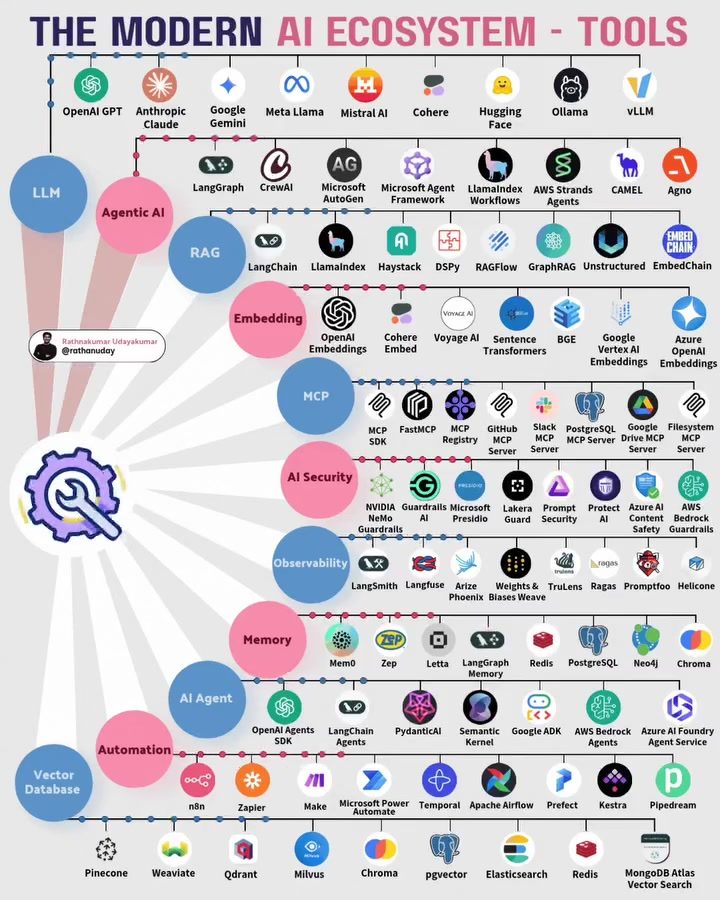
Navigating the Modern AI Ecosystem: Essential Tools and Categories
Modern artificial intelligence (AI) development is a complex landscape filled with numerous tools, frameworks, and services. Understanding how these components fit together is crucial for building robust, production-ready AI solutions. This guide breaks down the AI ecosystem into key categories, providing a comprehensive overview of the essential building blocks for AI development.
Context / Why This Matters
The AI ecosystem is rapidly evolving, and staying updated with the latest tools and frameworks can be daunting. Whether you're a data scientist, AI engineer, or developer, having a clear understanding of the available tools can significantly enhance your workflow. This guide aims to demystify the AI landscape by categorizing tools into functional areas, making it easier to navigate and implement AI solutions effectively.
Main Discussion
Large Language Models (LLMs)
Large Language Models (LLMs) form the foundation of modern AI development. These models are designed to handle a wide range of natural language processing (NLP) tasks, from generating human-like text to performing semantic searches. Some of the most prominent LLMs include:
- OpenAI GPT: Known for its versatility and advanced language generation capabilities.
- Anthropic Claude: Recognized for its strong language understanding and generation skills.
- Google Gemini: Offers robust language capabilities with a focus on scalability and efficiency.
- Meta Llama: A powerful model developed by Meta, known for its extensive training data and advanced architecture.
- Mistral AI, Cohere, Hugging Face: These platforms offer a variety of pre-trained models and tools for custom implementations.
Embeddings and Vectorization
Embeddings are essential for semantic search and understanding the meaning behind text. They convert textual data into numerical vectors, making it easier for AI models to process and analyze. Key tools and frameworks in this category include:
- Sentence Transformers: Specialized in generating sentence embeddings that capture the semantic meaning of text.
- BGE, Google Embeddings, and Azure Embeddings: Provide pre-trained embeddings for various NLP tasks.
- VLM: Visual Language Models, which combine visual and textual data for more comprehensive AI applications.
Agentic AI and Orchestration
Agentic AI and orchestration frameworks are designed to build autonomous, multi-agent workflows. These tools enable the creation of complex AI systems that can interact and collaborate seamlessly. Some of the leading frameworks in this category are:
- LangGraph: Designed for orchestrating multi-agent systems and managing their interactions.
- CrewAI and AWS Strands: These frameworks facilitate the development of autonomous AI agents that can perform specific tasks.
- Microsoft Agent Framework: Provides a comprehensive set of tools for building and managing AI agents.
Retrieval-Augmented Generation (RAG) and Vector Databases
Retrieval-Augmented Generation (RAG) enhances the ability of AI models to generate accurate and contextually relevant responses by integrating retrieval mechanisms. Vector databases store and manage these embeddings, making them accessible for retrieval and analysis. Key tools in this area include:
- LlamaIndex, Haystack, and GraphRAG: These tools help in retrieving relevant data and integrating it with AI models for enhanced performance.
- Unstructured and EmbedChain: These frameworks are designed for handling unstructured data and creating embeddings for various use cases.
- Pinecone, Weaviate, Qdrant, Milvus, and pgvector: These vector databases store and manage embeddings, making them accessible for retrieval and analysis.
Observability and Security
Ensuring the reliability and security of AI models is crucial. Observability tools help track the performance and behavior of AI models, while security tools protect them from misuse and breaches. Key tools in this category include:
- LangSmith, Langfuse, and Arize: Provide comprehensive observability and tracking of AI models.
- Weights & Biases, Trulens, and Promptfoo: These tools help in monitoring and managing AI workflows, ensuring robustness and reliability.
- NVIDIA Guardrails, Microsoft Presidio, and Lakera: These tools offer essential guardrails and protection mechanisms for AI models, ensuring their safety and reliability.
Memory and Automation
Memory and automation tools are essential for managing state and workflows in AI systems. These tools help in maintaining the coherence and continuity of AI operations, ensuring seamless performance. Key tools in this area include:
- Memo, Redis, and PostgreSQL: These tools provide efficient state management and data storage solutions.
- Neo4j and Chroma: These databases are designed for handling complex data structures and relationships.
- Apache Airflow, Make, and Zapier: These automation tools help in integrating AI workflows with various systems and services, ensuring smooth and efficient operations.
AI Agents and Automation Tools
AI agents are designed to perform specific tasks autonomously, while automation tools help in integrating and managing these agents within larger workflows. Key tools in this category include:
- OpenAI Agents SDK and LangChain Agents: These tools help in building and managing AI agents for various applications.
- Google AI, AWS Bedrock, and Azure AI Foundry: These platforms provide a comprehensive set of tools for building and deploying AI agents.
- Microsoft Power Automate, Temporal, and Prefect: These tools facilitate the integration and management of AI agents within larger workflows, ensuring seamless performance and efficiency.
Practical Tips
When navigating the AI ecosystem, here are some practical tips to keep in mind:
- Start with LLMs and Embeddings: These foundational tools are essential for any AI project. Understanding how to work with these models will provide a solid base for more complex implementations.
- Integrate RAG and Vector Databases: These tools enhance the performance and accuracy of AI models by enabling context-aware retrieval.
- Focus on Observability and Security: Ensuring the reliability and security of AI models is crucial. Use observability and security tools to monitor and protect your models.
- Optimize Memory and Automation: Efficient state management and workflow integration are key to seamless AI operations. Utilize memory and automation tools to ensure smooth performance.
- Leverage Agentic AI and Orchestration Frameworks: These frameworks enable the creation of autonomous, multi-agent workflows, enhancing the capabilities and efficiency of AI systems.
Important Takeaways
- Understand the AI Ecosystem: Breaking down the AI landscape into functional categories makes it easier to navigate and implement AI solutions.
- Foundation Matters: LLMs and embeddings are the cornerstones of modern AI development. Mastering these tools will provide a strong foundation for more complex implementations.
- Integrate RAG and Vector Databases: These tools enhance the performance and accuracy of AI models, making them essential for any AI project.
- Security and Observability: Ensuring the reliability and security of AI models is crucial. Utilize observability and security tools to monitor and protect your models.
- Efficient Memory and Automation: Efficient state management and workflow integration are key to seamless AI operations. Utilize memory and automation tools to enhance performance.
Conclusion
The modern AI ecosystem is a complex landscape filled with numerous tools, frameworks, and services. By categorizing these components into functional areas, it becomes easier to navigate and implement AI solutions effectively. Understanding the essential building blocks—LLMs, embeddings, AI agents, RAG, observability, security, memory, and automation—will help you build robust, production-ready AI systems. Whether you're a data scientist, AI engineer, or developer, having a clear understanding of these tools will significantly enhance your workflow and enable you to leverage the full potential of AI development.
Watch the Reel
Questions readers ask
What are some of the most prominent large language models in the modern AI ecosystem?
Large language models are a cornerstone of the modern AI ecosystem. Some of the most notable models include OpenAI's GPT series, which is renowned for its versatility and advanced natural language understanding capabilities. Another key player is Anthropic's Claude, known for its safety features and conversational abilities.
How do AI embeddings and vectorization contribute to AI development?
AI embeddings and vectorization are essential for transforming complex data into a format that AI models can understand and process efficiently. Embeddings convert data like text, images, or other inputs into dense vectors, capturing semantic meanings. Vectorization then allows these embeddings to be used in machine learning algorithms, enabling tasks such as similarity searches and clustering.
Why are AI observability tools important in the modern AI ecosystem?
AI observability tools are crucial for monitoring and maintaining the performance, reliability, and accuracy of AI models in production. These tools provide insights into model behavior, help identify and diagnose issues, such as data drift or bias, and ensure that AI systems operate as intended, maintaining trust and reliability.
What are AI guardrails, and how do they enhance AI development?
AI guardrails refer to the rules and constraints put in place to guide the behavior of AI models, ensuring they operate within acceptable parameters. These guardrails can include safety measures, ethical guidelines, and performance benchmarks. By implementing guardrails, developers can mitigate risks, enhance user safety, and ensure that AI models align with organizational values and regulations.
What role do enterprise AI tools play in the modern AI ecosystem?
Enterprise AI tools are designed to facilitate the integration of AI solutions within large-scale business environments. These tools offer robust frameworks, security features, and scalability options that cater to the complex needs of enterprise-level operations. They enable businesses to deploy AI models efficiently, manage data securely, and ensure compliance with industry standards.
How can AI automation tools streamline development processes?
AI automation tools are instrumental in streamlining various aspects of AI development, from data preprocessing and model training to deployment and monitoring. These tools can automate repetitive tasks, reduce human error, and accelerate development cycles. By leveraging AI automation, developers can focus on more strategic and innovative aspects of their projects, enhancing overall productivity and efficiency.
What are some key considerations when implementing LangGraph AI and LLM Index tools?
When implementing LangGraph AI and LLM Index tools, it's important to consider their specific use cases and integration capabilities. LangGraph AI is particularly useful for knowledge graph construction and querying, while LLM Index tools help in efficiently indexing and retrieving information from large language models. Both tools require careful planning for data integration, scalability, and performance optimization to ensure they meet the demands of your AI applications.
Related deep dives
Similar reads based on topic and creator.


Recent articles
Fresh deep dives from the latest Reels we unpacked.




Comments
Be the first to comment.