Brainteaser Puzzle for Engineers
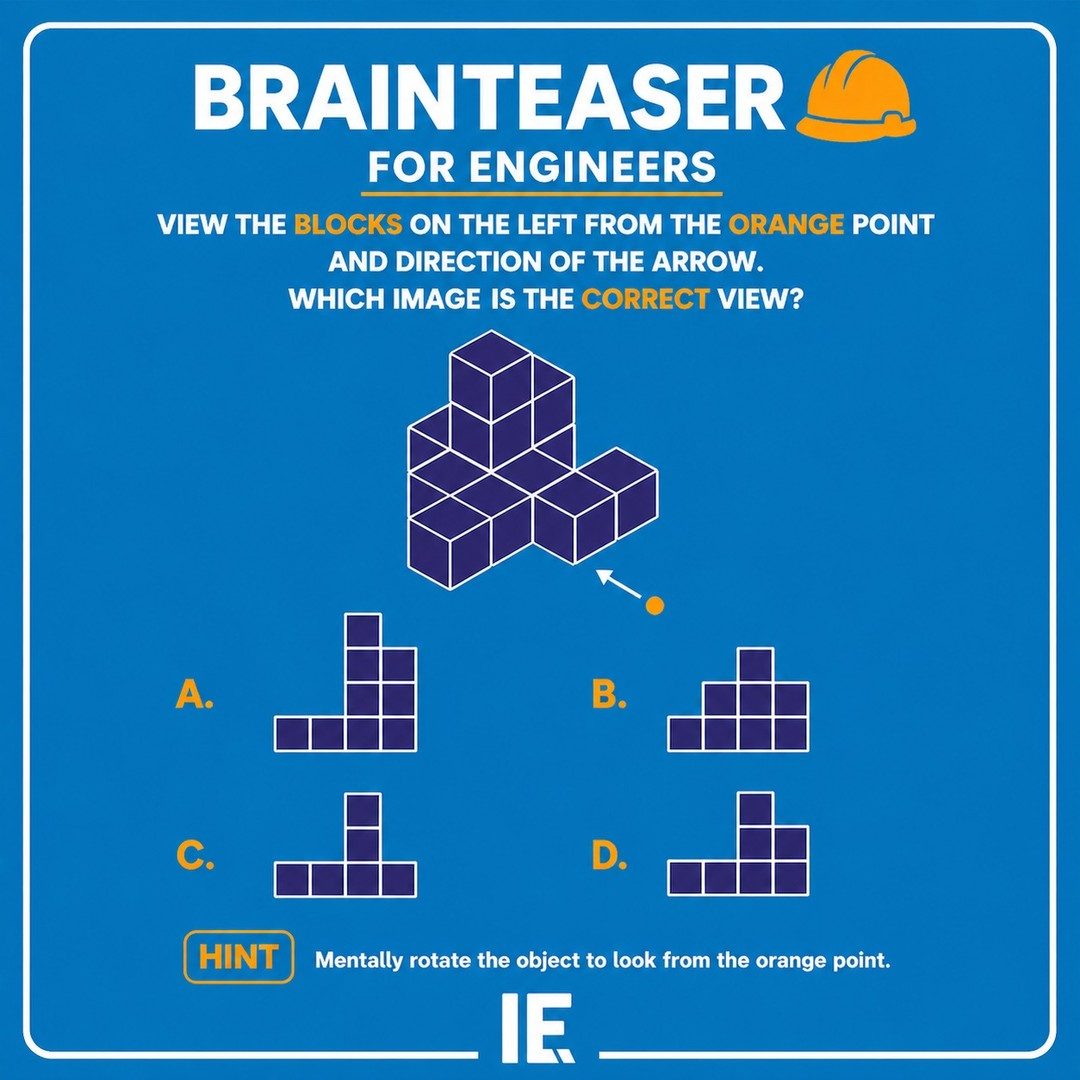
Have you ever wondered how engineers think in three dimensions? A brainteaser puzzle designed specifically for engineers provides a fascinating glimpse into the world of spatial reasoning and mental rotation. This challenge involves viewing a 3D block structure from a specific perspective and identifying the correct 2D representation.
Context / Why This Matters
This type of puzzle is particularly useful for those in engineering and design fields, where understanding and visualizing 3D structures is crucial. By solving this puzzle, engineers can improve their spatial reasoning skills, which are essential for designing and analyzing complex structures, mechanical systems, and architectural plans. The ability to mentally rotate objects and view them from different angles is a fundamental skill that can enhance problem-solving abilities in various engineering disciplines.
Main Discussion
Understanding the Puzzle
The puzzle presents a 3D block structure and asks the viewer to view it from a specific point and direction indicated by an arrow. The goal is to identify the correct 2D representation of this 3D structure from four given options (A, B, C, and D). This task requires spatial reasoning and the ability to mentally rotate the object to align it with the 2D images.
The Importance of Spatial Reasoning
Spatial reasoning is the ability to understand and manipulate objects in three-dimensional space. It involves visualizing how objects fit together, how they move, and how they look from different angles. For engineers, this skill is indispensable. Whether designing a bridge, a building, or a mechanical component, engineers must be able to visualize how different parts will fit together and function as a whole.
Mental Rotation Skills
Mental rotation is the mental process of rotating a 2D or 3D object to view it from different angles. This skill is essential for solving the given puzzle and is a critical component of spatial reasoning. To solve the puzzle, one must imagine rotating the 3D block structure to match one of the provided 2D images. This mental exercise helps in developing a deeper understanding of how objects interact in space.
The Hint
The hint provided with the puzzle—"Mentally rotate the object to look from the orange point"—is crucial. It guides the viewer to use their mental rotation skills effectively. By visualizing the 3D structure from the perspective indicated by the arrow, one can more easily identify the correct 2D representation. This hint underscores the importance of mental rotation in solving spatial reasoning problems.
Practical Tips
-
Start with the Basics: Begin by practicing simpler 2D-to-2D rotations. For example, try rotating a square or a triangle in your mind and drawing the new orientation. This can help build the foundational skills needed for more complex 3D rotations.
-
Use Physical Models: For more complex structures, use physical models to help visualize the 3D structure. Manipulating a physical model can give you a better understanding of how the object looks from different angles.
-
Break Down the Problem: Divide the 3D structure into smaller, more manageable parts. Visualize each part separately and then combine them in your mind to form the complete structure.
-
Practice Regularly: Like any skill, mental rotation improves with practice. Regularly engage in activities that require spatial reasoning, such as solving puzzles, playing 3D games, or working with 3D modeling software.
-
Draw It Out: If you're having trouble visualizing the object in your mind, try drawing it out on paper. Start by sketching the basic shape and then add details as you mentally rotate the object.
Important Takeaways
- The puzzle is designed to test spatial reasoning and mental rotation skills, which are crucial for engineers.
- Mental rotation is a key component of spatial reasoning, and it involves visualizing how an object looks from different angles.
- Practicing spatial reasoning and mental rotation can enhance problem-solving abilities in various engineering disciplines.
- Using physical models and breaking down complex structures can aid in developing these skills.
- Regular practice and drawing out the object can help improve your mental rotation abilities.
Conclusion
Solving this brainteaser puzzle can be a challenging but rewarding experience. It not only tests your spatial reasoning and mental rotation skills but also provides valuable practice for those in engineering fields. By understanding and improving these skills, you can enhance your ability to design and analyze complex structures, which is essential for success in engineering. The next time you encounter a similar puzzle, use the tips provided to tackle the challenge with confidence.
Watch the Reel
Questions readers ask
What is the purpose of the 3D brainteaser challenge for engineers?
The 3D brainteaser challenge is designed to help engineers enhance their spatial reasoning and mental rotation skills. It provides a practical way to practice visualizing and manipulating objects in three-dimensional space, which is crucial for various engineering tasks.
How does solving this 3D puzzle benefit engineers?
By solving 3D puzzles, engineers can improve their ability to design and analyze complex structures. This skill is vital for creating detailed mechanical systems and architectural plans, as it allows them to visualize and understand 3D structures more effectively.
What skills are tested in a 3D block structure puzzle?
A 3D block structure puzzle tests an individual's spatial reasoning and mental rotation abilities. These skills are essential for identifying the correct 2D representation of a 3D object from a specific angle, a task that is commonly encountered in engineering and design fields.
Why is mental rotation important for engineers?
Mental rotation is crucial for engineers as it enables them to visualize how different parts of a structure or system interact in three dimensions. This skill allows them to identify potential issues, optimize designs, and ensure the functionality and safety of their projects.
What is the significance of viewing 3D structures from different angles?
Viewing 3D structures from various angles helps engineers understand the spatial relationships between different components. This ability is critical for accurate design, problem-solving, and problem-solving in complex engineering projects, where every detail matters.
How can engineers improve their spatial reasoning skills through puzzles?
Engaging with 3D puzzles and brainteasers can significantly improve an engineer's spatial reasoning skills. Regular practice with these puzzles helps develop the ability to visualize and manipulate 3D objects, making it easier to tackle real-world engineering challenges.
What makes the 3D brainteaser challenge unique for engineers?
The challenge is unique because it specifically targets the spatial reasoning and mental rotation skills that are fundamental to engineering work. By using 3D block structures and requiring the identification of 2D representations, it mimics real-world engineering tasks, making it a practical training tool.
Related deep dives
Similar reads based on topic and creator.



Recent articles
Fresh deep dives from the latest Reels we unpacked.




Comments
Be the first to comment.