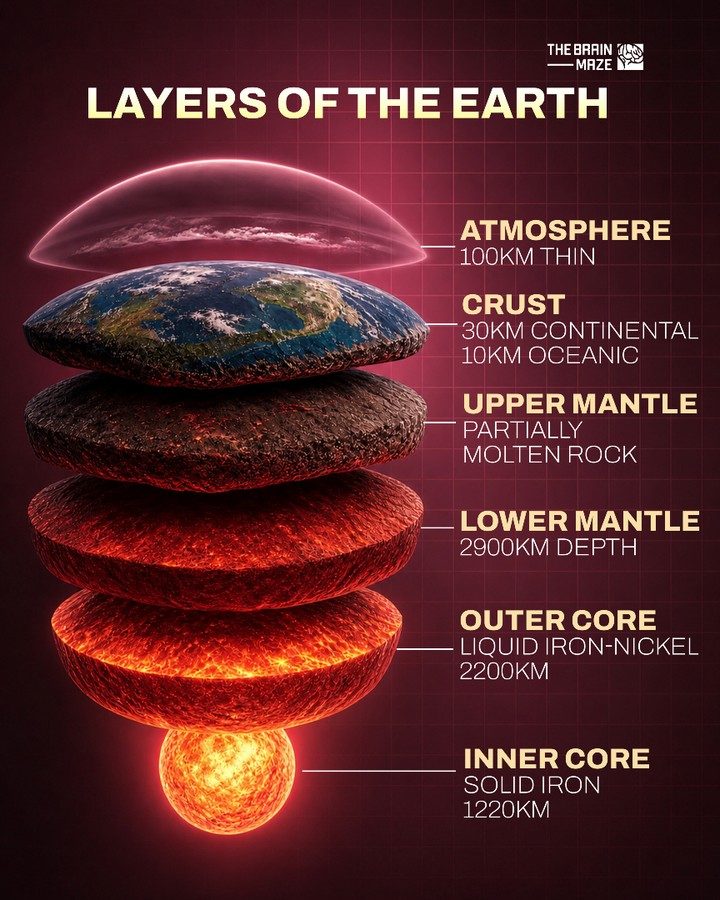
Earth's Layers
Earth's structure is a complex interplay of distinct layers, each with a unique composition and role. Understanding these layers—from the thin atmosphere to the solid inner core—provides insight into the planet's dynamics and the processes that shape its surface.
Context / Why this matters
Earth's layers play a crucial role in sustaining life and regulating the planet's climate. The atmosphere protects us from harmful solar radiation and helps maintain a habitable temperature range. Beneath the surface, the crust, mantle, and core interact in ways that drive plate tectonics, volcanic activity, and the generation of Earth's magnetic field. These processes have shaped the planet's geography and continue to influence its evolution.
Main discussion
The Atmosphere
The atmosphere is the thinnest layer, extending about 100 kilometers above the surface. Despite its relative thinness, it is vital for life. The atmosphere regulates climate by trapping heat and distributing it around the globe. It also protects life by absorbing harmful ultraviolet radiation from the sun. This layer is composed of gases such as nitrogen, oxygen, and carbon dioxide, which create the conditions necessary for life on Earth.
The Crust
The crust is the outermost solid layer of the Earth, forming the surface we live on. It is relatively thin, varying in thickness from about 10 kilometers beneath the oceans to 30 kilometers under the continents. The crust is composed of solid rock and is broken into tectonic plates that move and interact, creating mountains, volcanoes, and earthquakes. This layer is essential for understanding the geology of our planet and the processes that shape its surface.
The Mantle
Beneath the crust lies the mantle, which is further divided into the upper and lower mantle. The upper mantle extends to a depth of about 2900 kilometers and is composed of hot, partially molten rock. This layer is in a state of constant motion, with convection currents driving the movement of tectonic plates. The lower mantle, extending to the core, is also composed of hot, dense rock and is crucial for the planet's thermal dynamics.
The Outer Core
The outer core is a liquid layer composed primarily of iron and nickel. It extends from about 2200 kilometers beneath the surface to the inner core. The liquid state of the outer core is due to the extreme heat and pressure at this depth. This layer generates Earth's magnetic field through a process called the dynamo effect, which is essential for protecting the planet from solar wind and cosmic rays.
The Inner Core
At the center of the Earth lies the inner core, a solid ball of iron and nickel with a radius of about 1220 kilometers. Despite the extreme heat, the inner core is solid due to the immense pressure exerted by the layers above. The inner core's solid state is crucial for maintaining Earth's magnetic field, which in turn protects the planet's atmosphere and surface from harmful radiation.
Practical tips
Understanding Earth's layers can enhance your appreciation for the planet's complexity and the interconnectedness of its systems. Here are some practical tips for deepening your knowledge:
- Explore Geological Maps: Look for geological maps that show the different types of rocks and formations on the Earth's surface. These maps can provide insights into the structure of the crust and the processes that have shaped it.
- Study Plate Tectonics: Learn about the movement of tectonic plates and how they interact to create mountains, volcanoes, and earthquakes. This knowledge can help you understand the dynamic nature of the Earth's surface.
- Investigate Climate Patterns: Study how the atmosphere influences climate patterns and weather systems. This can provide a deeper understanding of the role the atmosphere plays in regulating the planet's temperature and precipitation.
- Explore Volcanic Activity: Learn about the types of volcanoes and the role of the mantle in driving volcanic activity. This can offer insights into the processes that shape the Earth's surface and the impact of volcanic eruptions on the environment.
Important takeaways
Earth's layers are more than just geological features; they are interconnected systems that work together to create and sustain life on the planet. From the protective role of the atmosphere to the dynamic processes of the mantle and core, each layer plays a crucial part in shaping the Earth's environment. Understanding these layers can provide a deeper appreciation for the planet's complexity and the importance of protecting its delicate balance.
Conclusion
Earth's layers are a testament to the planet's intricate and dynamic nature. From the thin atmosphere that protects life to the solid inner core that generates the magnetic field, each layer plays a vital role in sustaining the planet's environment. By studying these layers, we can gain a deeper understanding of the processes that shape the Earth and the importance of preserving its delicate balance.
Watch the Reel
Questions readers ask
What are the primary layers of Earth and their basic compositions?
Earth's primary layers, from the outermost to the innermost, are the atmosphere, crust, mantle, outer core, and inner core. The atmosphere is a mixture of gases, the crust is composed of solid rock, the mantle is a viscous layer of rock, and the outer and inner core are made predominantly of iron and nickel, with the inner core being solid and the outer core being liquid.
How does the atmosphere contribute to life on Earth?
The atmosphere plays a vital role in sustaining life by filtering out harmful solar radiation and maintaining a temperature range suitable for life. Additionally, it contains gases like oxygen and carbon dioxide, which are essential for respiration and photosynthesis.
What is the role of the mantle in Earth's dynamics?
The mantle, which is composed of hot, viscous rock, plays a crucial role in driving plate tectonics. Convection currents within the mantle cause the plates of the crust to move, leading to the formation of mountains, volcanoes, and other geological features. This process also aids in recycling carbon and other elements, which is essential for maintaining Earth's habitability.
Why is Earth's magnetic field important, and how is it generated?
Earth's magnetic field, generated by the movement of liquid metal in the outer core, is important because it shields the planet from solar wind and cosmic rays. It also aids in navigation and helps protect the atmosphere. This magnetic field is a result of the dynamo effect, where the motion of the outer core's liquid metal creates electric currents that generate the magnetic field.
What are the two main layers of Earth's core, and what distinguishes them?
Earth's core consists of two main layers: the outer core and the inner core. The outer core is a liquid layer composed of iron and nickel, while the inner core is solid due to the immense pressure. The movement of the liquid metal in the outer core creates Earth's magnetic field, while the solid inner core helps to stabilize the planet.
How does the Earth's crust interact with the mantle to create geological features?
The Earth's crust interacts with the mantle through the process of plate tectonics. The crust is divided into several plates that float on the mantle. The movement of these plates, driven by convection currents in the mantle, leads to the formation of various geological features, such as mountains, volcanoes, and oceanic trenches. This interaction also plays a significant role in shaping the planet's geography.
Related deep dives
Similar reads based on topic and creator.




Recent articles
Fresh deep dives from the latest Reels we unpacked.




Comments
Be the first to comment.