Our planet’s layered structure
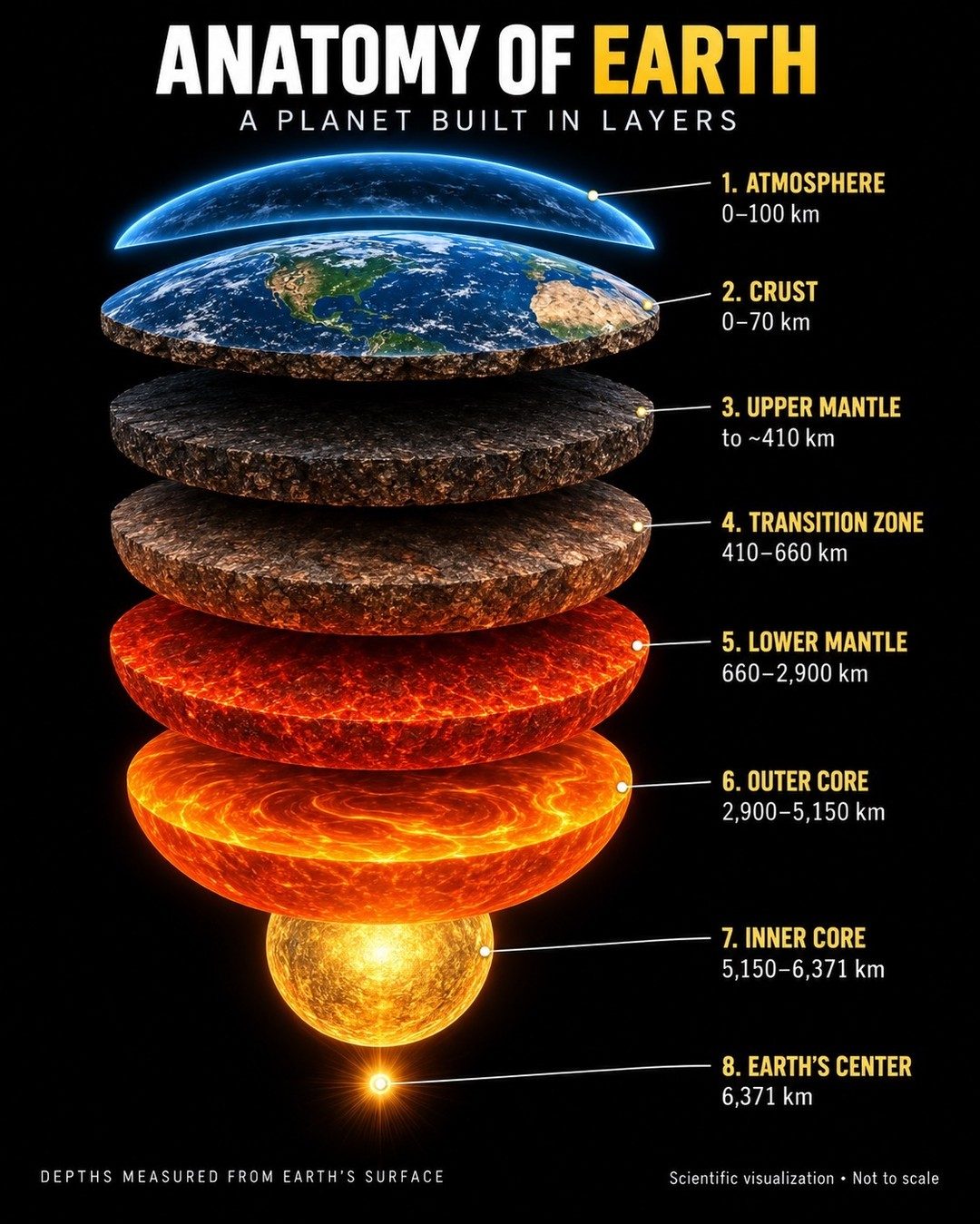
Earth is a multi-layered system, not a homogenous structure—not unlike an onion, albeit on a vastly larger scale. Each layer, from the atmosphere to the center of the planet, has specific properties and depth ranges. The layers aren’t just arbitrary divisions. Rather, they are a scientific visualization of our planet’s chemistry, density, and state. The atmosphere, the outermost layer, extends roughly 100 kilometers from the Earth’s surface. It’s a gaseous envelope that protects the planet and supports life. Below this is the crust, a thin solid layer ranging up to 70 kilometers in depth. The crust is dynamic, constantly moving and reshaping the surface.
The mantle’s deep science
The upper mantle, which lies between the crust and approximately 410 kilometers below, exhibits complex behavior. Known as the asthenosphere, this layer has lower viscosity and fluidity. It plays a pivotal role in plate tectonics, allowing the crust to move. The transition zone, spanning from 410 to 660 kilometers, marks a significant change in the mantle’s composition. It separates the mantle’s upper and lower regions, each with distinct properties. It’s important to note that a region is not "hotter" than another because of greater heat, but because of differences in density and mineral composition. The lower mantle, extending from 660 to 2,900 kilometers, comprises the majority of the planet’s mass. It’s characterized by high pressure and temperature, making it more solid. The convection currents in this layer drive the movement of the plates above.
The core of the matter
The outer and inner cores possess distinct properties. The outer core, ranging from 2,900 to 5,150 kilometers, is liquid and composed primarily of an iron-nickel alloy. It generates Earth’s magnetic field, which shields the planet from harmful solar radiation. The magnetic field is not static; it periodically reverses polarity. The inner core, extending from 5,150 to 6,371 kilometers, is solid despite extreme heat and pressure. This layer is crucial for maintaining the Earth’s magnetic field.
Additional depth details
Delving deeper into the core, there’s a lesser-known layer: the Inner Core Boundary. This layer, from about 4,800 to 5,150 km, is thought to be in a different state. This region is where the outer core meets the inner core. Some reasearchers believe the solid inner core is steadily growing, while occasionally shrinking. The Earth’s center, essentially the center of the core, reaches 6,371 kilometers in depth. These layers contribute to understanding the Earth’s internal dynamics.
Watch the Reel
Related deep dives
Similar reads based on topic and creator.



Recent articles
Fresh deep dives from the latest Reels we unpacked.


Comments
Be the first to comment.