Earth's Geological Timeline: Epochs and Golden Spikes
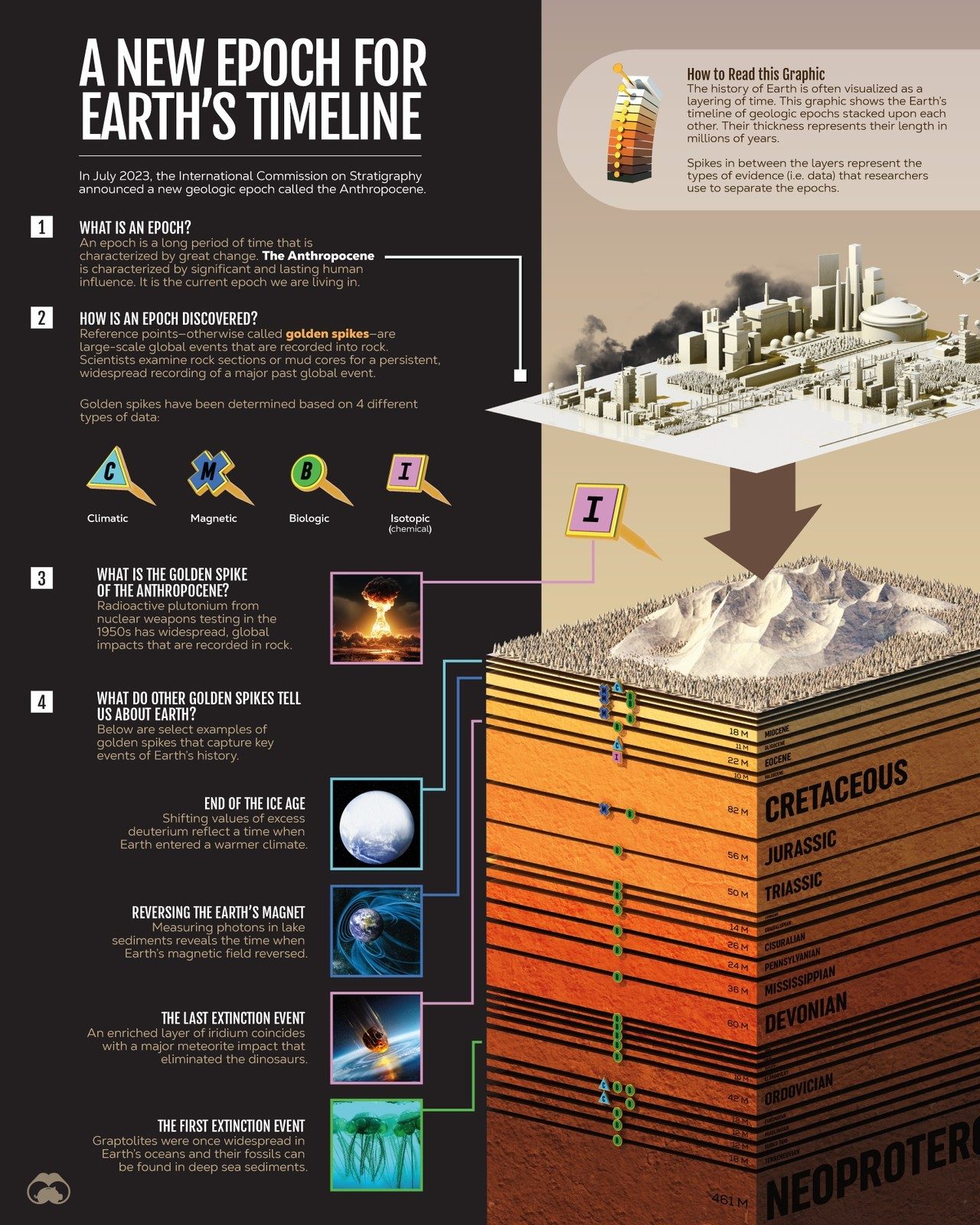
Earth's history is a dynamic narrative of dramatic shifts in landscape, climate, and biodiversity. This journey is archived in the planet’s crust, with layers carrying evidence of pivotal moments such as ice ages, asteroid impacts, and the more recent epoch known as the Anthropocene. This graphic dives into Earth’s geological timeline, revealing the planet’s transition through various epochs and the significant events that define them.
Context/Why This Matters
Understanding Earth’s geological timeline is essential for appreciating the planet’s evolution and the impact of recent changes. The study of geological epochs provides insights into how the planet has transformed over millions of years, driven by both natural events and human activities. This knowledge helps scientists predict future changes and understand the current state of the planet.
Main Discussion
What is an Epoch?
An epoch is a specific segment of time within the geological time scale. It is a unit of geological time that signifies a significant period marked by distinctive geological or paleontological events. These periods are often characterized by specific fossil assemblages, magnetic polarity, and distinct geological formations. For example, the Cretaceous Period, which lasted from approximately 145 to 66 million years ago, is known for the dominance of dinosaurs and the eventual asteroid impact that ended their reign.
Golden Spikes
Golden spikes are reference points in geological time, representing large-scale global events that leave a distinct mark in the rock record. These events can be biological, climatic, magnetic, or isotopic (chemical). For instance, the Cretaceous-Paleogene boundary, marked by the Chicxulub impact crater, is a golden spike that indicates the mass extinction event that wiped out the non-avian dinosaurs.
The Golden Spike of the Anthropocene
The Anthropocene is the most recent epoch, characterized by human impact on the Earth's geology and ecosystems. The golden spike for the Anthropocene is yet to be definitively determined. However, candidates include the widespread distribution of plastic waste, the increased carbon dioxide levels, and the significant changes in sediment layers caused by human activities. These markers indicate that human influence has become a dominant force in shaping the Earth's geological record.
Other Golden Spikes and Their Significance
Golden spikes provide critical information about Earth’s history. For example, the reversal of the Earth’s magnetic field is a significant geological event recorded in rocks. This reversal, known as a geomagnetic reversal, occurs when the Earth's magnetic north and south poles switch places. The most recent reversal, the Brunhes-Matuyama reversal, happened around 780,000 years ago and is a key reference point in the Earth’s magnetic timeline.
Another notable golden spike is the Permian-Triassic extinction event, which occurred around 252 million years ago. This event is often referred to as the "Great Dying" because it resulted in the most severe mass extinction in Earth’s history, wiping out approximately 96% of all marine species and 70% of terrestrial vertebrate species. This event was likely caused by massive volcanic eruptions and subsequent environmental changes.
Key Geological Periods
The Earth’s geological timeline is divided into several key periods, each marked by unique geological and biological events. These periods include the Cretaceous, Jurassic, Triassic, and many others. Let's take a closer look at a few of these periods:
The Cretaceous Period
The Cretaceous Period spanned from 145 to 66 million years ago and is famous for the dominance of dinosaurs. This period also saw the diversification of flowering plants and the emergence of birds. The Cretaceous ended with a catastrophic event—the Chicxulub asteroid impact, which caused the Cretaceous-Paleogene mass extinction.
The Jurassic Period
The Jurassic Period, from 201 to 145 million years ago, is often referred to as the "age of reptiles." This period saw the rise of large dinosaurs, the continued diversification of marine reptiles, and the emergence of early birds. The Jurassic is also known for the breakup of the supercontinent Pangaea into separate landmasses.
The Triassic Period
The Triassic Period, from 252 to 201 million years ago, marked the recovery of life after the Permian-Triassic extinction event. During this period, the first true dinosaurs and mammals emerged, and the Earth's climate became increasingly arid.
Other Significant Periods
The Ordovician Period, from 485 to 444 million years ago, saw the rapid diversification of marine life, including the first true vertebrates. The Devonian Period, from 419 to 359 million years ago, is known as the "age of fishes" and saw the development of the first amphibians and the first forests.
The Mississippian and Pennsylvanian periods, collectively known as the Carboniferous, spanned from 359 to 299 million years ago and were marked by the formation of vast coal deposits and the emergence of the first reptiles.
The Neoproterozoic Era, from 1,000 to 541 million years ago, included the Cryogenian Period, also known as the "snowball Earth" period, where the planet experienced severe glaciation. This era also saw the emergence of the first multicellular organisms.
Practical Tips
Navigating Earth’s geological timeline can be a daunting task, but understanding some key concepts can make it more accessible:
-
Understand the Basics of Time Scale: Familiarize yourself with the basic divisions of the geological time scale, from eras to epochs and periods. This will help you place significant events in context.
-
Focus on Golden Spikes: Pay attention to golden spikes, as they serve as key reference points in Earth’s history. These events provide a clear marker for understanding significant transitions in the planet’s evolution.
-
Explore Different Epochs: Delve into the specific characteristics of different epochs to understand the unique geological and biological features of each period. This will give you a deeper appreciation for the diversity of Earth’s history.
-
Use Visual Aids: Leverage visual aids, such as geological timelines and maps, to help visualize the complex relationships between different periods and events.
-
Stay Updated: Keep up with the latest research and discoveries in geology, as new findings can provide fresh insights into Earth’s history and the significance of golden spikes.
Important Takeaways
The Earth’s geological timeline is a complex and fascinating narrative of the planet’s evolution. Understanding key concepts such as epochs and golden spikes provides a framework for appreciating the significant events and transitions that have shaped our world. From the dramatic shifts during the Cretaceous Period to the ongoing changes in the Anthropocene, each epoch tells a unique story about Earth’s past and future.
Conclusion
Earth’s geological timeline is a testament to the dynamic nature of our planet. By exploring the various epochs and golden spikes, we gain a deeper understanding of the forces that have shaped the Earth’s landscape, climate, and biodiversity. This knowledge is crucial for predicting future changes and appreciating the ongoing impact of human activities on the planet. Whether you are a geology enthusiast or simply curious about Earth’s history, diving into the geological timeline offers a wealth of insights into the story of our planet.
Watch the Reel
Questions readers ask
What are the key geological epochs in Earth's history?
Earth's geological timeline is divided into several key epochs, including the Hadean, Archean, Proterozoic, Paleozoic, Mesozoic, and Cenozoic. Each of these epochs is marked by distinct geological events and shifts in Earth's biodiversity, such as the formation of the earliest continents, the emergence of complex life forms, and mass extinctions.
What are some major geological events that have shaped Earth?
Major geological events include ice ages, asteroid impacts, and volcanic eruptions. For instance, the Permian-Triassic extinction event, caused by extensive volcanism, wiped out approximately 90% of marine species and 70% of terrestrial vertebrates. The Cretaceous-Paleogene extinction event, likely caused by an asteroid impact, led to the extinction of non-avian dinosaurs.
What significant events occurred during the Triassic period?
The Triassic period, which lasted from around 252 to 201 million years ago, began with a mass extinction event and saw the diversification of archosaurs (ancestors to modern crocodiles and dinosaurs) and the emergence of early mammals and dinosaurs.
What is the Anthropocene epoch, and why is it significant?
The Anthropocene epoch refers to the current geological age, starting around the mid-20th century, where human activities have significantly impacted the Earth's geological processes and ecosystems. This includes changes in climate, land use, and biodiversity, making it a crucial period to study for understanding Earth's future.
How do scientists study Earth's geological layers?
Scientists study Earth's geological layers through various methods, including fieldwork, laboratory analysis, and remote sensing. By examining the composition, structure, and fossil content of these layers, researchers can reconstruct past environments, climates, and geological events, providing a comprehensive view of Earth's history.
What can the study of geological epochs tell us about future changes on Earth?
Studying geological epochs helps scientists understand the natural cycles and processes that have shaped Earth in the past. By identifying patterns and trends, such as the frequency of asteroid impacts or the causes of ice ages, researchers can make informed predictions about future geological events and their potential impacts on Earth's climate and biodiversity.
Related deep dives
Similar reads based on topic and creator.




Recent articles
Fresh deep dives from the latest Reels we unpacked.




Comments
Be the first to comment.