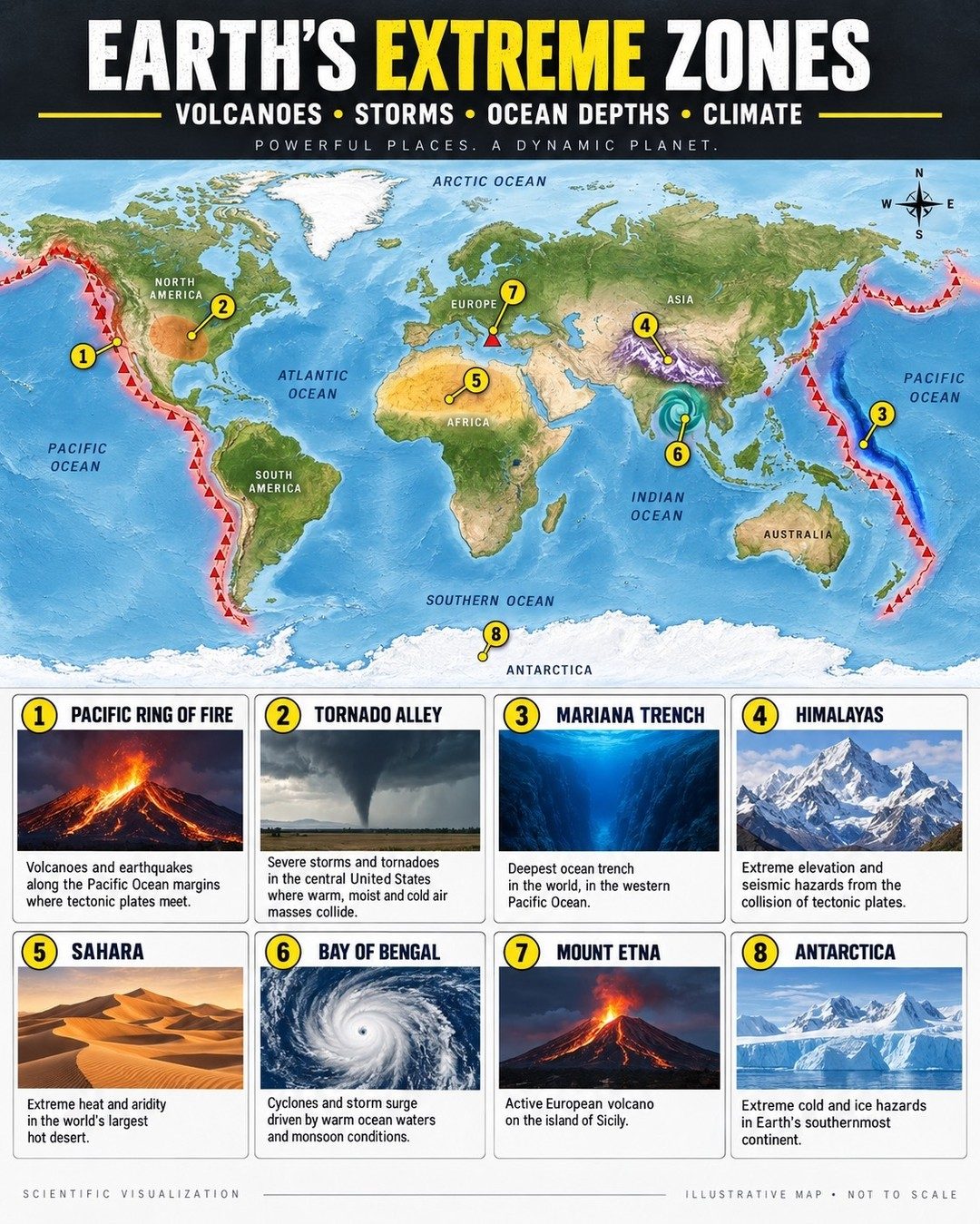
The Unique Drama of Earth's Extreme Zones
Earth's extreme zones may look dramatically different from each other, but they are united by their capacity to humble humanity. The Pacific Ring of Fire is the boundary where tectonic plates collide, creating volcanic hotspots and seismic activity. This zone spans from the western part of North America, southward to Chile, and around to Japan. Nigeria, for instance, is far from the Pacific Rim, but lives in fear of the Ring of Fire. These devastating seismic events might shift landscapes in hours or days. On the other hand, Antarctica presents different threats. Not earthquakes, but temperatures. Cold is routinely worse than heat for human survival: "Out here, heat can be deadly, but cold kills you," as an Arctic survivor might say. The Sahara may be the polar opposite of the Mariana Trench, but not all deserts are hot. The Gobi, for instance, is bitterly cold in winter. Heat is hardly the challenge in cold deserts of Antarctica and the Arabian Peninsula. Yet, the Sahara is unrelenting. Its crime is drought. While Antarctica challenges the physical endurance of human body, societies at risk of drought show that a walk in the desert is easy compared to surviving in it. Some geographers posit we are in the Anthropocene age, but it is the Sahara's aridity that will harness our greatest endurance.
Not All Deserts Are Hot
Antarctica and the Sahara are not the only extreme climate zones. The Himalayas hold the highest point on earth, which is like the limit to human exploration of high altitudes. In contrast, Mariana Trench is the lowest point on Earth. This trench has swallowed some of our most advanced instruments and technology. The Himalayas, however, are not just a cold and dry mountain range. They are also a source of water for various countries. Water from melting glaciers provides local economies with irrigation and drinking water. The Pacific Ring of Fire is not a volcanic zone only for fire and lava. It is also where the deepest ocean trench in the world is located: Mariana Trench. No human being has ever been on the deepest part of the Mariana Trench. Some see it as a sign of all that we don’t know on Earth. Scientists would like us to see it as a last frontier of discovery.
The Pacific Ocean and its extremes
The Pacific Ocean hosts two extremes — the Mariana Trench, the lowest point on Earth, and the Pacific Ring of Fire. Mount Etna is an exception. It is active volcano sitting on no trench. It might be the least active volcano on the list. The Ring of Fire is the locus of the world’s most dramatic earthquakes. On the other hand, Mount Etna is a most violent volcano in Europe. The Arctic Ocean and the Southern Ocean are cold, dark, icy and isolated. The Mariana Trench and Mount Everest are both dark, cold water and ice, or deep “water” and dry, cold rocks. Mount Everest, The Mariana Trench, and Mount Etna are all places where people live, or try to survive. The Sahara and the Arctic are both dry and cold. The Arctic, the Pacific Ring of Fire, and Mount Etna are all places where people live, or try to survive. Fruitful and destructive ocean currents may dominate the Great Barrier Reef, yet it evokes a sense of beauty and fascination that the Mariana Trench does not. Geographically, though, it makes sense that the world’s largest coral reef system forms a living boundary between the Bay of Bengal, and the vast, deep reaches of the Pacific Ocean where massive earthquakes and tsunamis are born.
The Deadliest Natural Phenomena
Natural phenomena are unpredictable, but scientific advancements have made zones like the Sichuan Basin and Tornado Alley more predictable. These disaster-prone zones are generally areas where there is a high concentration of earthquakes, tsunamis, and landslides. These zones are also areas where there is a high concentration of people.
Watch the Reel
Related deep dives
Similar reads based on topic and creator.
Recent articles
Fresh deep dives from the latest Reels we unpacked.
Comments
Be the first to comment.