Earth’s Epic Journey
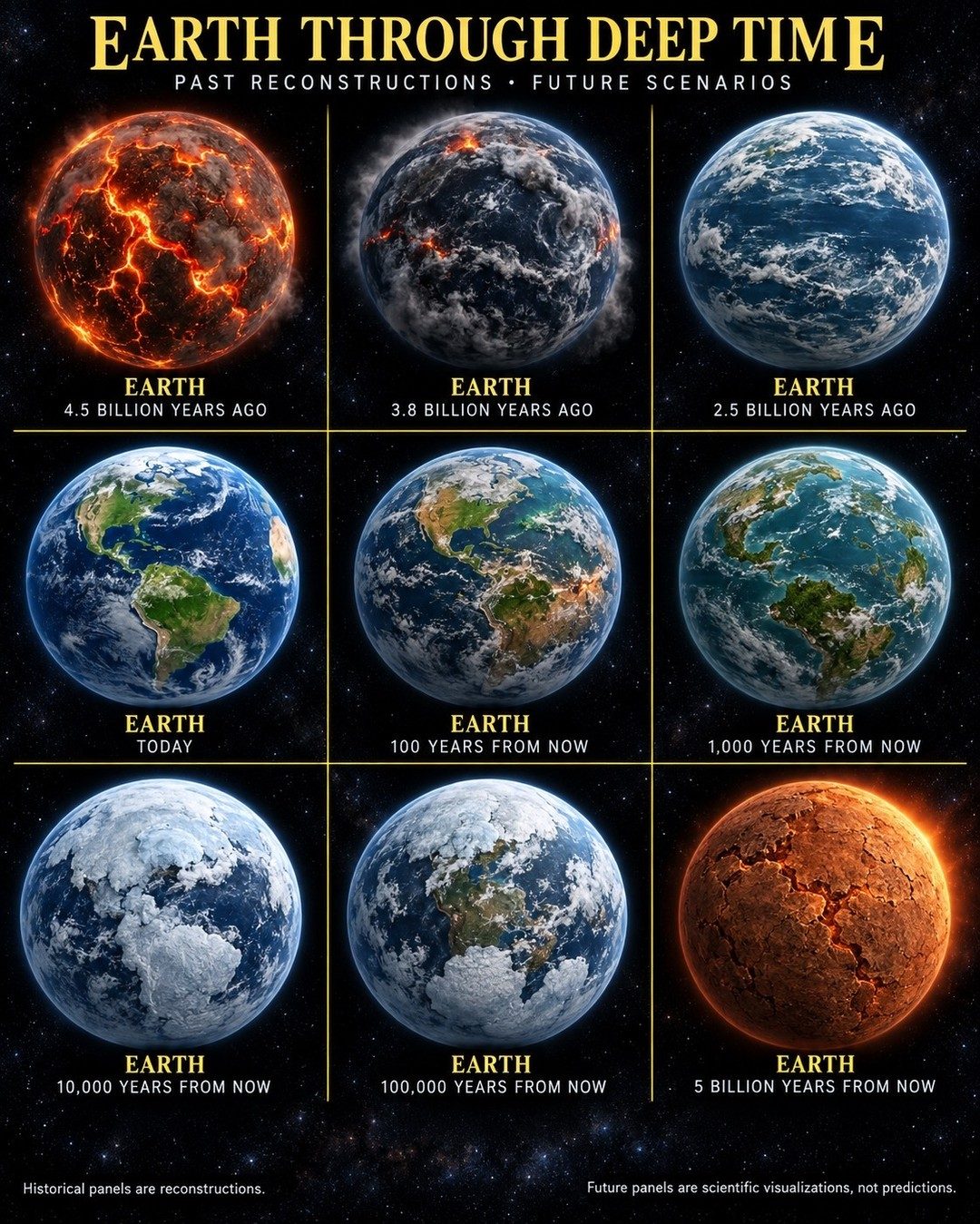
The first time humans beheld Earth from space was a revelation — the blue marble bathed in sunlight, an island of life adrift in cosmic emptiness. But our planet's past and future are far more dramatic than that tranquil scene. Earth’s evolution has been a tumultuous journey, defined by catastrophic turnover and rebirth. It conjures a picture of our planet as a living entity, constantly in flux. Why generate a visual timeline of Earth's evolution, from 4.5 billion years ago to 5 billion years hence? Our species's roots are firmly planted in the present. Yet, a mere 12,000 years ago, Earth was emerging from the last ice age. This geologic blip shaped humanity’s rise as a species. The tectonic plates, volcanic eruptions, and shifting climates that precede human history likewise sculpted the terrain, atmosphere and biosphere that shaped our origin. Notably, the extinction events that decimated past life forms paved the way for new ones to flourish, including the Cambrian explosion that birthed early marine animals. Similarly, the more distant future may hold surprises: ultramarine oceans that destroy the present biosphere, or even a second sun in the sky.
Charting Earth’s Past
Earth’s infancy, 4.5 billion years ago, was a fiery hellscape, a landscape of molten lava. The first three billion years saw the formation of Earth’s crust and the appearance of early microorganisms. Ocean formations emerged and oceans thrived. These provided the ocean environments that were critical for the emergence of complex life. The most dramatic leap forward began 3.8 billion years ago: the Great Oxygenation Event. The advent of plant life precipitated a cascade of change, including trends in climate — especially the sudden onset of ice ages and their cyclical recurrence. This event was a critical turning point for the evolution of life, likely the result of earth absorbing the sun’s energy in a fresh way. Yet, these changes transformed Earth’s atmosphere. The next epoch began 2.5 billion years ago. This transition has been pictured as our planet's “middle age.” By this period, the cataclysmic nature of Earth’s geological activity had more or less settled. Yet the biosphere's interactions with the atmosphere and climate would barely have begun. Evolutionary biologists have speculated that the Cambrian explosion heralded the appearance of complex multicellular life forms. However, fossils of around 2 billion years ago indicate the presence of animals. But these were not animals as we understand the term today. If tardigrade are an example of surviving early life forms, Earth’s future may lie in the hands of these durable water bears.
Our Dynamic Present
Our present planet is the product of billions of years of geological and biological evolution. But it is not stagnant. The geological record shows that changes that appear gradual on human timescales can be extreme over geologic ones. And let’s not forget, Earth’s past is but a prologue for what could happen next. The visual representation of future scenarios is no more than an educated guess, extrapolating from current scientific knowledge. The distant past was entirely different. The future will be a world shaped by forces very different from those that shaped the past. Yet, our planet's dynamic evolution doesn’t stop with humanity. Indeed, our life forms have endured far more radical changes than those we can anticipate today. Of this we can be sure: nothing lasts forever.
Watch the Reel
Related deep dives
Similar reads based on topic and creator.
Recent articles
Fresh deep dives from the latest Reels we unpacked.

Comments
Be the first to comment.