Earth’s Atmospheric Stratigraphy
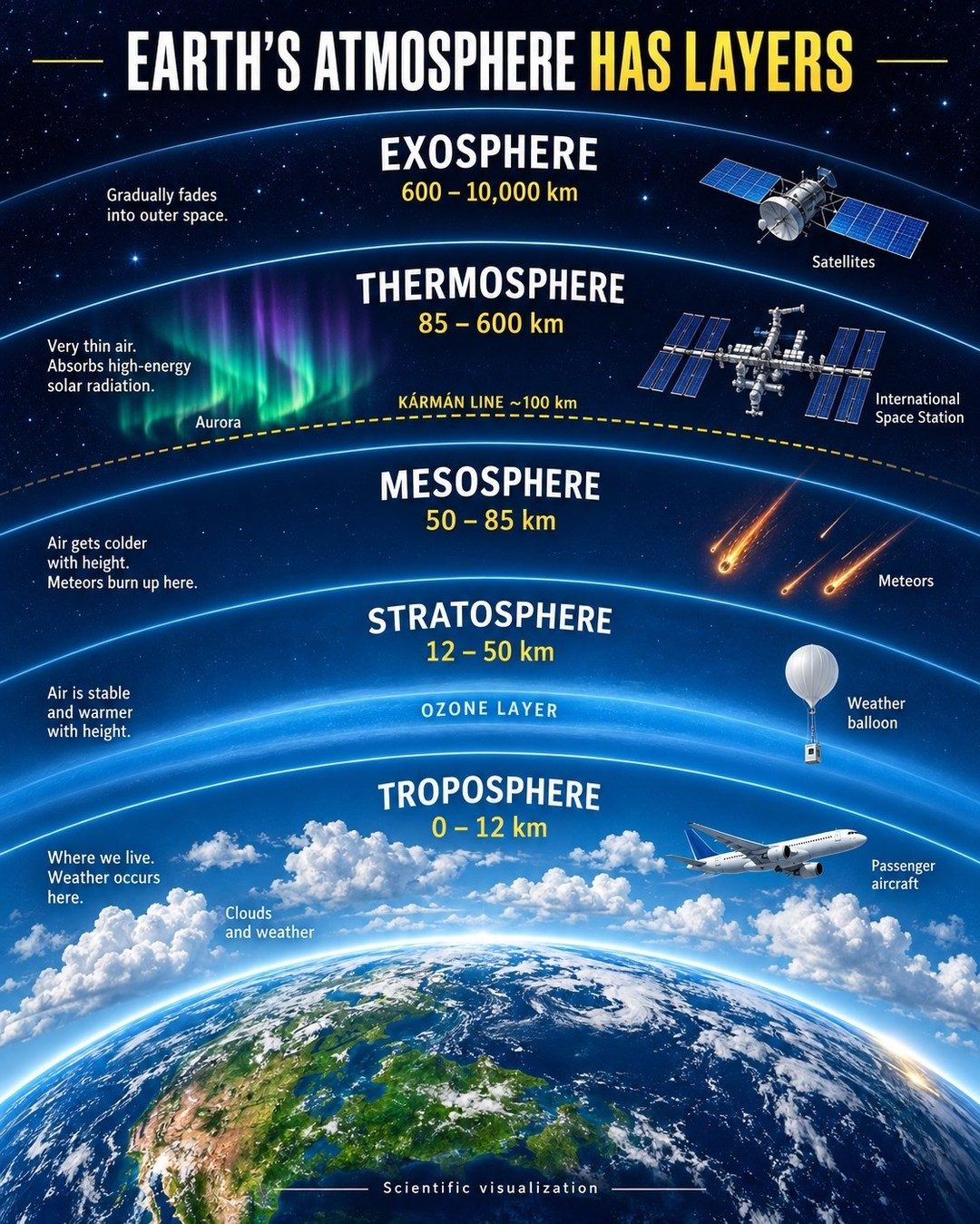
Earth's atmosphere is often visualized as a single, uniform layer. Reality is more complex. Our planet's atmosphere is stratified into five distinct layers: the troposphere, stratosphere, mesosphere, thermosphere, and exosphere. Each layer has unique characteristics and plays a critical role in sustaining life and enabling various technologies. The troposphere is the layer closest to Earth's surface, ranging from 0 to 12 kilometers. It is the densest part of the atmosphere and contains roughly 75% of all atmospheric gases and 99% of water vapor. This layer is pivotal for weather systems and climate patterns. Jet aircraft, weather balloons, and clouds operate at the upper reaches of this layer, which stretches up to the tropopause at around 12 kilometers. This is also where people live and work. While the stratosphere extends from 12 to 50 kilometers, the mesosphere stretches from 50 to 85 kilometers. The stratospheric layer hosts the ozone layer, which absorbs 97-99% of the Sun's UV radiation. This layer is critical for protecting life on Earth from harmful radiation. As a side note, the mesosphere is the layer in which most meteors burn up as they enter the atmosphere.
Technological Hurdles
The layers of the atmosphere are not just a matter of altitude from the stratosphere through the Karman Line to the exosphere. The layers create unique environments for human technology: the thermosphere, from 85 to 600 kilometers, is where satellites and the International Space Station reside. This layer is characterized by extremely low atmospheric pressure and high temperatures, which are caused by solar radiation. Some satellites orbit within few hundred kilometers of the atmosphere, while others venture as high as 10,000 kilometers, blurring the lines between atmospheric layers and space.
The Exosphere & Space
The exosphere begins at around 600 kilometers and extends outward from Earth. The exosphere is the final frontier of the atmosphere and its outer layer. Its boundary with space is undefined and blends into the solar wind. This layer is home to very few atmospheric gases, mainly hydrogen and helium. The exosphere transitions into the realm where satellites and space stations operate. This region is also where the atmosphere meets the void of space, marked by the Karman Line at approximately 100 kilometers. This line is a critical demarcation, distinguishing Earth's atmosphere from the space around us.
Watch the Reel
Related deep dives
Similar reads based on topic and creator.
Recent articles
Fresh deep dives from the latest Reels we unpacked.
Comments
Be the first to comment.