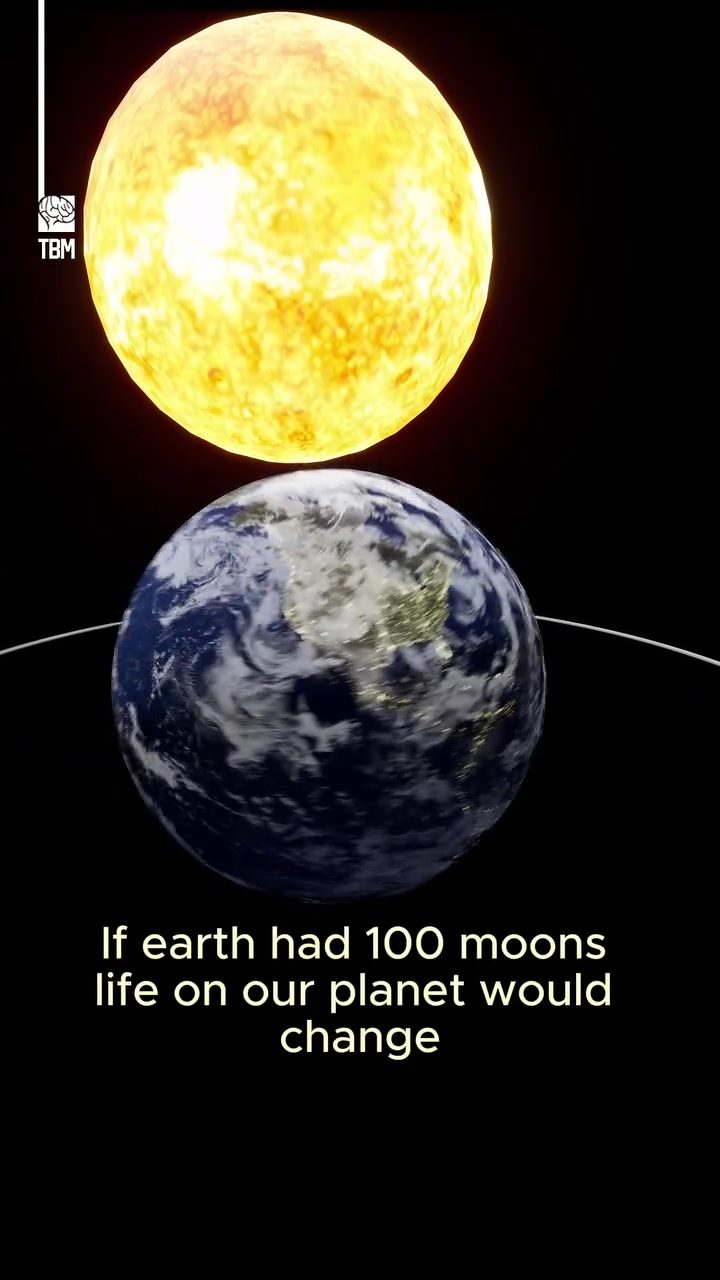
Hypothetical Earth with 100 Moons
Imagine a world where Earth has 100 moons. The concept, while fascinating, brings significant changes and challenges to our planet. This scenario would transform our nights, tides, and overall climate, making Earth a more dynamic but also more dangerous place to live.
Why This Matters
Understanding the potential impacts of having 100 moons on Earth provides valuable insights into the delicate balance of our planet’s systems. It highlights the importance of our current single moon and the stability it brings. Moreover, it offers a perspective on how celestial bodies influence life on Earth, a topic of ongoing interest for astronomers, geologists, and environmental scientists.
The Impact of 100 Moons
Gravitational Effects
The most profound change would be the gravitational influence of 100 moons on Earth. Each moon would exert its own gravitational pull, causing the oceans to rise and fall more dramatically. This would result in much stronger tides, potentially leading to giant waves that could flood coastlines and devastate coastal cities. The gravitational stress would also affect the Earth's rotation, making days unstable and altering weather patterns.
Night Sky and Eclipses
The night sky would undergo a dramatic transformation. Instead of a single moon, the sky would be filled with numerous bright moons, making nights much brighter. Some nights might never become fully dark. The frequent eclipses, caused by multiple moons, would create a spectacle but also pose challenges for navigation and astronomy.
Environmental Changes
The increased gravitational stress could lead to more frequent volcanic eruptions and earthquakes. This instability would make the planet more hazardous for life. Animals that rely on the moon for navigation, such as migratory birds and sea creatures, would face confusion and disorientation.
Long-Term Consequences
Over time, some moons could collide with each other, creating rings of debris around Earth. These debris rings would add another layer of complexity to the sky and potentially pose risks to satellites and spacecraft. Additionally, the constant tug of war between multiple moons could destabilize the Earth's axial tilt, leading to even more extreme climate changes.
Practical Tips
While the idea of 100 moons is purely hypothetical, understanding its potential effects can help us appreciate the importance of our single moon. Here are some practical tips related to this thought experiment:
- Appreciate the Stability: Recognize the stability that our single moon provides, from maintaining stable tides to influencing climate patterns.
- Study Lunar Influences: Engage in studying the effects of the moon on Earth. This can include understanding tides, lunar cycles, and their impact on marine life and weather.
- Explore Astronomy: The concept of multiple moons encourages a deeper exploration of astronomy, especially the dynamics of celestial bodies and their gravitational interactions.
Important Takeaways
Exploring the idea of Earth with 100 moons reveals several key points:
- Gravitational Forces: Multiple moons would significantly alter Earth's gravitational forces, impacting tides, weather, and geological activity.
- Nighttime Illumination: The night sky would be dramatically different, with constant moonlight and frequent eclipses.
- Environmental Impact: Increased gravitational stress would lead to more volcanic and seismic activity, making the planet less stable.
- Long-Term Changes: Over time, some moons could collide, forming debris rings and further altering the environment.
Conclusion
The hypothetical scenario of Earth with 100 moons offers a fascinating glimpse into the potential impacts of multiple celestial bodies on our planet. While the idea is purely speculative, it serves as a reminder of the delicate balance that exists in our solar system. It underscores the importance of our single moon and the stability it provides, encouraging a deeper appreciation for the intricate dynamics of our universe.
Watch the Reel
Questions readers ask
How would Earth's tides be affected by having 100 moons?
With 100 moons, Earth's tides would be significantly more complex and extreme. The gravitational forces from multiple moons would create frequent and dramatic tidal fluctuations, leading to much higher high tides and much lower low tides. This could result in substantial coastal erosion and flooding.
What would the night sky look like with 100 moons?
The night sky on a 100-moon Earth would be a breathtaking spectacle. The sky would be filled with multiple bright, visible moons at various sizes and phases, creating a stunning celestial display. However, this would also mean less visible stars and constellations due to the extra moonlight.
How would 100 moons impact Earth's weather patterns?
The weather on a 100-moon Earth would be far more volatile and unpredictable. The increased gravitational stress and frequent eclipses would lead to extreme temperature fluctuations and erratic weather patterns, including stronger storms and more severe weather events. This could make long-term weather forecasting much more challenging.
Would having 100 moons increase volcanic activity on Earth?
Yes, the increased gravitational stress from 100 moons could potentially lead to more frequent and intense volcanic activity. The constant tug of gravity from numerous moons could cause more tectonic activity, leading to a higher number of volcanic eruptions and earthquakes, making Earth a more geologically active place.
How often would eclipses occur with 100 moons?
Eclipses would be a common occurrence on a 100-moon Earth. With so many moons, the likelihood of one or more moons aligning between Earth and the Sun or Earth and the Moon would significantly increase, leading to frequent lunar and solar eclipses. This could result in periods of temporary darkness in the middle of the day or night.
How would the climate change with 100 moons?
Earth's climate would see drastic changes with 100 moons. The altered gravitational forces would lead to more pronounced seasonal variations, changes in ocean currents, and shifts in atmospheric circulation. This could result in some regions becoming much colder while others become warmer, creating new climate zones and potentially making some areas uninhabitable.
What would be the impact of 100 moons on Earth's gravitational changes?
With 100 moons, Earth would experience constant and varying gravitational forces. The pull from multiple moons would cause the Earth to be slightly stretched and compressed in different directions, leading to a more oblate shape and potential changes in the Earth's rotational axis. This could affect the planet's overall stability and internal dynamics.
Related deep dives
Similar reads based on topic and creator.




Recent articles
Fresh deep dives from the latest Reels we unpacked.




Comments
Be the first to comment.