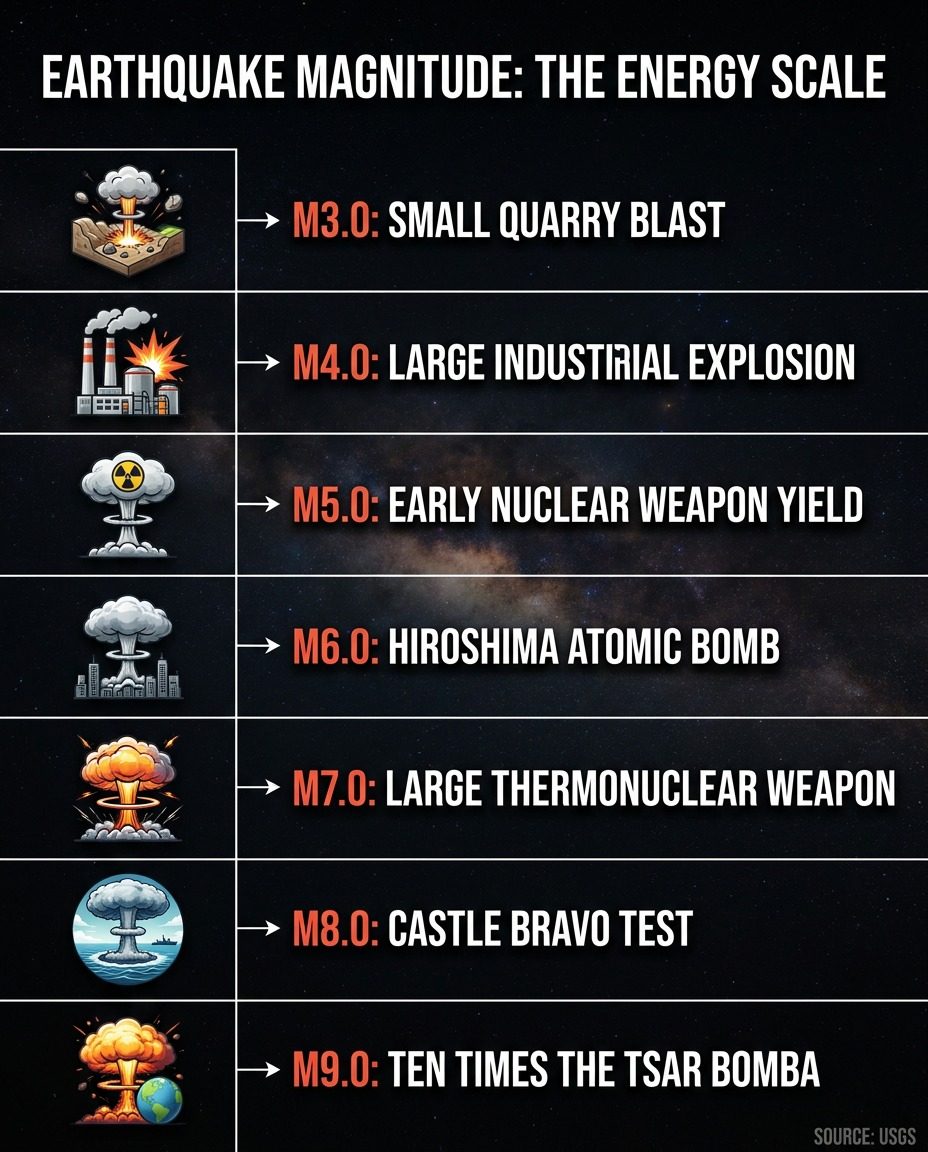
The exponential nature of earthquake magnitudes
Seismologists worldwide rely on a logarithmic scale to measure earthquakes, one that is anything but straightforward. Each whole number increase in magnitude represents a dramatic leap in energy release. Specifically, each step up the scale denotes approximately 32 times more energy. The most powerful earthquakes are unforgivingly stronger than lower magnitudes. This means the jump from a magnitude 6.0 to a 9.0 isn't just three times more powerful, but over thirty-thousand times stronger. That’s a tenfold increase over the energy release the Tsar Bomba, the largest nuclear weapon ever detonated, and the almost incomprehensible force that was the 1960 Valdivia earthquake in Chile, measuring 9.5. On this scale, seismologists be careful when estimating a magnitude. Half a point makes a world of difference. The reference point for the most powerful earthquake is the 1960 Valdivia in Chile, which measured 9.5, a devastating earthquake that showed just how destructive the ground underfoot could be. This was also before the last major earthquake in Haiti, which measured a mere 7.0. The exponential scale makes the destruction seem so much less severe, but it was devastating in its own right. It displaced over 220000 people and resulted in over 100,000 deaths.
Earthquakes & Comparable destruction
Earthquakes can be simplified in how they break down destruction into relatable figures. A magnitude 3.0 earthquake, a minor tremor, is comparable to a small quarry blast. Moving up, a magnitude 4.0 earthquake is similar to a large industrial explosion that would cause noticeable shaking. A 5.0 earthquake is about the same power as an early nuclear weapon. At the higher end of the scale, a magnitude 6.0 earthquake is equivalent to the Hiroshima atomic bomb. That would be an earth-shattering roar of flames, a mushroom cloud, and devastation, and this scales up. So, for instance, a magnitude 7.0 earthquake is comparable to a large thermonuclear weapon, the sort of weapon that would result in the sort of nuclear fallout that would spread over a wide distance, tainting soil for years on end. The scale of destruction is almost unimaginable. A magnitude 8.0 earthquake is comparable to the Castle Bravo test, which had an unpredictable wind event, the amount of radiation was not close to the test’s prediction. And a magnitude 9.0 earthquake is ten times the energy of the Tsar Bomba, the most powerful nuclear device ever detonated. These immense energy releases could be unparalleled in their immediate destruction. The sheer force of a 9.5-magnitude earthquake could leave whole countries uninhabitable and us breathless,
Energy liberation vs. ground displacement
The impact of an earthquake is not just about the power of the energy released. It's about how the energy is liberated. While rock is a strong material, it doesn’t behave like the steel and concrete we’re accustomed to working with. So, imagine trying to build a house with extra-long boards that occasionally snap. That’s what rock is trying to do - stay strong, while under pressure and squeezing. This means that rock won’t snap until it’s under the right stress, because it’s under pressure everywhere, and it can bend and flex and roll with the punches. That’s why they can continue to be strong under pressure from earthquakes. But, when the pressure is too much, it cracks, creating a fault. This crack between rock faces is a fracture that creates a plate boundary. This is where the crust of the Earth separates. There are three main types of fault. Normal faults go down and pull apart. These are the sort of earthquakes that are usually found in mountain-building regions. There’s also the reverse fault, which is when the Earth moves upwards and pushes together. At the fault line, when this happens, the depth is defined when the rocks on either side slide past each other. They could slide upwards, or they could slide downwards. This isn’t just about earthquakes, it’s about the life of our planet.
Watch the Reel
Related deep dives
Similar reads based on topic and creator.
Recent articles
Fresh deep dives from the latest Reels we unpacked.
Comments
Be the first to comment.