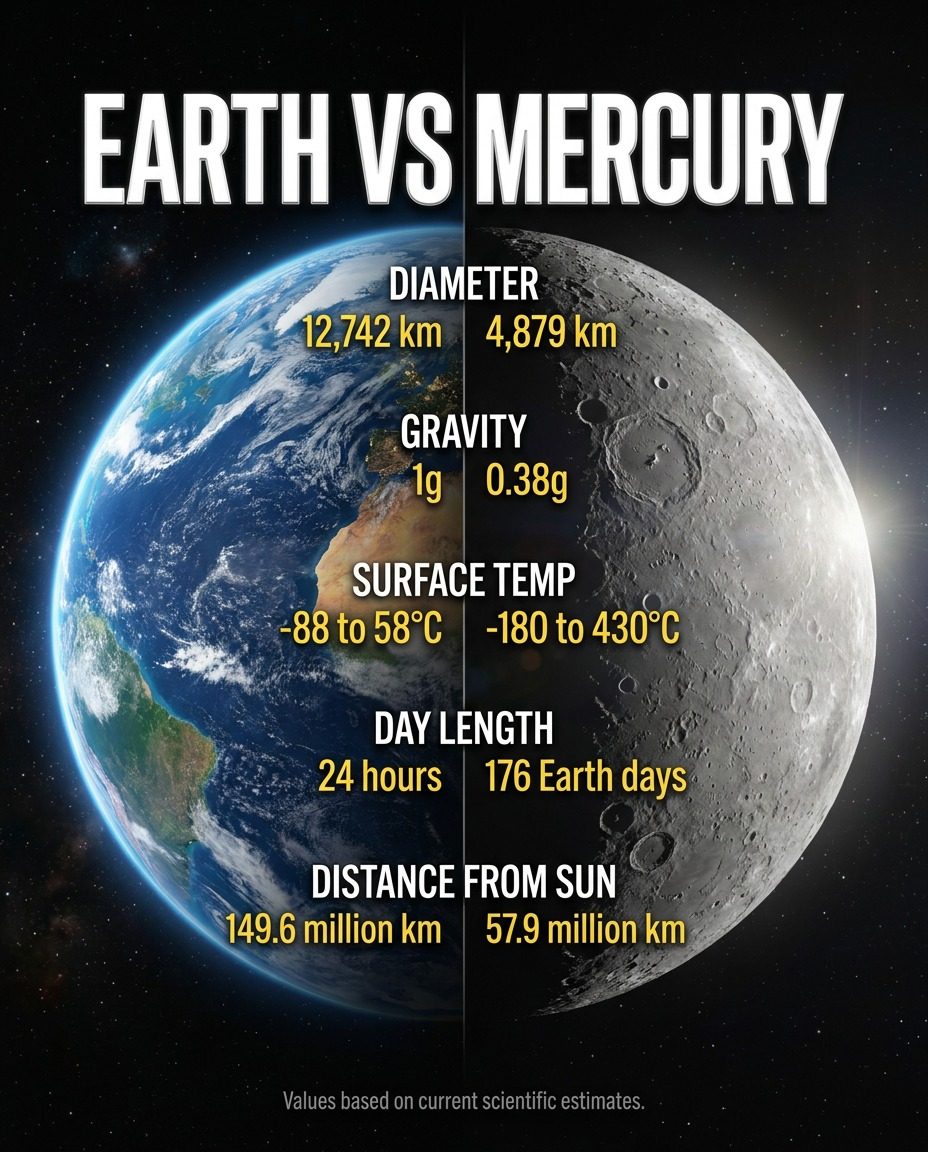
Earth vs. Mercury — a study in extremes
Earth and Mercury present a stark contrast, highlighting the diversity of planets within our solar system. Mercury, the smallest of the eight planets, has a mere diameter of 4,879 kilometers. This makes it just over a third the size of Earth, which boasts a diameter of 12,742 kilometers. Mercury's diminutive size has significant implications for its gravitational pull, which is only about 0.38 times that of Earth. This lower gravity would make a person weigh far less on Mercury than on Earth. Furthermore, Mercury's surface temperature extremes are far more pronounced. Earth’s temperatures range from a freezing -88°C to a scorching 58°C. In contrast, Mercury’s surface temperature swings from -180°C to a blazing 430°C. These extremes are due to its proximity to the sun and lack of a substantial atmosphere to regulate heat. Mercury’s extreme temperatures are a direct result of its orbit. At just 57.9 million kilometers from the sun, it is the closest planet to our star, making 176 Earth days equal to just one day on Mercury. The length of a day on Mercury is drastically different from Earth, which rotates on its axis once every 24 hours. The proximity to the sun also means Mercury receives more intense solar radiation.
A day on the smallest planet
The lengthy day on Mercury—176 Earth days—is a stark contrast to Earth's 24-hour cycle. This extended day night cycle means that one side of Mercury is constantly exposed to sunlight for prolonged periods. This prolonged exposure contributes to the planet's extreme day temperature of 430° C. Conversely, Mercury’s night side experiences temperatures as low as -180°C. The vast disparity in temperature between Mercury’s day and night sides underscores the planet's extreme conditions. The disparity in day and night lengths arises from Mercury’s slow 59-day rotation around its axis and a highly eccentric, or elliptical, orbit around the Sun. The daylight period on Mercury is longer, amounting to 88 Earth days. This extended daylight period, paired with its proximity to the Sun, results in extreme temperatures. Additionally, Mercury's extremely thin atmosphere doesn't retain heat effectively, resulting in drastic temperature shifts between day and night. Moreover, Mercury’s slow rotation rate of 59 Earth days is another contributing factor to the temperature variability.
Migration of Ice
The prolonged daylight period is responsible for the migration of ice on Mercury. Mercury's Polar Regions may contain ice water according to NASA, but what drives the migration? Recent research suggests that the movement of ice on Mercury is tied to the tides created by the Sun. As the Sun’s gravitational pull causes Mercury's surface to bulge, the ice—trapped beneath the surface—migrates along with the bulge. This phenomenon, known as tidal deformation, occurs because of Mercury's close proximity to the sun and its highly eccentric orbit. This extreme environment has polar ice. Despite the intense heat, Mercury has permanent ice at its poles. This is possible due to the low angle of the sun at these regions and the deeply shielded, permanently shadowed craters. The tilt of the planet results in some polar regions being permanently shadowed and subfreezing. Much of this ice is believed to have arrived via cometary impacts.
Orbital impact
Mercury’s orbit, unlike Earth's circular one, is markedly elliptical. At its closest approach to the Sun, known as perihelion, Mercury is a mere 46 million kilometers away. This proximity results in Mercury’s daylit side experiencing significantly higher temperatures. Conversely, at its furthest point, or aphelion, Mercury is 70 million kilometers from the Sun. This distance and Mercury’s lack of a substantial atmosphere means that temperatures can drop dramatically during its night. The elliptical orbit further contributes to the temperature extremes, causing dramatic shifts in its distance from the sun. This orbit results in Mercury experiencing two full days in a Mercurian year. Furthermore, Mercury's elliptical orbit causes the Sun to appear two and a half times larger than it does from Earth.
Watch the Reel
Related deep dives
Similar reads based on topic and creator.


Recent articles
Fresh deep dives from the latest Reels we unpacked.

Comments
Be the first to comment.