Cosmic distinctions
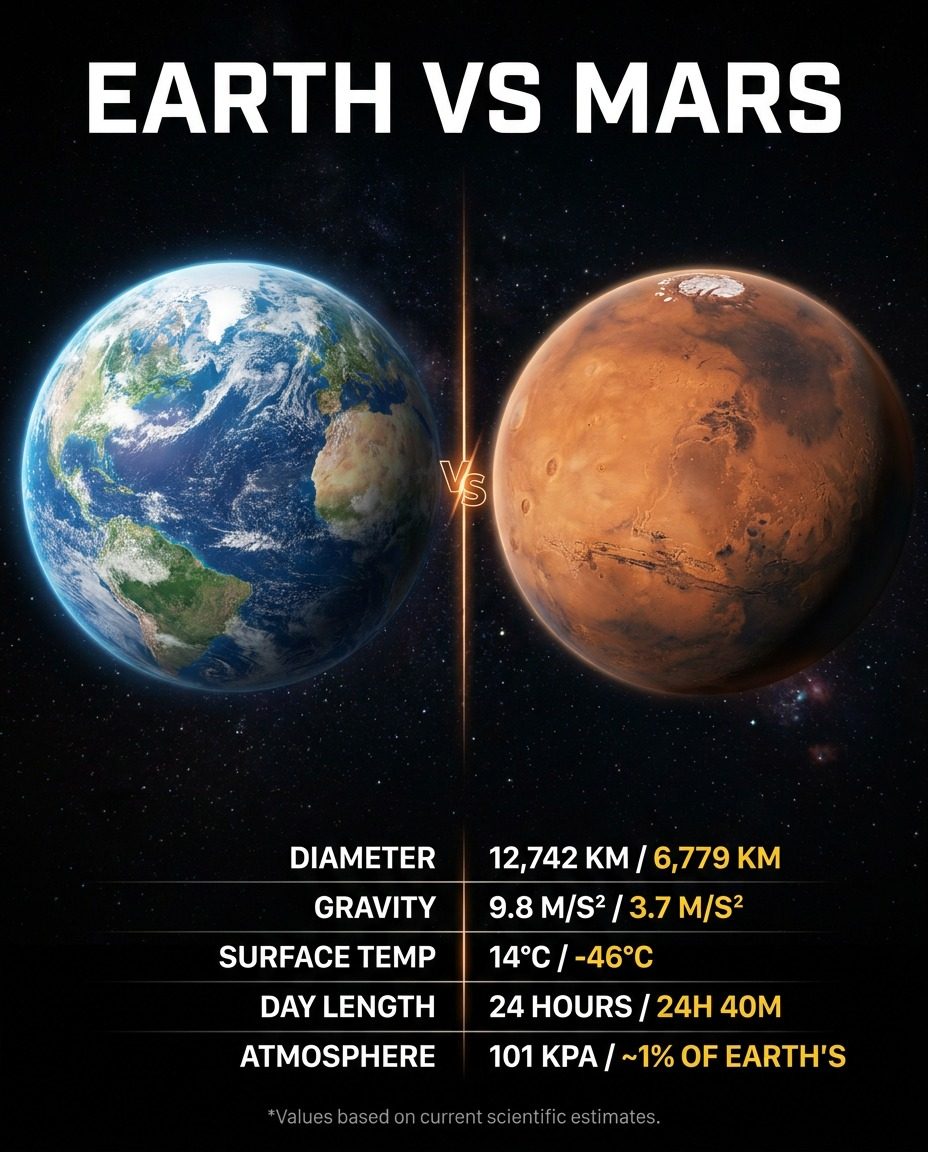
Earth and Mars share a cosmic neighborhood, but their differences are stark. Mars languishes as a shrunken sibling, with a diameter of 6,779 km compared to Earth's 12,742 km. This discrepancy in size isn’t merely academic. It influences the strength of gravity on Mars, which stands at a mere 3.7 M/S²—about 38% of Earth’s 9.8 M/S². This gravitational difference is more than a simple factoid; it profoundly affects the physical characteristics of the two planets. On Mars, a person weighing 100 pounds on Earth would feel like they weigh a mere 38 pounds. Furthermore, Mars is less densely packed with matter, contributing to its lower gravitational pull—an important consideration for future human exploration and habitation. One of the most striking differences between Earth and Mars is their day lengths. Earth completes a full rotation on its axis in a comfortable 24 hours. Mars, on the other hand, takes 24 hours and 40 minutes. This extra 40 minutes might not seem significant, but over time, it adds up to considerable differences. For instance, a year on Mars is roughly 687 Earth days, making its seasonal cycles nearly twice as long as Earth’s. Observing the Martian sky, a person would witness the sun rise and set 2.7% slower, a subtle but palpable difference that would affect everything from daily routines to long-term astronomy data.
The thin atmosphere of Mars
Earth's robustness and habitability are due in significant part to its atmosphere. Earth's atmosphere exerts 101 kilopascals (kPa) of pressure, a force that can press down on a square meter with a weight of approximately 1,000 kilograms. On Mars the atmospheric pressure is approximately 1% of Earth's, making it almost a vacuum compared to what we experience. While Earth's atmosphere is a dynamic blend of nitrogen, oxygen, and trace gases, Mars has a thin, cold atmosphere composed primarily of carbon dioxide (96%), with trace amounts of nitrogen and argon. Together, Earth's dense atmosphere and moderate gravity protect the planet from solar and cosmic radiation. This difference in atmospheric pressure affects more than just human habitability. Mars' thin atmosphere results in weather patterns that are vastly different from Earth’s. Dust storms on Mars can become global, enveloping the entire planet, whereas Earth’s atmospheric density allows for localized weather phenomena. Furthermore, the lack of a global magnetic field on Mars allows solar wind to strip away the planet’s atmosphere over time, a process that has contributed to its current state. Earth’s magnetic field, on the other hand, acts as a protective shield, deflecting solar particles, mostly keeping its atmosphere intact.
Watch the Reel
Related deep dives
Similar reads based on topic and creator.


Recent articles
Fresh deep dives from the latest Reels we unpacked.


Comments
Be the first to comment.