Defining the worlds
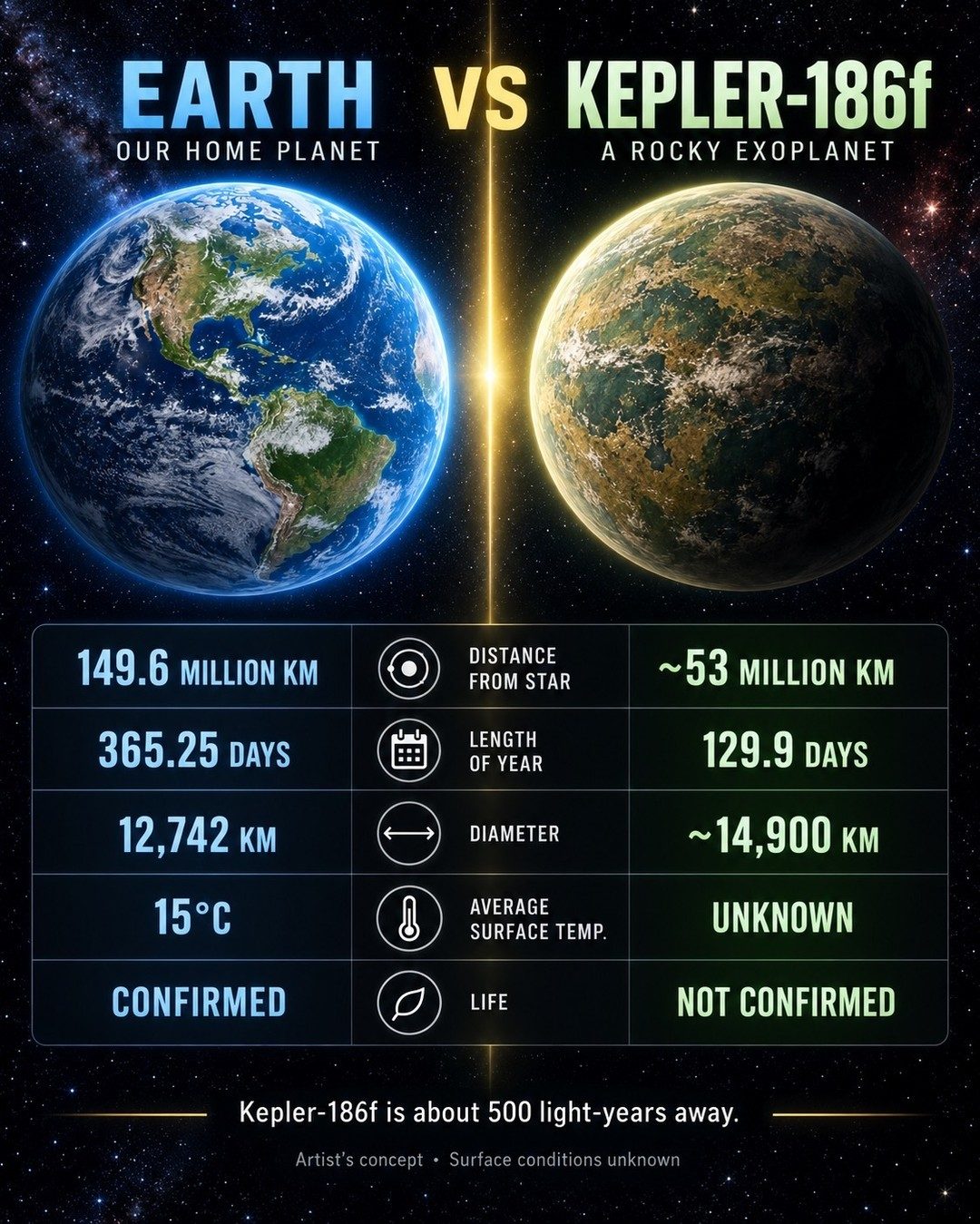
In the vast expanse of the universe, two planets, Earth and Kepler-186f, offer a stark contrast in basic characteristics. Earth, our home, is a familiar, confirmed habitable zone planet. It orbits the sun, approximately, 149.6 million kilometers away and circles it every 365.25 days, creating our calendar of seasons. In comparison, Kepler-186f orbits a sun five times farther away with a length of year 129.9 days. The planets have different diameters: Earth's is 12,742 kilometers, while Kepler-186f's is approximately 14,900 kilometers. This larger diameter suggests Kepler 186f is a rocky planet. However, its surface temperature is up for debate, since no one has yet been close enough for measurement. This temperature is a key marker for habitability, meaning the possibility of liquid water.
The depth of distance
An average surface temperature of 15°C is one thing, but the status of Kepler-186f’s life cannot be confirmed even with the best technology. Earth's status as a habitable planet is confirmed, an obvious statement, but a point that sets the scene for this comparison. Conversely, Kepler-186f remains an exoplanet, a rocky world beyond our solar system, roughly 500 light-years away. This distance isn't just a measure of separation, but a call to imagine whether life might exist elsewhere and what we need to explore such a question. Kepler-186f is the first and currently the closest planet we've found in the habitable zone — the orbital distance where liquid water might exist on a surface. Data shows its year length is 129.9 days and it is a rocky world. The imagination required to imagine this planet is its own topic, however.
The constraints of visibility
Kepler-186f is an artist’s concept — and not a confirmed habitable planet. Its surface conditions are unknown. The planet's rocky nature and its size compared to Earth give us a backdrop for understanding its characteristics, but confirmation of life remains elusive. Kepler-186f is not alone in the habitable zone. 13,994 planets have been discovered, with many lying within the habitable zone. This means they lie in the "Goldilocks zone" of a star, but it doesn’t mean they have life. Earth and Kepler-186f are two points on a spectrum of possibilities, both making us question how many planets are truly habitable. What does this comparison really tell us? It makes us interpret data and draw lines between our own concepts of life and of our universe.
Watch the Reel
Related deep dives
Similar reads based on topic and creator.


Recent articles
Fresh deep dives from the latest Reels we unpacked.



Comments
Be the first to comment.