Earth's Little Cousin
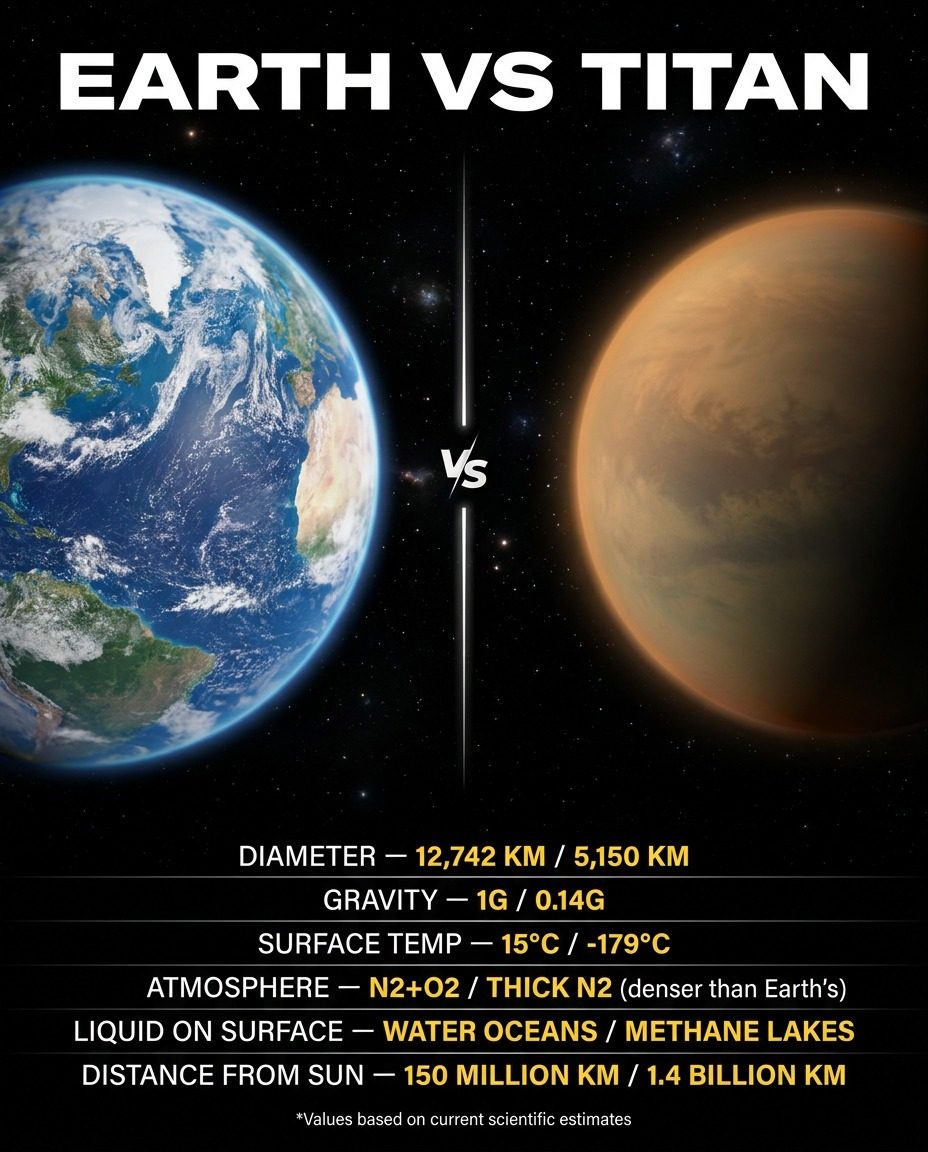
Saturn's largest moon, Titan, has long fascinated astronomers with its Earth-like features. Titan is the more distant cousin of Earth—clouded and mysterious but with intriguing parallels. Physically, Titan is smaller, with a diameter of 5,150 kilometers compared to Earth's 12,742 kilometers. But Titan's gravitational pull is a mere 0.14G, a stark contrast to the perfect 9.8 meters per second squared measure of Earth’s gravity. One may struggle to walk if ever on Titan. The conditions on Titan are so different that its gravity might elicit an Earthling to "I'd need more than just a strong metal ladder to stand on the surface, it would be a bouncy experience compared to Earth."
Distance, Atmosphere, and Temperature
Titan orbits 1.4 billion kilometers from the sun, almost ten times farther than Earth’s 150 million kilometers. This vast distance results in a frigid surface temperature of -179 degrees Celsius. Yet, despite the harsh temperature, Titan’s atmosphere is another point of fascination. Earth’s atmosphere, rich in oxygen, sustains life, comprised of nitrogen and oxygen. Titan's atmosphere is even thicker, denser. Though it's comprised of nitrogen, the gas composition creates a dense blanket around the moon. But the parallels don't stop there. On Titan, the atmospheric pressure is much higher and the density creates a thicker and more resistant layer in contrast to Earth's atmosphere.
Lakes and Surface Composition
The surface of Titan is another point of difference and similarity. Liquid bodies can exist there but the hydrocarbon-based lakes which are rich in methane. Whereas Earth hosts oceans rich with water. This suggests that life might be possible there, albeit very different from life as we know it. Researchers are still discovering whether the conditions on Titan could potentially allow for the formation of complex organic molecules, which are the building blocks of life.
The Potential for Life
The presence of hydrocarbons on Titan also hints at the potential for life as we know it. Yet, while Earth’s water and oxygen sustain carbon-based life, Titan’s methane and ethane lakes present a different avenue for possible life. Methane might function as a solvent in place of water, and the environment might favor different forms of organic chemistry. Exoplanet-similar but not Earth. Scientists are dazzled by this — and for good reason. The idea of an entirely new biochemistry is fascinating. Titan might reveal that life, however tenuous, is more prevalent in our universe.
Watch the Reel
Related deep dives
Similar reads based on topic and creator.


Recent articles
Fresh deep dives from the latest Reels we unpacked.

Comments
Be the first to comment.