Geo-nemesis
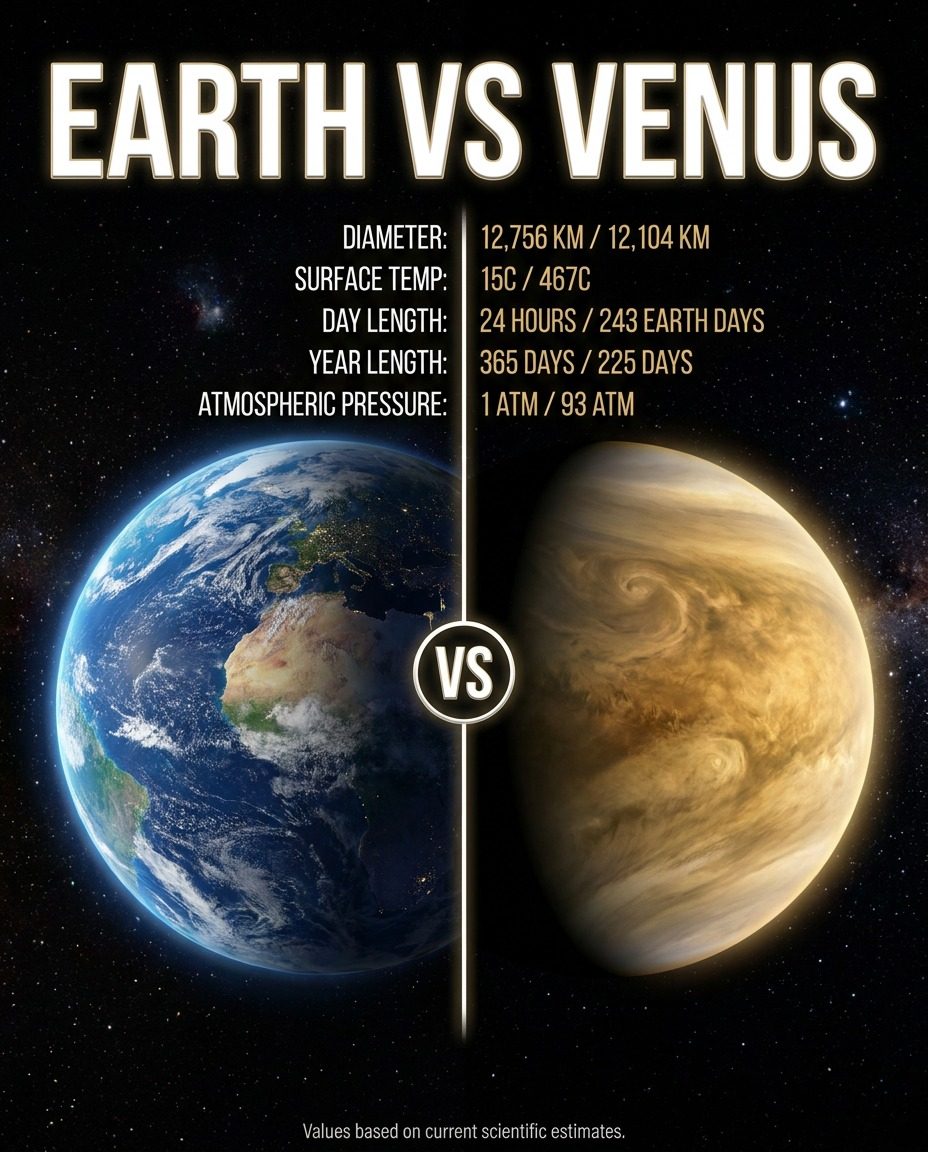
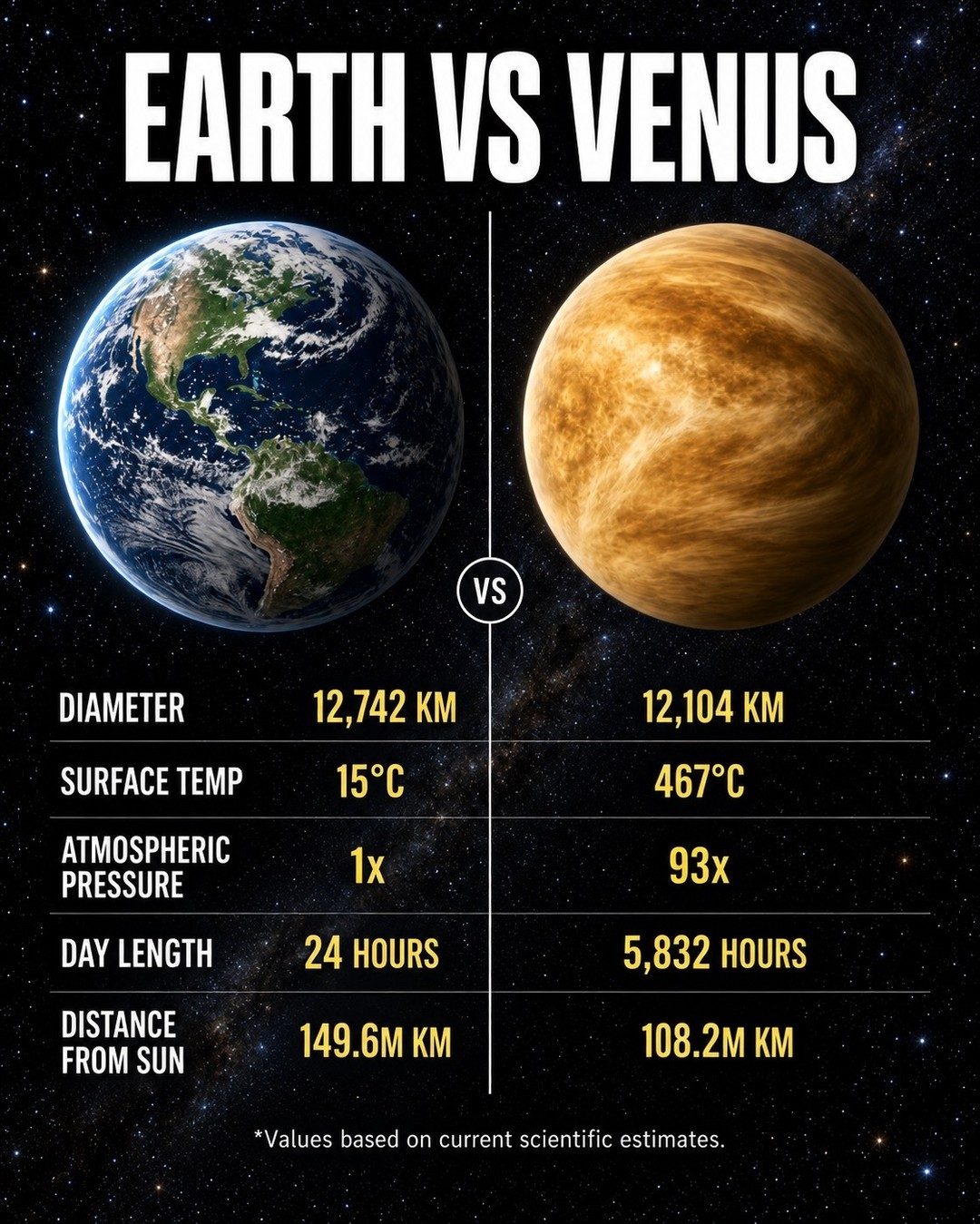
Venus is Earth’s celestial doppelganger, eerily similar in size, yet wildly divergent in habitability. Measuring in at 12,756 km and 12,104 km respectively, the two planets are nearly twins in diameter. However, that is where the resemblance ends. The surface temperature of Venus is approximately 467°C — hot enough to melt lead. This stark contrast underscores the dramatic difference in atmospheric conditions. Earth’s surface temperature is a relatively hospitable 15°C. The reason for this extreme heat is Venus's runaway greenhouse effect, powerful enough to trap immense heat under an crushing atmospheric pressure of 93 ATM. This is equivalent to standing nearly 3,000 feet underwater. The atmosphere is so oppressive. This is what is responsible for the postcard temperature on Venus, about 872°F. It is this substantial difference in pressure that starkly differentiates the two planets.
Earth and Venus: A Study in Contrasts
Considering their nearly identical origins and size, what makes Venus such an inhospitable planet? A primary factor is the planet's unique rotation pattern. Venus rotates in reverse compared to nearly every other planet. Additionally, it rotates slowly — painstakingly so. One full spin takes 243 Earth days. That is longer than an entire Venusian year, which is 225 Earth days. This counterintuitive rotation affects the planet's day-night cycle. Additionally, it contributes to the extreme temperature and atmospheric conditions. It would not be incorrect to assume that this extreme rotation also contributes in some way to the extreme atmospheric pressure of the planet.
Missing ingredients for life
Venus formed alongside Earth from similar materials and at a similar distance from the Sun. It has nearly the same constituent elements. However, something went amiss. Venus's proximity to the sun, while favorable, was a recipe for disaster because it triggered the runaway greenhouse effect that rendered Earth's twin an uninhabitable inferno. Venus's atmospheric pressure is 93 times that of Earth's, creating a crushing environment. Thus, the Earth formed a more tenable environment for life as we know it. This has profound implications for understanding the development of different planetary environments.
Earth and Venus: A Tale of Two Outcomes
The similarities in size and composition between Earth and Venus make their divergent fates all the more striking. Venus, the second planet from the Sun, is a cautionary tale. Its atmospheric conditions suggest what the Earth's environment could have been. As the similar material of the planets show the proximity to the sun contributed to the development of the two planets. With one planet greatly affected by the proximity of the sun and the other just hospitable enough to sustain life. Humanity is left to ask the profound questions: what broke the runaway greenhouse effect for Earth? Why did Earth get water while Venus got nothing. Why are conditions on Venus so extreme? Understanding Venus could provide clues to Earth’s future. And as we gaze at the cosmic comparison, we are left to wonder what happened to Venus, the Earth that was.
Watch the Reel
Related deep dives
Similar reads based on topic and creator.
Recent articles
Fresh deep dives from the latest Reels we unpacked.

Comments
Be the first to comment.