The Conception of Day and Night
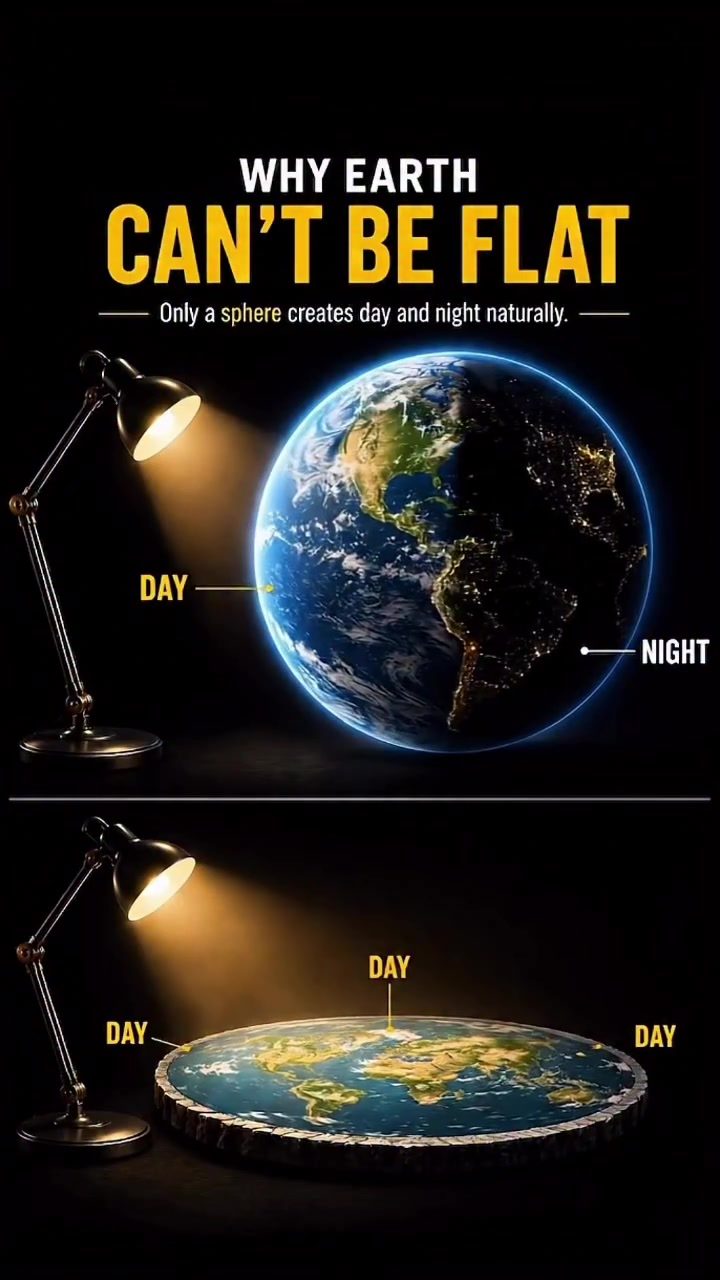
Our understanding of the Earth's shape has evolved through centuries of observation and scientific inquiry, with the shape being the most widely accepted as a sphere. But why? Why does the Earth have to be a sphere and not a rectangular prism or a flat plane? The answer lies in the occurrence of day and night. This is not a feature of the axis of rotation, but a feature of the shape of the Earth. In fact, a sphere is the only shape that can sustain the natural occurrence of day and night. The concept begins with the Earth's rotation. The Earth rotates on an axis that is tilted 23.5 degrees from the vertical. The Earth rotates on this axis once every 24 hours, and the parts of the Earth that are facing towards the Sun experience day, while the parts that are facing away from the Sun experience night. The flat shape does not provide this variation. The process operates like a giant globe. A flat Earth model cannot sustain the natural occurrence of day and night, because it would not be possible to have varying degrees of sunlight at the same time. The sun, being a spherical object, would be able to hit the entire surface of the Earth as it rotates. The flat Earth model, which is a rectangle, would result in some parts of the Earth being perpetually in light and others in darkness. This is why, the flat Earth model could never cause sunrise and sunset.
The Role of the Sun
Its distance from the Earth affects how much sunlight reaches the surface. The Earth's tilt and rotation, combined with the sun's position in the sky, create the cycle of day and night. The Earth's surface is such that the Sun illuminates the varying degrees of surfaces. These degrees range from the equator to the poles. The sun's rays strike the equator more directly than the poles, resulting in a greater amount of daylight and a higher intensity of sunlight at the equator. The flat Earth model fails to justify this because it does not simulate this process. This is because the flat Earth model is not a representation of the Earth's surface, it is a representation of the Earth's surface as a flat plane. The sphere's rotation allows for varying degrees of sunlight and thus day and night. The sun's rays strike the Earth at different angles, resulting in different amounts of daylight and different intensities of sunlight. This is why the spherical Earth model is the only model that can sustain the natural occurrence of day and night. The rotation of the Earth also creates the cycle of seasons, with the amount of daylight and the intensity of sunlight varying throughout the year. The same is not the case with the flat Earth model, it can not explain the varying degrees of sunlight at the same time.
The Distribution of Sunlight
The Earth's shape distributes sunlight unevenly across its surface. This uneven distribution creates the varying lengths of day and night, with the poles experiencing extended periods of daylight and darkness throughout the year while the equator has relatively consistent day and night lengths throughout the year. This uneven distribution of sunlight on the Earth's surface, day and night, is independent of the axis of rotation. It is a feature of the spherical shape of the Earth. This is due to the shape of the Earth and the angle of its axis of rotation. The Earth's tilt and rotation, combined with the sun's position in the sky, create the cycle of day and night. On the flat Earth model, the distribution is not anywhere as uniform as on a sphere. This distribution means that it's not possible to have a day or a night at the same time at every location on a flat Earth. This difference is the key feature of distinction in the two models. It is not the axis of rotation, but the spherical shape of the Earth that provides the varying degrees of sunlight. The sphere's rotation of the axis in the tilted position allows for varying degrees of sunlight and thus day and night. This is why the Earth must be a sphere to naturally create day and night.
Watch the Reel
Related deep dives
Similar reads based on topic and creator.


Recent articles
Fresh deep dives from the latest Reels we unpacked.


Comments
Be the first to comment.