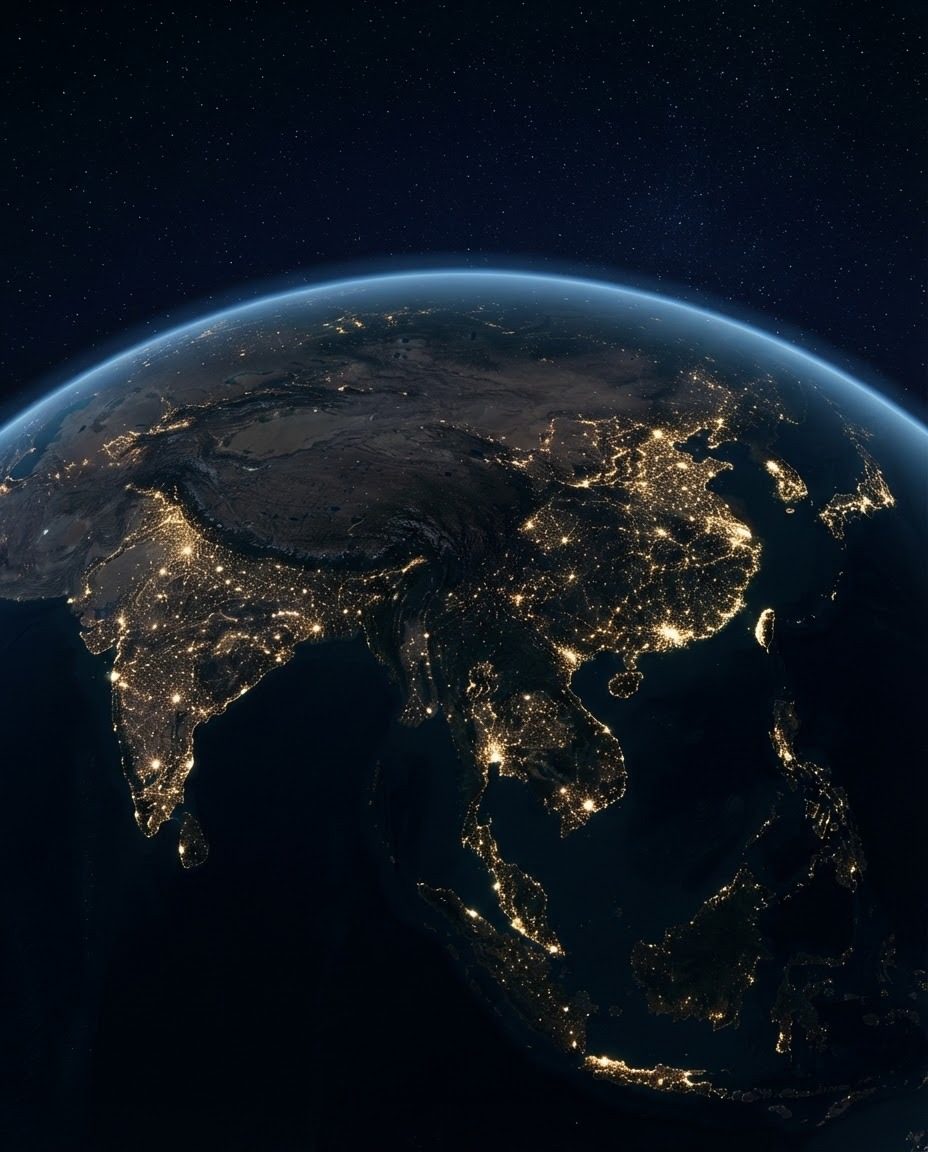
The Intertwined Destinies of Light and Darkness
Here, amidst the cosmic darkness, is a silent testament to humanity’s relentless drive for ambient light. The Earth’s curvature is a reminder of our planet’s confines, yet the millions of city lights that glow through the night defy its limitations. These lights offer a sense of proximity to the cosmos. The continents of India, China, and Southeast Asia, teeming with billions of people, are etched out one bright patch at a time. Their luminescence makes us, the Earth’s residents, a united constellation. The pattern of lights across the Asian continent reveals a story. Each radiating dot is a tale of its own — a living community, a bustling economy, and a diverse geography. India, with its dense population centers, lights up the northern regions. Further east, China appears as a sprawling canvas of light, with the seascape dotting the eastern coastline. Southeast Asia glows next, a jumble of small and large clusters that mimic a starry expanse. Humans are a force of nature, and this image is one of our more visible impacts. As it turns out, we may have to work towards a more balanced light distribution. Our collective brightness exacerbates the levels of light pollution and disrupts the natural night cycles affecting all life forms. Yet, understanding our patterns of light is a step towards managing its footprint. As a species, we have found ways to illuminate the world. The city lights show how far we've come from using fire and candles, to having a night that doesn’t need moon or stars. This day and age gives us the ability to bathe in a world of radiance. Dense city lights create a glittering tapestry, and how fascinating it is to look at this image from above. It creates an illusion of a celestial body, with these bright cities acting as blue-white stars. The ability to view this image is a marvel on its own, especially when you take into account the height from which this image was captured. Vision for viewing these patterns from afar isn’t new. Astronauts have long shared images of Earth from space, which illuminate our planet at night, showcasing the power of our collective energy. There is evidence that urban light pollution is disrupting both the human and nocturnal ecosystems. Researchers have recorded that thousands of birds, insects, and fish struggle to navigate due to the light pollution.
A World Without Night
Yet, the very presence of these lights has led us to believe that we are in control, and there are consequences. The uninterrupted night cycles are vital for both humans and wildlife. Artificially lit nights have been described as a physiological stressor. This impacts the well-being of humans, causing repercussions on health. Disruption to animals is even more pronounced. Light pollution isn’t just visual; it’s dangerous. Nevertheless, the stunning visuals of our planet’s northern half illuminate a larger question. There isn’t a night anymore, entirely. There is a spectrum of shades to it. Perhaps the most fascinating aspect of what these lights define is their limitations. Their existence is finite, but this image captures a moment in time, and a region, a unique perspective on a story that keeps on unfolding. The Earth’s light, from India to Southeast Asia, is a no man’s wonder that’s too beautiful to ignore, yet too complex to fully comprehend.
Watch the Reel
Related deep dives
Similar reads based on topic and creator.

Recent articles
Fresh deep dives from the latest Reels we unpacked.




Comments
Be the first to comment.