College Degree Salaries
In today's job market, the choice of a college degree can significantly influence your earning potential. This is particularly evident when comparing the median mid-career wages across different fields. According to recent data from the New York Federal Reserve, some degrees command substantially higher salaries than others.
Why this matters
Choosing a college degree is a critical decision that can shape your financial future. Understanding which degrees lead to the highest and lowest median salaries can help students and professionals make more informed choices about their educational and career paths.
Highest-Paying College Degrees
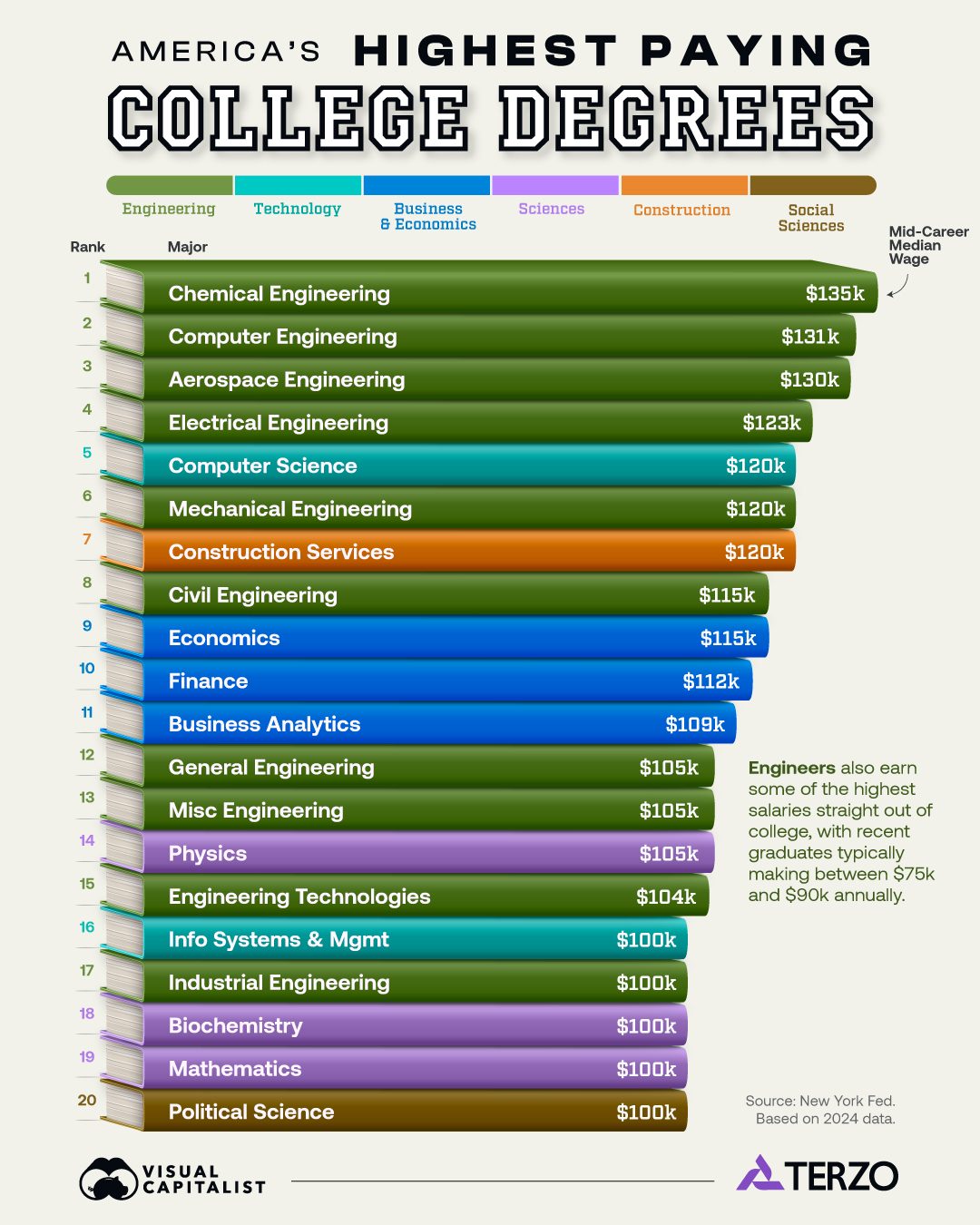
Engineering and technology fields dominate the list of highest-paying college degrees. Here are the top earners:
-
Chemical Engineering: At the top of the list, chemical engineering graduates earn a median mid-career salary of $135,000. This field involves the design and development of processes and systems for the production of chemicals and related products, making it highly valuable in various industries.
-
Computer Engineering: Close behind, computer engineering graduates earn a median of $131,000. These professionals work on the hardware and software aspects of computers, making them indispensable in the tech industry.
-
Aerospace Engineering: With a median salary of $130,000, aerospace engineering is another high-earning field. These engineers design and develop aircraft, spacecraft, and related technologies, making them critical in both the defense and aerospace industries.
-
Electrical Engineering and Computer Science: Tied at $120,000 each, electrical engineering and computer science are both crucial in the tech world. Electrical engineers focus on the design and development of electrical systems, while computer science deals with the theoretical foundations of computation and software development.
Other High-Paying Degrees
Beyond engineering and tech, other fields also offer substantial median mid-career wages:
-
Mechanical Engineering: With a median salary of $120,000, mechanical engineers work on the design, development, and analysis of mechanical systems.
-
Construction Services and Civil Engineering: Both fields command a median salary of $115,000. Civil engineers focus on the design and construction of physical infrastructure, while construction services involve managing and executing construction projects.
-
Economics, Engineering Management, and Information Systems Management: These fields have median salaries around $115,000, $104,000, and $100,000 respectively. Economists analyze economic data, solve complex problems, and make informed policy decisions. Engineering Management combines technical expertise with business acumen, while Information Systems Management involves managing and securing information systems.
-
Industrial Engineering, Biochemistry, Mathematics, and Political Science: These fields all command a median salary of $100,000. Industrial engineers improve productivity and efficiency, biochemists study the chemical processes within living organisms, mathematicians solve complex mathematical problems, and political scientists study political systems and behaviors.
Lowest-Paying College Degrees
On the other end of the spectrum, degrees in education, social sciences, health, and arts tend to have lower median mid-career wages:
-
Early Childhood Education, Elementary Education, Special Education, and Miscellaneous Education: These fields have some of the lowest median salaries, ranging from $52,000 to $60,000. Educators in these fields play a crucial role in shaping young minds, but their salaries reflect the lower funding and resources in public education.
-
Social Services, Health Services, Nutrition Sciences, and Psychology: These fields have median salaries ranging from $60,000 to $72,000. Social service professionals work with individuals and communities to address social and health issues, while health service providers and nutrition scientists focus on public health and wellness.
Practical Tips
When choosing a college degree, consider the following tips:
Explore Your Passions: While salary is important, pursuing a degree in a field you are passionate about can lead to greater job satisfaction and long-term success.
Research Job Growth: Look into the job outlook for different fields. Even if a degree has a lower median salary, it might offer strong job growth prospects.
Consider Location: Salaries can vary significantly based on location. Researching regional salary differences can help you make a more informed decision.
Network: Building connections in your desired field can open up opportunities for internships, mentorship, and job offers.
Pursue Advanced Degrees: In some fields, pursuing an advanced degree can significantly boost your earning potential.
Important Takeaways
Choosing a college degree is a significant decision that can shape your financial future. By understanding the median mid-career wages across different fields, you can make more informed choices about your educational and career paths. While engineering and tech fields offer the highest salaries, it's essential to consider your passions, job growth, location, and networking opportunities. Pursuing advanced degrees can also boost your earning potential in many fields.
Conclusion
Choosing a college degree is a pivotal moment that can set the trajectory for your career and financial future. By understanding the median mid-career wages across different fields, you can align your educational choices with your earning potential. Whether you choose a high-paying field like engineering or a lower-paying field like education, pursuing your passions and making informed decisions can lead to a fulfilling and successful career.
Watch the Reel
Questions readers ask
Which college degrees are expected to have the highest salaries in 2024?
In 2024, degrees in engineering and technology fields are projected to have the highest salaries. Specific areas like aerospace, computer, chemical, and electrical engineering, as well as computer science, are expected to lead the way in median earnings.
How do engineering degrees fare in terms of salary compared to other fields?
Engineering degrees, particularly in specialized areas such as aerospace, electrical, and chemical engineering, consistently rank among the highest-paying college degrees. These fields often command significantly higher salaries compared to degrees in the social sciences and arts.
What is the expected median salary for a computer science graduate in 2024?
Data from the New York Federal Reserve indicates that computer science graduates can expect a high median mid-career salary, placing it among the top-paying degrees in 2024. The exact figure may vary, but it is generally competitive with other high-paying engineering fields.
Which college degrees typically have the lowest salaries?
Degrees in the arts and social sciences generally have lower median salaries compared to those in engineering and technology. For example, graduates with degrees in fine arts, sociology, and psychology tend to have lower earning potential when compared to their peers in high-demand STEM fields.
Why is it important to consider salary trends when choosing a major?
Considering salary trends when choosing a major can help students align their career goals with their financial needs. It enables informed decision-making, ensuring that the chosen field of study has the potential to offer a rewarding career path and financial stability.
Related deep dives
Similar reads based on topic and creator.

Recent articles
Fresh deep dives from the latest Reels we unpacked.




Comments
Be the first to comment.