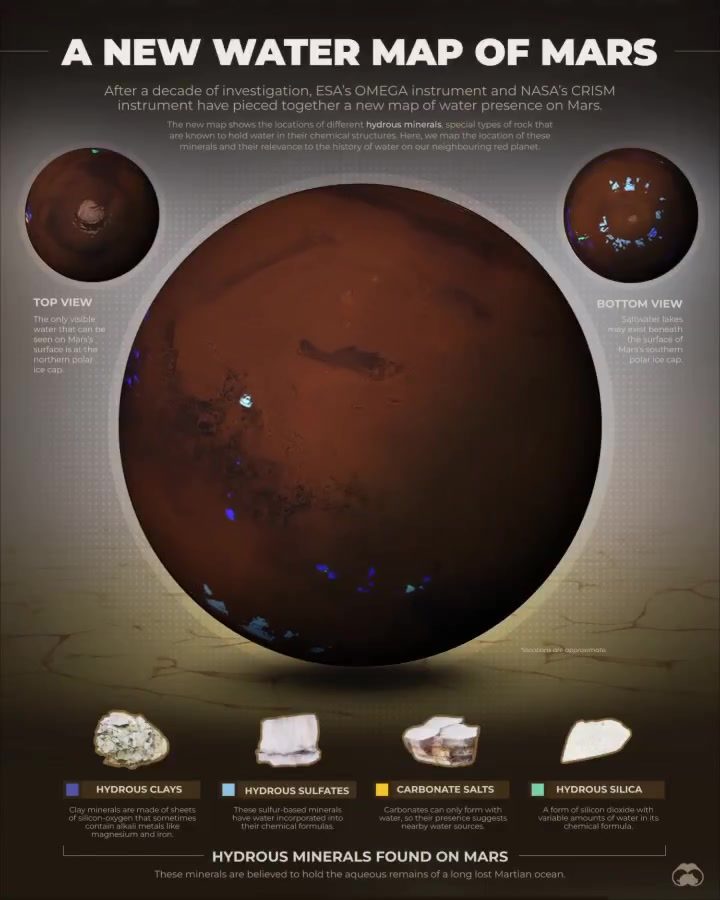
New Water Map of Mars
The recent discovery of new data on Martian water has produced a detailed map highlighting the presence of water on Mars. Both NASA and the European Space Agency (ESA) have been using special instruments to search for water on Mars. Their joint effort has resulted in a map showing the locations of different hydrous minerals. These minerals are special types of rock that can hold water in their chemical structures. The location and types of these minerals provide crucial insights into the history of water on Mars.
The new map is the result of a decade of investigation by ESA's OMEGA instrument and NASA's CRISM instrument. These instruments have mapped the locations of various hydrous minerals that tell the story of Mars' water-rich past.
Context / Why this matters
The search for water on Mars is driven by both scientific curiosity and practical considerations. On Earth, water is essential for life as we know it—from simple microorganisms to complex ecosystems. Discovering where water exists on Mars could reveal similar life forms, such as microbes, and provide valuable insights into the potential habitability of the planet.
Knowing where water is present on Mars is crucial for any future human exploration and potential habitation. It could provide essential resources, like drinking water and raw materials for life support systems. Understanding the history and distribution of water on Mars will be fundamental to planning future missions and ensuring human survival on this challenging frontier.
Main discussion
The new map
The new map of Mars highlights the locations of different hydrous minerals, which are special types of rock that hold water in their chemical structures. These minerals are crucial for understanding the history of water on Mars. The map, created by the OMEGA and CRISM instruments, offers a detailed view of the red planet's water presence.
Hydrous minerals and their significance
Hydrous minerals are essential for understanding Mars' water history. These minerals include:
-
Hydrous Clays: Made of sheets of silicon, oxygen, and sometimes containing alkali metals like magnesium and iron. These minerals are often found in areas where water once flowed, providing clues about past water activity.
-
Hydrous Sulfates: These minerals form in the presence of water and sulfuric acid, often found in dry lake beds and other dried-up water sources.
-
Carbonate Salts: These minerals indicate the presence of water and carbon dioxide, suggesting a possible role in Mars' carbon cycle.
-
Hydrous Silica: This mineral is often associated with hot springs and geothermal activity, pointing to areas where water may have been heated and circulated.
The history of water on Mars
The presence of these hydrous minerals provides a window into Mars' watery past. Scientists believe that these minerals hold the aqueous remains of a long-lost Martian ocean. The distribution of these minerals across the planet tells a story of a once-wet Mars, where water flowed and potentially supported life.
Practical tips
For those interested in exploring the new water map of Mars, here are some practical tips:
-
Understand the Instruments: Familiarize yourself with the OMEGA and CRISM instruments. Knowing how these tools work can help you better interpret the data they provide.
-
Study the Mineral Types: Learn about the different hydrous minerals and their significance. Each type of mineral provides unique insights into Mars' water history.
-
Analyze the Map: Use the map to explore the distribution of hydrous minerals. Look for patterns and correlations that might offer clues about past water activity.
-
Explore Related Research: Stay updated with the latest findings from NASA and ESA. These agencies regularly publish new data and insights that can deepen your understanding of Mars' water history.
Important takeaways
One of the most significant takeaways from the new water map of Mars is the richness of data it provides. The presence of various hydrous minerals tells a complex story of Mars' water history. This data is essential for both scientific research and future exploration missions. Understanding where water is located on Mars could be crucial for future human habitation and survival.
Conclusion
The new water map of Mars is a significant milestone in our understanding of the red planet. It provides a detailed view of where water exists and has existed in the past. This information is invaluable for scientific research, future exploration missions, and potential human habitation. By studying the distribution and types of hydrous minerals, we can gain deeper insights into Mars' water history and its potential to support life.
Watch the Reel
Questions readers ask
What are hydrous minerals and why are they important in the new Mars map?
Hydrous minerals are types of rock that contain water in their chemical structure. In the context of the new Mars map, these minerals are crucial because they provide evidence of past water activity on the planet. Their locations help scientists understand where and when water was present on Mars, aiding in the quest to learn about the planet's water history.
Which instruments were used to create the new water map of Mars?
The new water map of Mars was created using data from two instruments: ESA's OMEGA (Observatoire pour la Mineralogie, l'Eau, les Glaces et l'Activité) and NASA's CRISM (Compact Reconnaissance Imaging Spectrometer for Mars). These instruments were used to identify and map the locations of hydrous minerals on the Martian surface.
How long did it take to create the latest Mars water map?
The latest Mars water map is the result of a decade of investigation. Both ESA and NASA utilized special instruments to search for water on Mars, and the process took over ten years to complete.
What does the new map reveal about the history of water on Mars?
The new map reveals that Mars once had a water-rich past. By showing the locations of various hydrous minerals, the map provides vital clues about where water was present and how it shaped the Martian surface over time, offering insights into the planet's water history.
Why is the collaboration between NASA and ESA significant for Mars exploration?
The collaboration between NASA and ESA is significant because it combines the expertise, technology, and resources of two major space agencies. This collaboration has led to the creation of detailed maps, like the new water map, which are essential for understanding the Martian environment and planning for future human exploration and missions on the Red Planet.
What are the implications of the new water map for future Mars missions?
The new water map can help identify potential sites for future Mars missions, particularly those focused on finding signs of past life or assessing the availability of water resources. Knowing the locations of hydrous minerals can guide the selection of landing sites and the planning of surface operations for rovers and human explorers.
How does the new water map contribute to our understanding of Mars' surface water?
The new water map contributes to our understanding of Mars' surface water by providing a detailed overview of where hydrous minerals are found. These minerals indicate the presence of past water activity, helping scientists piece together the puzzle of how water flowed and pooled on the Martian surface in the past.
Related deep dives
Similar reads based on topic and creator.




Recent articles
Fresh deep dives from the latest Reels we unpacked.




Comments
Be the first to comment.