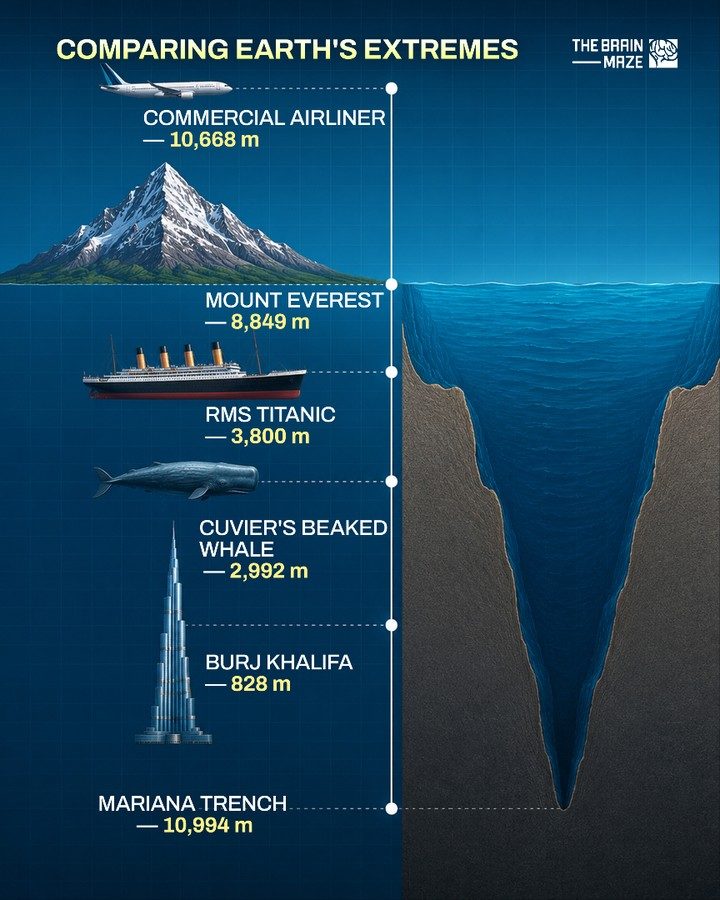
Earth's Extremes: A Vertical Comparison of Heights and Depths
The visual representation of Earth’s most extreme heights and depths offers a fascinating perspective on the vast scale of our planet. This infographic from The Brain Maze places iconic landmarks and natural phenomena on a single vertical scale, providing a clear comparison between some of the highest and lowest points on Earth.
Context: Why This Matters
Understanding the extremes of our planet's topography helps us appreciate the sheer magnitude of our environment. It underscores the incredible diversity of ecosystems and the challenges that come with exploring and studying them. By visualizing these extremes, we gain a deeper appreciation for the limits of human exploration and the technological advancements required to reach these heights and depths.
Main discussion
The Mariana Trench
The Mariana Trench is the deepest part of the world’s oceans, reaching a staggering 10,994 meters below sea level. Located in the western Pacific Ocean, this trench is a site of intense scientific interest. The extreme pressure and near-freezing temperatures at these depths make it one of the most inhospitable environments on Earth. Despite these challenges, the trench is home to a variety of unique and hardy species, many of which have adapted to the harsh conditions.
Commercial Airliners at Altitude
Commercial airliners typically fly at an altitude of around 10,668 meters. This height is crucial for fuel efficiency and passenger comfort, as it allows planes to avoid turbulence and fly through thinner, less dense air. Flying at such high altitudes also helps in overcoming air resistance, making long-distance travel faster and more economical. The placement of airliners on the scale highlights the remarkable engineering that allows humans to traverse the skies so efficiently.
Mount Everest
Mount Everest, standing at 8,849 meters, is the highest peak on Earth. Located in the Himalayas, it attracts mountaineers from around the world seeking the challenge and prestige of summiting the world's tallest mountain. Climbing Mount Everest requires extensive training, specialized equipment, and a deep understanding of high-altitude physiology. The sheer elevation makes it a formidable challenge, with harsh weather conditions and thin air posing significant risks.
The RMS Titanic Wreck
The RMS Titanic rests at a depth of 3,800 meters in the North Atlantic Ocean. This iconic ship, which sank in 1912, has become a symbol of maritime disaster and human tragedy. The wreckage, discovered in 1985, offers valuable insights into the technology and materials used in shipbuilding during the early 20th century. The depth at which it lies underscores the challenges of underwater exploration and preservation.
Cuvier's Beaked Whale
Cuvier’s beaked whale is known for its remarkable diving abilities, reaching depths of up to 2,992 meters. These whales are one of the deepest-diving mammals, capable of holding their breath for up to 90 minutes. Their diving behavior is driven by the need to hunt for prey in the deep sea, where food sources are sparse. The extreme depths at which these whales dive reveal much about the adaptations needed to survive in such a challenging environment.
The Burj Khalifa
The Burj Khalifa, located in Dubai, stands at 828 meters, making it the world’s tallest building. This architectural marvel is a testament to human ingenuity and engineering prowess. The building's height and modern design have made it an iconic symbol of Dubai and a major tourist attraction. The Burj Khalifa's position on the scale emphasizes the impressive achievements of modern construction and the impact of vertical urban development.
Practical Tips
Understanding Heights and Depths
When exploring the extremes of our planet, it’s essential to understand the technical challenges and risks involved. Whether you are a scientist studying the Mariana Trench or a mountaineer aiming to summit Mount Everest, meticulous planning and extensive preparation are crucial. This includes acquiring the right equipment, undergoing physical and mental training, and being aware of the potential hazards associated with extreme environments.
Scientific and Technological Innovations
The study of Earth’s extremes has driven significant advancements in various scientific and technological fields. These include deep-sea exploration, high-altitude medicine, and structural engineering. Innovations in these areas not only help us explore and understand our planet better but also have practical applications in everyday life, such as improving medical technologies and enhancing building safety.
Environmental Conservation
Exploring and understanding Earth’s extremes also underscores the importance of environmental conservation. The unique ecosystems found in these extreme environments are fragile and vulnerable to human interference. Efforts to protect these areas are crucial for preserving biodiversity and ensuring the sustainability of our planet.
Technological Advancements in Exploration
The exploration of Earth’s extremes relies heavily on cutting-edge technology. From remotely operated vehicles (ROVs) used to explore the depths of the ocean to advanced climbing gear and satellite imagery, technology plays a pivotal role in making these explorations possible. Staying informed about the latest technological advancements can enhance your understanding and appreciation of these extreme environments.
Important Takeaways
1. Scale and Magnitude: The sheer scale of Earth’s extremes highlights the vast differences between the highest and lowest points. This comparison underscores the challenges and risks associated with exploring these environments.
2. Technological Innovations: The exploration of these extremes has driven significant technological advancements, from deep-sea exploration to high-altitude medicine.
3. Environmental Sensitivity: Understanding the fragility of these environments is crucial for conservation efforts and ensuring the sustainability of our planet.
4. Human Achievement: The placement of iconic landmarks and natural phenomena on a single scale showcases human achievements in exploration, engineering, and scientific research.
Conclusion
The vertical scale comparison of Earth’s extremes provides a captivating visualization of our planet’s most impressive heights and depths. From the soaring peaks of Mount Everest to the depths of the Mariana Trench, these extremes offer a wealth of knowledge and insights into the challenges and triumphs of exploring our world. By understanding these extremes, we gain a deeper appreciation for the diversity and complexity of our planet, as well as the ingenious technologies and adaptations that enable us to explore and study these environments.
Watch the Reel
Questions readers ask
What is the depth of the Mariana Trench?
The Mariana Trench, located in the western Pacific Ocean, reaches a maximum-known depth of approximately 11,000 meters (36,070 feet) at a point known as the Challenger Deep, making it the deepest point on Earth.
How tall is Mount Everest compared to other tall peaks?
Mount Everest, standing at about 8,848.86 meters (29,031.7 feet), is the world's tallest peak above sea level. To put this into perspective, it is more than twice as tall as the second-highest peak, K2, and more than three times taller than the tallest man-made structure, the Burj Khalifa.
What are some of the engineering feats that have allowed humans to explore the extremes of Earth's heights and depths?
Engineering innovations such as advanced climbing equipment and specialized vehicles like submersibles and drones have enabled humans to reach the summit of Mount Everest and descend into the Mariana Trench. Additionally, advanced materials and technologies have facilitated the construction of tall buildings and bridges, pushing the limits of human exploration and achievement.
What are the limits of human exploration on Earth?
The limits of human exploration on Earth are defined by extreme heights and depths, as well as harsh environmental conditions. These include the highest peaks, the deepest ocean trenches, and some of the most remote and inhospitable regions on the planet. Exploring these areas requires specialized training, equipment, and resources.
How do the world's tallest buildings compare to the world's tallest mountains?
The world's tallest buildings, such as the Burj Khalifa, reach heights of around 828 meters (2,717 feet). In contrast, the world's tallest mountains, like Mount Everest, reach heights of approximately 8,848.86 meters (29,031.7 feet). This means that the tallest mountains are many times taller than the tallest man-made structures, highlighting the vast scale of Earth's natural formations.
Are there other deep ocean trenches besides the Mariana Trench?
Yes, besides the Mariana Trench, there are several other deep ocean trenches on Earth. Some of the notable ones include the Tonga Trench, which reaches a depth of about 10,882 meters (35,702 feet), and the Philippine Trench, which is approximately 10,540 meters (34,580 feet) deep. These trenches are formed by tectonic activity and are home to unique ecosystems.
What are some of the most extreme depths of the Earth?
The most extreme depths on Earth are found in the ocean trenches, with the Mariana Trench being the deepest at about 11,000 meters (36,070 feet). Other notable deep points include the Tonga Trench, reaching approximately 10,882 meters (35,702 feet), and the Philippine Trench, which is around 10,540 meters (34,580 feet) deep. These depths are far beyond the reach of most sunlight, creating unique and often inhospitable environments.
Related deep dives
Similar reads based on topic and creator.




Recent articles
Fresh deep dives from the latest Reels we unpacked.




Comments
Be the first to comment.