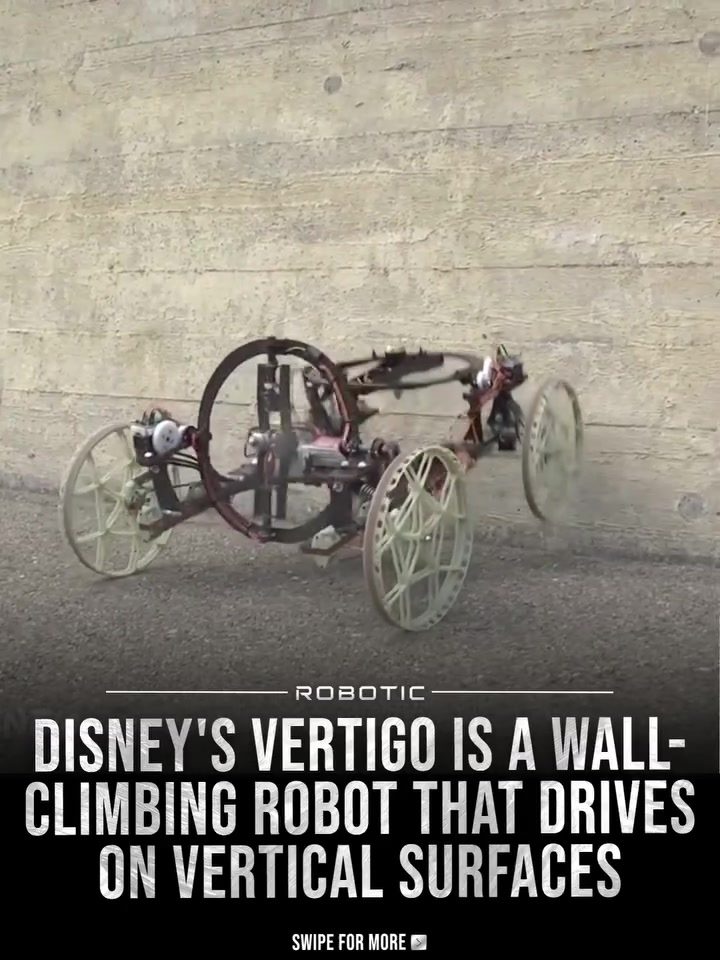
Wall-Climbing Robots
Wall-climbing robots represent an exciting frontier in robotics, pushing the boundaries of what's possible in terms of mobility and navigation. One of the most impressive examples is Disney's VertiGo, a creation born from a collaboration between Disney Research and ETH Zurich. This innovative robot can seamlessly transition from the ground to vertical surfaces, opening up new possibilities for inspection, exploration, and operations in hard-to-reach areas.
Context / Why This Matters
Traditional robots often face limitations when it comes to navigating complex environments, especially those with vertical surfaces. This is where wall-climbing robots like VertiGo come into play. Their ability to move on vertical surfaces makes them invaluable for tasks such as infrastructure inspection, search and rescue operations, and even environmental monitoring. By overcoming the constraints of conventional robots, wall-climbing robots can reach new heights, both literally and figuratively, in their applications.
Main Discussion
The Mechanics of Wall-Climbing
VertiGo employs a unique design that combines two tiltable propellers with four wheels. This innovative combination allows the robot to generate the necessary force to adhere to vertical surfaces while maintaining mobility. Unlike other wall-climbing robots that rely on magnets or suction, VertiGo's design provides a more flexible and versatile solution. The propellers create an upward force that counteracts gravity, while the wheels ensure stable movement along the surface.
Transitioning Between Surfaces
One of the standout features of VertiGo is its ability to transition smoothly between the ground and vertical walls. This is achieved through a sophisticated control system that manages the tilt of the propellers and the direction of the wheels. The robot can seamlessly switch from horizontal to vertical movement, making it highly adaptable to different terrains and environments. This capability is particularly useful in scenarios where robots need to inspect structures from various angles.
Practical Applications
The applications of wall-climbing robots like VertiGo are vast and varied. In infrastructure inspection, these robots can be used to check the condition of buildings, bridges, and other structures without the need for human climbers, reducing risk and cost. In search and rescue operations, they can explore hard-to-reach areas, providing valuable information to response teams. Additionally, in environmental monitoring, wall-climbing robots can assess the health of ecosystems in vertical habitats, such as cliffs and canyons.
Design Considerations
The design of a wall-climbing robot involves several critical considerations. First and foremost is the propulsion system, which must provide enough force to keep the robot attached to the surface. VertiGo's use of tiltable propellers and wheels is a prime example of an effective propulsion system. Additionally, the control system must be highly sophisticated to manage the complex movements required for wall-climbing.
Another important consideration is the material and design of the robot's body. It must be lightweight yet durable enough to withstand the rigors of vertical movement. Materials such as advanced composites and lightweight metals are often used to achieve this balance.
Finally, the sensors and cameras on the robot play a crucial role in navigation and data collection. High-resolution cameras, infrared sensors, and other tools enable the robot to gather detailed information about its surroundings, making it an invaluable tool for inspection and exploration.
Practical Tips
Choosing the Right Wall-Climbing Robot
When selecting a wall-climbing robot, it's essential to consider the specific needs of your application. For example, if you need a robot for infrastructure inspection, you might prioritize a design that can handle rough surfaces and provide high-resolution imagery. On the other hand, if you're using the robot for search and rescue, you might need one that can navigate through tight spaces and provide real-time data.
Maintenance and Upkeep
Like any advanced technology, wall-climbing robots require regular maintenance and upkeep to ensure optimal performance. This includes checking the propulsion system, sensors, and control mechanisms. Regular calibration and updates to the software can also help keep the robot running smoothly.
Safety Precautions
Safety is paramount when using wall-climbing robots, especially in high-risk environments. Always follow the manufacturer's guidelines for safe operation and ensure that the robot is fully tested before deploying it in the field. Additionally, consider the environmental conditions and any potential hazards that could affect the robot's performance.
Important Takeaways
Wall-climbing robots like Disney's VertiGo represent a significant leap forward in robotics, offering unparalleled versatility and flexibility in navigating complex environments. Their ability to transition between horizontal and vertical surfaces makes them ideal for a wide range of applications, from infrastructure inspection to search and rescue operations.
The key to their success lies in innovative design elements such as tiltable propellers and advanced control systems, which enable smooth and stable movement on vertical surfaces. By understanding the mechanics and applications of these robots, we can better leverage their capabilities to solve real-world problems and explore new frontiers.
Conclusion
Wall-climbing robots are paving the way for the next generation of robotic systems, offering unprecedented mobility and adaptability. With their ability to navigate vertical surfaces, these robots are opening up new possibilities for inspection, exploration, and operations in hard-to-reach areas. As technology continues to evolve, we can expect to see even more innovative designs and applications, pushing the boundaries of what robots can achieve.
Watch the Reel
Questions readers ask
How does Disney's VertiGo robot achieve wall-climbing capabilities?
VertiGo uses a combination of propellers and wheels, controlled by a complex algorithm, to stick to walls and transition from surfaces. The propellers generate a downward force, creating vacuum-like suction. This helps VertiGo to climb vertical surfaces and also switch between surfaces easily.
What are some potential applications for VertiGo and similar robots?
VertiGo's ability to navigate vertical surfaces makes it well-suited for infrastructure inspection, such as checking buildings or bridges for damage. It could also be crucial in search and rescue operations, reaching areas that are difficult or dangerous for humans to access. Additionally, it could be used for environmental monitoring or exploration in areas with complex terrains.
Who developed the VertiGo robot, and who collaborated on this project?
Disney's VertiGo robot was developed by Disney Research in collaboration with ETH Zurich, a prestigious research university in Switzerland. This partnership combined Disney's expertise in creative robotics with ETH Zurich's advanced research in robotics and artificial intelligence.
Can VertiGo only climb smooth surfaces, or can it handle textured walls as well?
VertiGo is designed to handle a variety of surfaces, including both smooth and textured walls. Its unique propulsion system, including wheel and propellers, along with advanced algorithms, enables it to adhere and move across different types of vertical surfaces, making it highly versatile in diverse environments.
What sets VertiGo apart from other wall-climbing robots?
VertiGo stands out due to its unique design and the combination of propellers and wheels. This allows VertiGo to not only climb walls but also transition seamlessly between ground and vertical surfaces. Additionally, its compact size and agility make it particularly well-suited for navigating complex and hard-to-reach environments.
How does the VertiGo robot navigate complex environments, and what kind of operations does it facilitate?
VertiGo navigates complex environments by using a combination of propellers for suction and wheels for movement, enabling it to transition from horizontal to vertical surfaces. These capabilities facilitate operations in infrastructure inspection, search and rescue, and exploration of challenging terrains.
What is the significance of VertiGo in the future of robotics?
VertiGo represents a significant advancement in robotics, particularly in mobility and navigation. Its ability to traverse vertical surfaces opens up new possibilities for robotics in various fields, including infrastructure maintenance, search and rescue, and environmental monitoring. As such, VertiGo paves the way for innovative applications of robotics in the future.
Related deep dives
Similar reads based on topic and creator.




Recent articles
Fresh deep dives from the latest Reels we unpacked.




Comments
Be the first to comment.