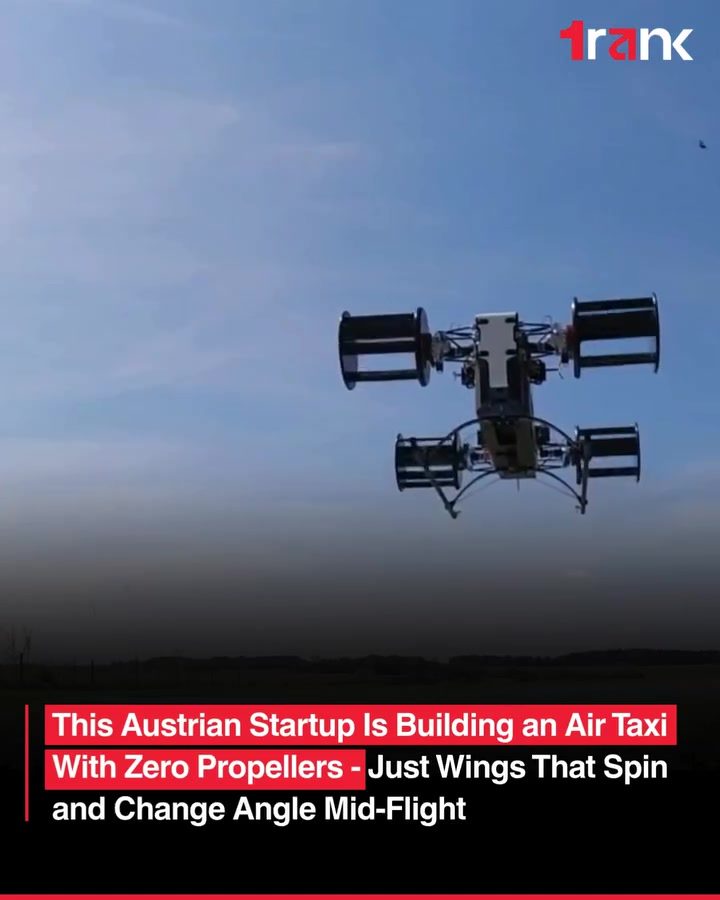
Air Taxi Prototype
Air taxis are increasingly being looked at as a solution to urban congestion, but most designs rely heavily on traditional propellers. CycloTech, an Austrian startup, is taking a different route. Their air taxi prototype eschews propellers entirely, opting instead for a unique propulsion system called the CycloRotor.
Why This Matters
The CycloRotor technology represents a significant departure from conventional air taxi designs. By eliminating propellers, CycloTech aims to address some of the inherent limitations and safety concerns of traditional vertical takeoff and landing (VTOL) aircraft. This innovation could pave the way for more agile, precise, and safer urban air mobility solutions.
The CycloRotor System
The Basics of CycloRotor Technology
The core of CycloTech's design is the CycloRotor, a system inspired by the Voith Schneider Propeller, which is commonly used on tugboats and ferries. Unlike traditional propellers that spin at a fixed angle, the CycloRotor features rotating wing blades that continuously adjust their angle as they spin. This dynamic design allows the aircraft to generate thrust in a full 360-degree direction, enabling unprecedented maneuverability.
Key Advantages
The CycloRotor's ability to change the angle of its blades in real-time offers several key advantages:
- Omnidirectional Thrust: The aircraft can move sideways, hover, brake mid-air, or rotate in place without needing to tilt its entire body.
- Enhanced Safety: By eliminating the need for large, spinning propellers, the design reduces the risk of accidents and injuries.
- Improved Maneuverability: The precise control over thrust direction allows for smoother and more responsive flight.
The CycloTech Air Taxi
Design and Specifications
CycloTech's planned air taxi will be a four-seater, equipped with four CycloRotors. The design promises an 85 km range, roughly 40 minutes of flight time, and a cruising speed of 150 km/h. These specifications are competitive with other air taxi concepts, but the unique propulsion system sets it apart.
Test Flights and Approvals
CycloTech has already logged over 500 test flights with earlier technology demonstrators. Notably, the company successfully flew its BlackBird prototype outdoors under Austrian aviation authority approval. This milestone not only validates the safety and reliability of the CycloRotor technology but also showcases its potential for real-world applications.
Historical Context
Interestingly, the underlying rotor design was patented almost a century ago but was never used in an actual aircraft until CycloTech revived it. This underscores the innovative approach of leveraging old ideas with modern technology to create something genuinely new.
Practical Tips for Air Taxi Enthusiasts
If you're an aviation enthusiast or someone interested in the future of urban air mobility, here are some key points to consider:
- Stay Informed: Keep an eye on developments in CycloRotor technology and other innovative propulsion systems. The future of air taxis is likely to be shaped by such advancements.
- Support Innovation: Encourage startups and companies like CycloTech that are pushing the boundaries of traditional aviation design.
- Engage with the Community: Join forums, attend conferences, and participate in discussions about the future of air mobility. Your input can help shape the direction of this emerging technology.
Important Takeaways
Innovation in Propulsion
CycloTech's CycloRotor technology represents a significant leap forward in air taxi propulsion. By adapting a marine propulsion system for flight, the company has demonstrated the potential for cross-industry innovation.
Safety and Maneuverability
The CycloRotor's omnidirectional thrust capabilities offer enhanced safety and maneuverability, addressing some of the key challenges faced by conventional air taxis.
Real-World Applications
With successful test flights and regulatory approvals, CycloTech's air taxi prototype is on track to become a viable solution for urban air mobility. The company's progress highlights the importance of real-world testing and regulatory compliance in bringing new technologies to market.
Conclusion
CycloTech's air taxi prototype, powered by the innovative CycloRotor technology, offers a fresh perspective on urban air mobility. By addressing the limitations of traditional propulsion systems, CycloTech is paving the way for safer, more agile, and more efficient air taxis. As the technology continues to develop, it will be exciting to see how it reshapes the future of urban travel.
Watch the Reel
Questions readers ask
What makes CycloTech's air taxi different from other urban air mobility solutions?
CycloTech's air taxi stands out due to its unique propeller-free design, utilizing the CycloRotor system. This allows for 360-degree thrust, enabling smooth, responsive flight and precise control, which is a significant departure from traditional propeller-based designs.
How does the CycloRotor system enhance safety in urban air mobility?
The CycloRotor system improves safety by eliminating the risks associated with traditional propellers, such as blade strikes and debris. Its design allows for more controlled and predictable flight paths, reducing the likelihood of accidents in congested urban environments.
Can the CycloTech air taxi take off and land vertically like other VTOL aircraft?
Yes, the CycloTech air taxi is designed for vertical takeoff and landing (VTOL), but unlike traditional VTOL aircraft, it achieves this without the use of propellers. The CycloRotor system enables precise vertical maneuvers, making it well-suited for urban environments.
What advantages does flying without propellers offer in urban mobility?
Flying without propellers offers several advantages, including reduced noise pollution, lower risk of injury to pedestrians, and less wear and tear on the aircraft. Additionally, the CycloRotor system's design allows for more agile and precise movements, which is crucial for navigating urban landscapes.
How does the CycloRotor system work?
The CycloRotor system uses a unique propulsion mechanism that generates thrust through rotating cylinders. This design allows for 360-degree thrust vectoring, enabling the aircraft to move in any direction smoothly and efficiently, which is particularly beneficial for urban air mobility.
What are the potential implications of CycloTech's innovation for the future of air travel?
CycloTech's propeller-free air taxi could significantly impact the future of air travel by addressing key challenges in urban air mobility. The enhanced safety, precision, and maneuverability offered by the CycloRotor system could lead to more widespread adoption of air taxis, revolutionizing urban transportation.
Why did CycloTech choose to develop a propeller-free air taxi?
CycloTech chose to develop a propeller-free air taxi to overcome the limitations and safety concerns associated with traditional propeller-based designs. By innovating with the CycloRotor system, CycloTech aims to provide a safer, more efficient, and more reliable solution for urban air mobility.
Related deep dives
Similar reads based on topic and creator.


Recent articles
Fresh deep dives from the latest Reels we unpacked.




Comments
Be the first to comment.