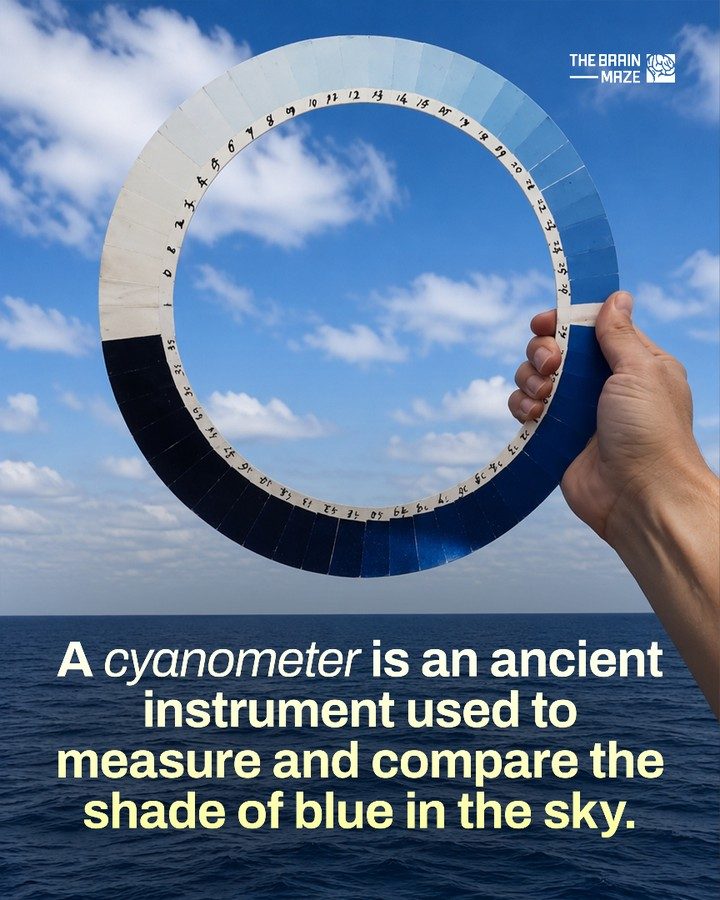
The Cyanometer: A Historic Tool for Measuring Sky Color
The cyanometer, an ingenious scientific instrument, was invented by Swiss scientist Horace-Bénédict de Saussure in 1789. Essentially, it is a tool that measures the blueness of the sky. This instrument is one of the early tools used in the study of atmospheric qualities. It remains an intriguing subject in the realm of meteorology and atmospheric science.
Context / Why this matters
The cyanometer's significance lies in its ability to estimate atmospheric moisture and the concentration of suspended particles in the air. By matching the shade of the sky against its scale, which ranges from white to deep blue and black, observers could gather valuable data about air quality and weather patterns. This early tool gives us insights into how scientific inquiry evolved and the curiosity that drove early climate studies.
Main Discussion
History and Design
Developed by Horace-Bénédict de Saussure, a renowned physicist and geologist, the cyanometer’s design is elegantly simple. It features a circular scale with 53 distinct shades, providing a visual spectrum to compare the color of the sky. The instrument's purpose was twofold: to measure the intensity of the sky's blue and to assist in atmospheric observations.
The circular design, with its numbered segments, allows users to gauge the shade of blue accurately. Users would align the cyanometer with the sky and find the closest matching shade. This straightforward method made it accessible for various observers, from scientists to amateurs, to contribute to atmospheric studies. The simplicity of its design is what makes it an ingenious tool of its time.
The Science Behind It
The cyanometer operates on the principle that the color of the sky can reveal information about the atmosphere. On a clear day, the sky appears a vibrant blue due to a process called Rayleigh scattering. This happens when sunlight collides with the tiny molecules and particles in the atmosphere, scattering shorter blue wavelengths more than other colors.
The varying shades observed in the sky can indicate different atmospheric conditions. For instance, a deeper blue sky suggests fewer particles in the air, while a paler or grayish hue can indicate higher moisture or pollution levels. These observations were especially vital in the 18th century, when the cyanometer provided valuable data for understanding weather patterns and predicting storms.
Modern Relevance
While the cyanometer may seem antiquated by today's standards, it serves as a reminder of how simple, yet effective, tools were crucial in the early days of atmospheric science. Modern meteorologists use advanced tools and satellites for detailed atmospheric analysis, but the cyanometer's underlying principles still hold significance. Technology has evolved, but the essence of observing and interpreting natural phenomena remains the same.
Practical Tips
If you are intrigued by the cyanometer and wish to explore its use, here are some practical tips:
- Create a DIY Cyanometer: While the original cyanometer might be hard to find, you can make a simple version at home. Use a circular piece of paper or cardboard and paint or print 53 shades ranging from white to deep blue and black. Number each shade and compare it with the sky during different times of the day.
- Observe and Record: Hold the DIY cyanometer up to the sky and match the color to the closest shade. Record your observations along with the time of day, weather conditions, and any notable changes in the sky's appearance. Over time, you can build a dataset to analyze and understand the atmospheric conditions.
- Share Your Findings: Share your observations with others or contribute to local community science initiatives. Your findings can add to the collective understanding of local weather patterns and air quality.
Important Takeaways
The cyanometer is a testament to the ingenuity of early scientists and their methods of observing the natural world. Its principles, grounded in basic yet effective observational techniques, continue to inform modern atmospheric studies. The simplicity of its design and the wealth of information it provided make it a fascinating tool to explore and understand.
Conclusion
The cyanometer, a simple yet ingenious scientific instrument, offers a glimpse into the innovative methods of early atmospheric science. Its ability to measure the blueness of the sky provided valuable insights into atmospheric conditions and weather patterns. By understanding this tool, we appreciate the foundations upon which modern atmospheric studies were built and continue to evolve.
Watch the Reel
Questions readers ask
Who invented the cyanometer and when was it created?
The cyanometer was invented by Horace-Bénédict de Saussure, a Swiss scientist, in the year 1789. De Saussure designed it as a simple, circular device to measure the blueness of the sky, which is a unique tool for atmospheric observation.
How does the cyanometer measure the blueness of the sky?
The cyanometer features a circular design with 53 distinct shades ranging from white to deep blue and black. Users compare the sky's color to these shades to determine its blueness. This comparison provides insights into atmospheric moisture and air quality, making it a valuable tool for studying weather patterns and climate.
What are the primary applications of the cyanometer?
The cyanometer is primarily used to estimate atmospheric moisture and the concentration of suspended particles in the air. By observing and recording the sky's color, users can gather data that helps in understanding air quality and weather patterns, making it a useful instrument in meteorology and atmospheric science.
How does the cyanometer contribute to weather pattern observation?
By measuring the blueness of the sky, the cyanometer helps observers track changes in atmospheric conditions. These observations can indicate shifts in weather patterns, such as approaching storms or changes in air quality, providing a historical perspective on weather and climate trends.
Why is the cyanometer's circular color scale significant?
The cyanometer's circular color scale, with its 53 distinct shades, offers a visual representation of sky color that is both precise and easy to use. This design allows for consistent measurements, aiding in the comparison of data gathered over time and across different locations.
What makes the cyanometer a noteworthy historic weather instrument?
The cyanometer stands out as a historic tool due to its simplicity and effectiveness in measuring sky color. Invented in 1789, it predates many modern instruments and offers a unique window into past atmospheric conditions, making it a fascinating artifact in the history of meteorology.
How does the cyanometer help in understanding atmospheric moisture?
The cyanometer aids in understanding atmospheric moisture by correlating the sky's color with the amount of water vapor present in the air. Clear, blue skies typically indicate low moisture, while hazier skies suggest higher atmospheric moisture levels, helping to monitor and predict weather conditions.
Related deep dives
Similar reads based on topic and creator.



Recent articles
Fresh deep dives from the latest Reels we unpacked.




Comments
Be the first to comment.